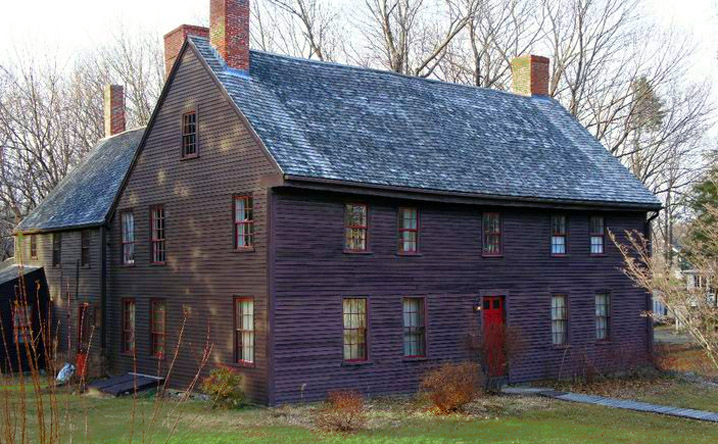
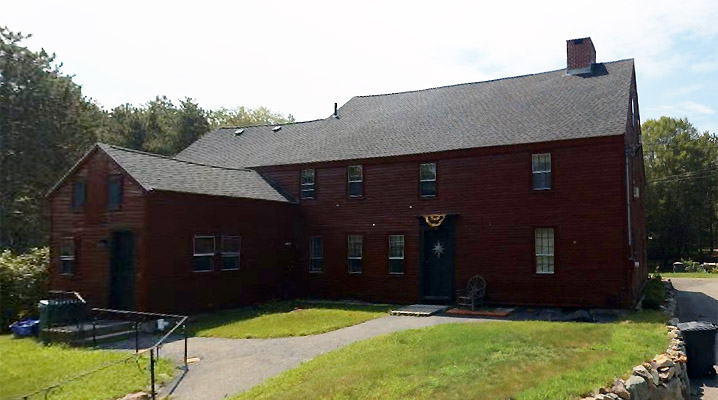
The Nathan Wheeler House, 38 Larkin Rd, Newbury (c. 1725)

John Wheeler moved to Newbury MA by 1650 and obtained considerable acreage at this location. He died in 1662. His son David married Sarah Wise and moved to Rowley in 1669, but maintained possession of the property he had acquired by purchase and inheritance. David’s son Nathan was born in 1669 and purchased a lot along the river from his father to establish a mill. He died in Newbury, age 88 in 1755, presumably at this location. In his will, he deeded 1/3 of his house to his wife Rebecca, and the remainder of the estate to his son Nathan2, who was born in 1701 and is believed to have been the original builder of this house, probably after he married 24-year-old Mary Plumer in January 1724-5.

At a meeting of the freeholders and inhabitants of Newbury, held December 9, 1701, a request by Nathan Wheeler and others was granted for an abatement of their dues to the First Church in Newbury because of the distance they lived from town. On October 13, 1706, Samuel Brocklebank, Jonathan Wheeler, Benjamin Plumer, Nathan Wheeler, John Brown, Andrew Stickney, and their wives, also Mary Chute, and Elizabeth Look, were dismissed from the Rowley church, to join the church in Byfield, sometimes referred to at that time as “Rowlbery.” On October 28, 1710, the General Court ordered that the area around Newbury Falls be set off by Newbury & Rowley, as an acknowledged and established precinct commonly called Byfield.

Nathan, Jr. was given land for a mill and 1/2 of all of Nathan, Sr’s. land in a 1734 filing, then by Nathan Sr.’s will proved in 1741, he received all of his father’s land. In 1799 there was no male heir and thus Nathan, Jr.’s daughters Rebecca Noyes and Sarah Sawyer sold Nathan’s estate to Joseph Pearson. Nathan Jr. had grown the estate from 30 acres to 70 during his stewardship. Thomas Rand Larkin bought the house attached property in 1822 and lived there until he died in 1851. The Story of Byfield Parish notes that “Mr. Horsch’s place was anciently a Wheeler place,” and the 1884 Newbury map shows the Horsch house at this location with its neighbor shown as “C. Noyes.”

Structural observations

The Newbury assessors list a date of 1690 for this house. While some of the frame may be from a pre-existing 17th-century building, structural evidence for the house points to a period of about 1725-30, with a later saltbox addition that was subsequently replaced with a modern ell.

  • There is no soffit or frieze board, and the upstairs windows are tight to the edge of the roof, which is found in First Period houses (before 1720), but continues to be found in some houses through the 18th Century.
  • Houses in surrounding towns with a similar half-house configuration date to the transitional era between First Period and Georgian, about 1725-1730
  • The summer beams were originally cased, are sawn, and have no chamfers, indicating early Georgian construction (after 1725).
  • The gunstock posts and girts protrude inside but were originally cased.
  • The spacing of the principal rafters in the attic is unusually long, with one on each side but only one in the middle.
  • The stone foundation does not perfectly fit the house frame, possibly indicating that parts of an older frame were used.
  • The three fireplaces are in the rear center of the house, sitting on a massive stone foundation., were probably added when the house was extended with a shed that no longer exists. The brick chimney is mortared with clay and sand, rather than lime. The bricks appear to be hand-made and are slightly larger than modern bricks. They may be reused, or they may be evidence of an earlier construction date.
  • The small kitchen hearth is at the rear of the original building, somewhat similar to a Rumford fireplace, and probably hides a larger original hearth The bake oven and another opening are outside the fireplace on the right.

The Mill

The Larkin Morrill Snuff Mill first operated in the 18th century as a sawmill and was converted to snuff manufacturing by 1804, if not before, when it was bought by Dr. Samuel Tenny who milled snuff until 1811. Between the years 1822 and 1837, Thomas R. Larkin, a “tobacconist”, purchased the mill. His partner in the business was Orlando W. Morrill, hence the name “Larkin Morrill Snuff.” After Larkin”s death, his heirs sold the major interest in the mill, property, and mill rights to Gorham D. Tenny and Daniel Bailey in the decade of the 1870s. In 1899 the mill was sold to the newly incorporated Byfield Snuff Company by Tenny & Bailey who maintained an interest in the company as stockholders. 

Sources:

The Tristam Coffin House, 14 High Rd., Newbury MA (1678)

The following text is from the MACRIS site:

The Tristram Coffin House (Massachusetts Historic Landmark; HABS: MASS 472) was continuously occupied by the Coffin family from 1654 when it was built by one of Newbury’s first settlers, Tristram Coffin, until its acquisition by SPNEA in 1929.

Dendrochronology conducted by the Oxford Tree-ring Labratory found that the earliest part of the Coffin House was built in 1678 on land owned by Tristram Coffin, Jr., though how he acquired the land is not recorded. The property remained in Coffin family ownership until it came to SPNEA in 1929 and was for a time divided in ownership among several members of the Coffin family. The traditional date of c. 1654 was assigned by Joshua Coffin, author of the 1845 history of Newbury, who resided in the house (Coffin 1845, 391).

Illustration from The Framed Houses of Massachusetts Bay by Abbot Lowell Cummings

The earliest portion of the Tristram Coffin House represents one of the outstanding examples of First Period architecture in New England and is the most important seventeenth century house in the District. It is set in deeply from High Road on a lot with a creek just beyond its western edge. Architectural analysis proceeds on the basis of dendrochronology, documentation and style. The original portion is the earliest example in the area in which the architectural treatments of both interior and exterior have been preserved. The portion facing south was enlarged with a First Period addition.

18th Century fireplace in the Coffin House

A more extensive enlargement occurred after 1750, expanding the house to its present size while establishing a new orientation facing east. By 1785 all major elements of the house as it now stands were named in a division of the property. The east facade facing the High Road continues the seventeenth century use of unpainted clapboarding, vertical chimneys and vernacular character of the original portion; its organization is now regularized and classicized so that its entrance and fenestration are symmetrically disposed into five bays, two and one-half stories in height. The placement of windows on the south facade reflects the additive nature of the house.

Summer beam and girt over a wall with clay and straw plaster in the Coffin House.
Coffin genealogy provided by Historic New England

Joseph Noyes house, 45 Elm St., Newbury MA (c 1695) (Frank and Carrie Knight Ambrose house)

The house is believed to have been constructed by a member of the Noyes family, descendants of Nicholas and James Noyes who emigrated from Choulderton in Wiltshire England in the year 1634 and settled at Newbury.

John Dummer deed to Daniel Noyes, “A certain parcel of land, Part of the Land Grant of my late honored father Richard Dummer.” May 20, 1715. (Book 30, Page 130). There were two Daniel Noyes in Newbury at that time:

  • Daniel, s. John, born Oct. 23, 1673, died Mar. 15, 1715-16, age 42 years
  • Capt. Daniel, s. Thomas, born Aug. 30, 1674, died at Madeira, Oct. 5, 1728, age 54 years.

Another possibility is the 1716 deed of Thomas Noyes to his son Joseph for his “love and affection” 17 acres with appurtenances. Joseph Noyes was born August 5, 1688, Newbury, the son of Thomas and Elisabeth Noyes.

On March 26, 1715, in Newbury, Joseph married Hannah Wadleigh. [2] Hannah was born circa 1697, in Deerfield, Rockingham County, New Hampshire, the daughter of Jonathan Wadleigh (1657-1748) and Hannah (Weare) Wadleigh

The owner of this house in 1727 is mentioned below as Joseph Noyes. (Speculation: this could be Joseph, son of Daniel and Judith, born on Aug. 6, 1705.)

45 Elm Street, Newbury MA (Byfield)
45 Elm Street at the turn of the 21st Century.

“In 1727 a highway 2 rods wide was laid out from the country road near to Lieutenant Governor Dummer’s house to the parsonage land in Byfield Parish through the land of John Dummer Esq., Mr. Richard Dummer and Mr. Joseph Noyes. In 1900 this house was the Ambrose residence. “(*Old Paths and Legends of New England: Saunterings Over Historic Roads” by Katharine Mixer Abbott).

The 1872 map of Newbury and Byfield shows this house owned by G. W. Knight.

In the Salem Deeds site, we find that John Noyes transferred property in Newbury to James Knight in 1855, but further research is needed to know if it is this house. (Salem deeds book=522; page 181)

A story has been passed down that the first owner of this house was a well-to-do businessman and ship owner who sent the lumber to England to be milled to his specifications. When the materials were returned, the house was allegedly assembled upside-down, i.e., the first floor was created with second floor materials and the second floor with first floor materials. The ceiling of the first floor is incredibly low, and persons over 6′ in height have to lean over when standing.

“In 1757 Robin Mingo, a free man of color and inhabitant of Rowley sickened and died at the house of Joseph Noyes in Newbury’s Byfield Parish. The town of Rowley paid Noyes for ten weeks board and nursing.

While originally a boys’ school, Dummer School admitted women briefly during the 1873-74 session. Carrie G. Knight Ambrose, who lived in this house, graduated from Dummer Academy in June, 1876, winner of the Moody Kent Prize for general excellence. Born in 1859, the daughter of George W. Knight and Caroline Lunt, she was one of six girls to first enroll at the Academy in 1872 under the direction of Ebenezer and Sarah Parsons. For a period of ten years, 1872 to 1882, neighborhood girls were accepted as day students. After graduating from the Academy, Carrie married classmate Frank M. Ambrose. They lived for many years in this 1695 house, which served for several years as the site of the South Byfield Post Office with Mrs. Carrie K. Ambrose as Postmistress.

Knight-Ambrose house plaque

Sources: