
Information from Land and Houses of Rowley by Joseph Dummer
This house originally stood on Summer Street in Rowley. One and a half acres were granted to Richard Wicom, an early settler of the town (whose son, Capt. Daniel Wicom, was Quartermaster in King Phillip’s War). In 1661, Richard Wicom willed it to John Wicom (2-199), and he, in 1683, sold it to John Pickard (5-39).
The Wicom family still owned lots in the former common lands. Daniel Wicom2, grandson of Richard Wicom, sold various properties before moving to Norwich, CT, in 1714, where he bought a farm. The last sale of the former Wicom wood lots and planting lots in Rowley was by Richard Wicom of Newbury in 1730.
After purchasing the property in 1683, the Pickard family owned it for over 100 years and enlarged or constructed this house. In 1797, Abigail, the widow of David Pickard, sold seven acres to Hannah Pearson, wife of Daniel Pearson and daughter of Joseph Nelson, for $1000, “bequeathed to me by my late husband (163 -24). In 1802, Hannah Pearson sold it to Solomon and Jacob Lowell, “blacksmiths.” Jacob and Mary Lowell, in 1804, sold five acres of the property to Lieut. Daniel Foster of Ipswich (185-24), who, the following year, built a house which he sold in 1809 to Moses Dole, and moved to Newburyport.
In 1812, Solomon and Moses Lowell sold the remaining two and 2/3 acres “with the buildings thereon” to Moses Palmer for $200.00 (195-218). These 2 &2/3 acres had originally been the house lot of Richard Wicom. Mr. Palmer sold it to John White (233-70), and in 1829, White sold it to Thomas Cressey (266-224). Mr. Cressey in 1836 sold the same 2 2/3 acres, with a dwelling house, barn, and two joined shops, to Peabody Dole (316-28) for $36.00.
The house is moved from Summer St. to Main St.
Peabody Dole sold the old house from the two & 2/3 acre former Wicom lot on Summer Street to Moses Jellison, who in 1844, purchased 3 1/2 acres on Main Street from Nathaniel Bradstreet (565-90). Joseph Dummer wrote that Jellison “bought the Wicomb house on Summer Street of Mr. Dole, and half of the Todd house on Pleasant Street and moved them to this lot” on Main Street (Rt. 1A). This was probably in 1845, the same year that the other half of the house was sold (see below). The section of the Todd house is still attached to the right rear of the combined structure at 155 Main Street.
Age of this House
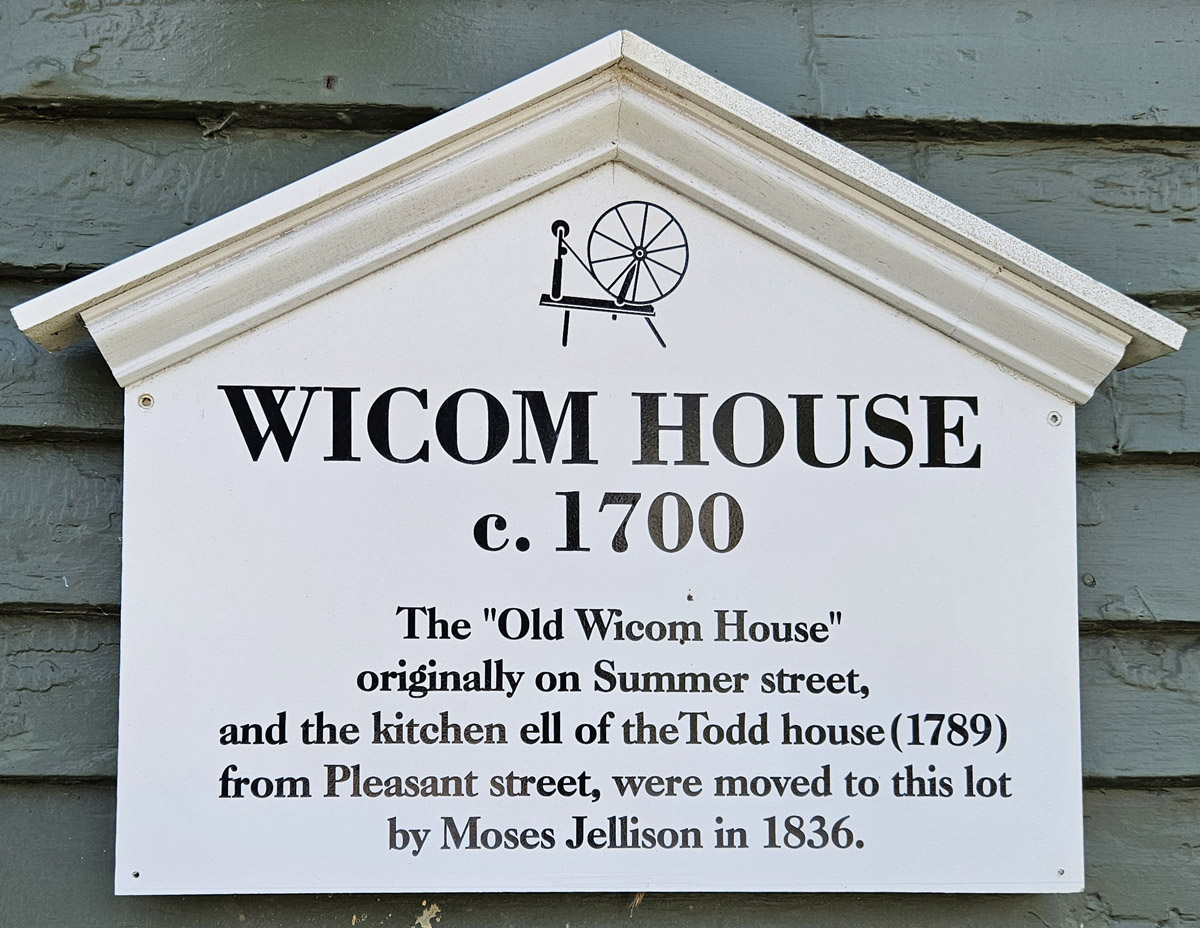
The year in which this house was originally constructed on Summer Street is unknown. The inventory created by the Rowley Historical Commission on the MACRIS site gives an approximate date of construction as 1750, whereas the sign on the front of the house reads “c. 1700.” Structural observations suggest that the north end of the house was possibly constructed in the late 17th century. The south side was added by the Pickard family in the 18th century, although the historical records refer to it as the Wicom house.
Structural Observations
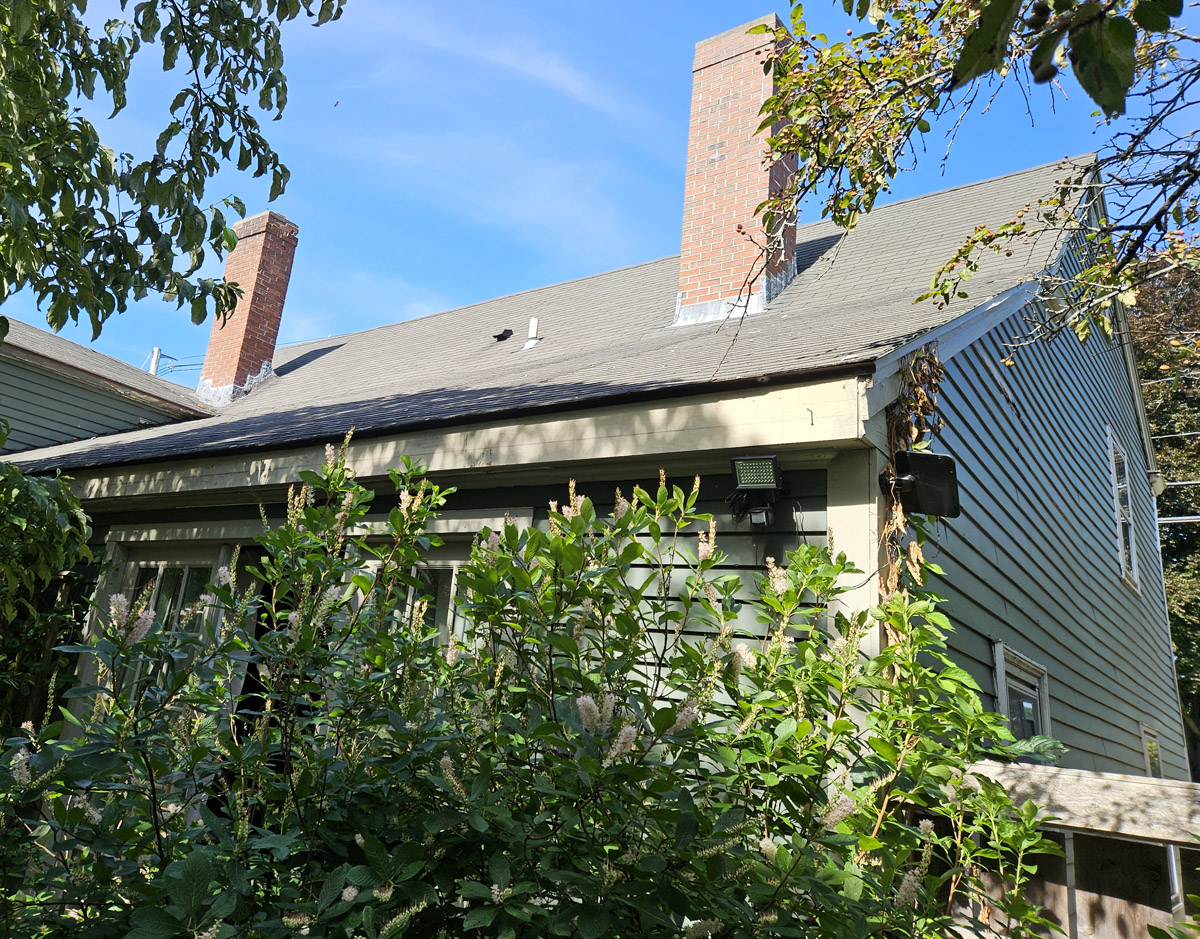
This house has a slightly asymmetrical front facade and single-bay depth for the main body of the house, with a later wing on the right rear that was moved from the Todd House. The “broken back” saltbox shed on the rear left is believed to have been added in the 20th century.
The left (north) side of the main body of the house appears to be somewhat older than the right side. The windows on the downstairs left are about 4″ higher than the right, albeit identical. The front entryway is shallow, typical of First Period and other early single-bay houses before 1725. The winder stairs are unusually wide for the depth of the house, extending into what was probably once the central chimney bay, which was replaced by Rumford fireplaces and twin chimneys in the rear wall of the front of the house. A third chimney is in the rear right wing that was moved from the Todd house and still serves as the kitchen.
Summer beams in the front and upstairs rooms are wide and substantial, but are boxed, preventing observation of chamfers or decoration. Two summer beams in the basement and an unboxed beam in a closet have a 1″ chamfer. The exterior clapboards are each only about 3-4′ long, scarf-jointed, with less exposure on each board than usual. Short clapboards with scarf joints were used in the Colonial era, although the form persisted in some rural areas into the early 19th century. It is unclear when the existing clapboards were installed.
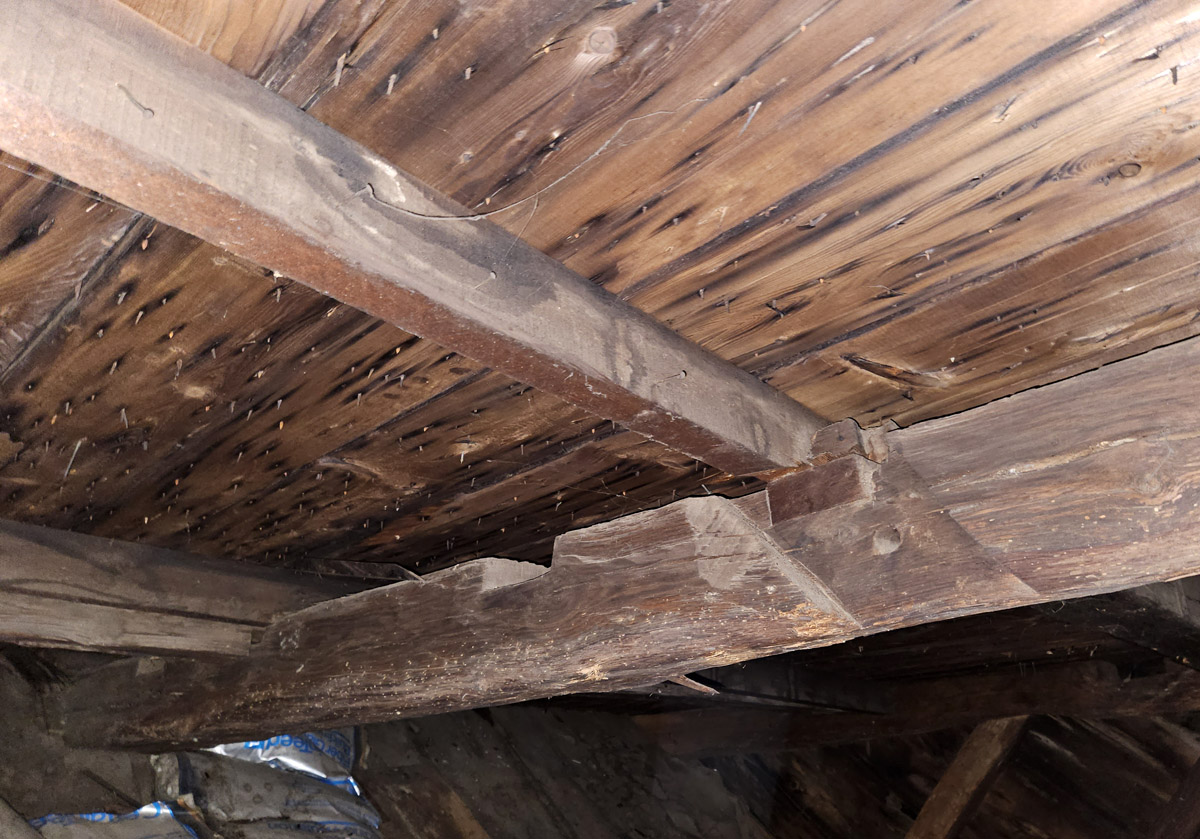
The roof doesn’t have rakes on the sides of the house. In the attic, new purlins were laid over the rafters, increasing the roof height by about 3-4″ to allow enough height for the front soffit, when the right side was added, or more likely, when the house was moved to its present location.
Subsequent History of 215 Main Street
In 1852, Moses Jellison sold the place to Charlotte Jellison (467-17), and she in 1855 sold the house and 1/2 acre to Nathan Todd (566-91), who in 1856 sold it to Daniel Morrison (567-91) Mr. Morrison in 1857 bought five acres of Joses Jellison (567-92). He also sold three acres in 1860 to Ezekiel Baley (614-65), who in the same year sold it to Frederick Bailey (614-66). Mr. Bailey in 1864 sold it to Oliver Blackington (715-171), who had bought in 1852, half of the house and 12 rods of land from Charles Cressey, the executor of the will of his father Richard Cressey, who had married Dorothy, daughter of Moses Bradstreet (302-227). In 1912, the heirs of Oliver Blackington sold 3/4 acres with the house to Loanda D. Pedrick (2171-239). She sold it to John N. Newell (2396-373) in 1918, and he sold it to Ernest C. Copper (2636-284) in 1925. In 1930, Copper sold it to Charles J. Henrich.
Richard Wikum of Rowley
From Early Settlers of Rowley by George Bodgette, page 291
“Richard Wicom (aka Wickham, Wakam) had an acre and a half house lot in 1643. By deed, dated 26 June 1661, he gave his homestead and some other lands to his son John, in consideration of the support of himself and wife Ann, during life (Essex Deeds 2 Ips: 199). John Wicom sold this homestead in 1683 to John Pickard (Essex Deeds, 5 Ips. 39). He was buried 27 Jan. 1663-4. His widow, Ann, was buried on 25 August 1674. Their children were Daniel, born in England about 1635, who married Mary Smith; Thomas was buried 6 July 1660, and John, born about 1647, married Abigail Kimball.
“John2 born about 1647, married Abigail, daughter of Henry Kimball of Ipswich. He was living in Newbury on 5 September 1702. His homestead was near the present Dummer Academy (Governor’s Academy).” Other members of the Wicom family relocated to Connecticut, and the Wicom surname disappeared from Rowley history around the beginning of the 18th century.
John Pickard of Rowley
From Early Settlers of Rowley by George Blodgette, page 291:
“John1 Pickard, carpenter, son of Widow Ann Lume, married in 1644, Jane, daughter of Widow Constance Crosby. He was a representative in the General Court and prominent in the affairs of the town. He was buried on 24 September 1683. His will, dated 6 September, 1683 mentions, to wife (unnamed, “I give my now dwelling-house & buildings, orchards and Lands I live upon situate & Lying in the bounds of Rowley & Ipswich; also the Village Farm which Matthew Perry liveth upon with the privileges thereof all during the time of her natural life; also all my moveable estate to be at her dispose; always providing that my Dear wife be my sole executrix & that she receive all such Debts as are Due to me from any persons whatsoever.” To son John Pickard, what has already been given him and the farm at Johnson’s Pond, also the reversion of what has been given wife. To son Samuel Pickard, all the land between Samuel Dresser’s land and land of John Wicom, also the land on the other side of the street, of about four acres, also one-half of that land “I purchased of my son Thomas Hammond,” also after wife’s decease, the farm now in occupation of Matthew Perry….The inventory of his state, amounting to £1279, was taken on September 23. 1683. His widow, Jane, died February 22, 1715-16 age 89 years. His homestead in Rowley, from 1660, was in the “Morland” or “murlay” field.”
The year in which John Pickard Sr. died was the same year in which John Pickard (perhaps Jr.) purchased the house of Richard Wicom.
George Blodgette wrote in Early Settlers of Rowley, Massachusetts, “The house in which he died was on the site now (1932) occupied by the house of the late Daniel Harris Hale on Main Street. It may have been a part of the present house. The home farm extended easterly and southerly into Ipswich to include a large portion of Jewett’s Hill.”
The Todd House
Joseph Dummer wrote that Jellison bought the Wicomb house on Summer Street and half of the Todd house on Pleasant Street and moved them to this lot” on Main Street (Rt. 1A) after he purchased the lot in 1844. The Pleasant Street lot on which the Todd House originally sat was granted to James Bailey. In 1780, Hannah Bailey married Nelson Todd. Their son Henry Bailey Todd sold one-half of the house across the street, and a new house constructed in 1841, to Caleb Todd in 1845 (202-268). The other half of the house across the street was moved to 155 Main Street the same year.
Description from MACRIS
“ROW.51 Wicom, Daniel – Todd House 215 Main St r 1750: This 18th-century, two-story house, with lean-to and side porch, is one of the few of its kind in the town. The fact that the house was originally two separate houses on different streets in town, moved to this location at the same time, and incorporated into one house with such pleasing style, demonstrates the capabilities and engineering knowledge available among the settlers at that period in history.
“Several persons connected with the military once lived in this house, or in one half of it. Another was a blacksmith. All played equally important parts in the development of the community in their individual ways. Dan Wicom was listed as a carpenter. He was a direct descendant of Richard Wicom, one of the First Settlers. One half of this house was moved from the First Settler’s original lot on Summer Street. The other half of the house was moved from Pleasant Street and was called the Todd House. A part of the old meeting house was used in building the barn, which has since been taken down.”


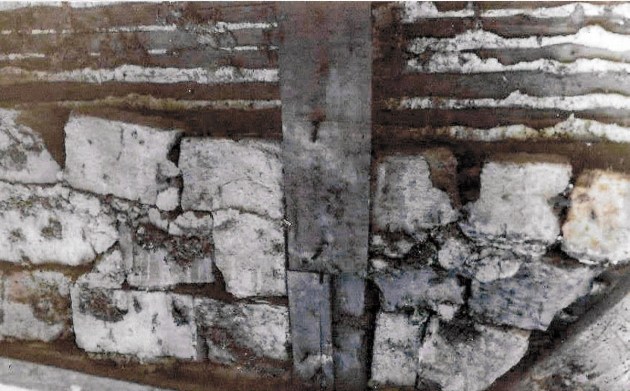
When the present owner was replacing clapboards on the north end of the Wicom House, he discovered several rows of bricks inside the wall, some of which fell out. The above photograph shows the three remaining rows of irregular bricks, which inexplicably appear to have been whitewashed on the outside.
Architectural historian Abbott Lowell Cummings, author of The Framed Houses of Massachusetts Bay, wrote, “Common, if not universal, was the infilling of the frame with brick and clay. For those areas of the frame where the fill might be exposed within, for example, on top of the plate, the bricks were either plastered over (as at the Boardman house in Saugus). Wall fill of brick and clay continued to be uniformly popular until into the eighteenth century at Massachusetts Bay.”

When the present owner was repairing the north side of the Wicom House, he found shoes of early, primitive styles concealed in separate locations in the walls and floors. It is generally suggested that shoes were concealed to protect the occupants of the building against evil influences. Early settlers in Essex County were predominantly from East Anglia, where many concealed shoes are frequently found. Rowley was settled by families from the York, England region, where the York Castle Museum features a collection of concealed shoes.


Wicom-Pickard-Todd House Deed History
Book (b) & Page (p) followed by date and deed transfer
- 1978 (b 6445-p 719): Rosario DeGloria to Michael Harney
- 1977 (b 6338-p 652): Lowell Henrich to Rosario DeGloria
- 1930 (b 2873-p 511): Earnest Cooper to Lowell Henrich
- 1925 (b 2336-p 284): John Newell to Earnest Cooper
- 1918 (b 2396-p 373): Loanda Pedrick to John Newell
- 1912 (b 2171-p 239): Alfred Blackington to Loanda Pedriek
- 1877 (b 997-p 216): Oliver Blackington to Alfred Blackington
- 1864: (b 715-p 171): Frederick Bailey to Oliver Blackington
- 1860 (b 614 -p 66): (Oct. 19): Ezekiel Bailey to Frederick Bailey for $400, three acres with the buildings thereon.
- 1860 (b 614 -p 66): (Oct. 17): Daniel Morrison to Ezekiel Bailey for one dollar, three acres with the buildings thereon, bounded by Bradstreet and Jamin
- 1858 (b 565-p 92): (January 29), Daniel Morrison to Nathaniel Pickard, for $500, “a lot of land called the Jellison land, containing three acres, more or less, with the buildings thereon” bounded by Bradstreet and Jamin, “being the same” (this line was left unfinished).
- 1858 (b 565-p 92) Moses Jellison, shoe manufacturer, to Daniel Morrison, for $100, real estate bounded by land of Jamin and Bradstreet. (It appears that Daniel Morrison expanded on the 1/2 acre lot with this purchase of land of unstated size).
- 1856 (b 567-p 91): Nathan Todd to Daniel Morrison, merchant, the same property as below, for $1200.
- 1855 (b 565-p 91): Charlotte Jellison, single woman, to Nathan Todd, for $1200.00, half an acre with the buildings thereon, bounded by land of Jamin and Bradstreet.
- 1852 (b 467-p 17): Moses Jellison to Charlotte Jellison
- 1846 (b 565 -p 90): Nathaniel Bradstreet to Moses Jellison, “real estate” from the Bradstreet property, bounded by Jamin & Bradstreet for $100. LOT THE WICOMB HOUSE SITS ON NOW.
- 1837: (b 294-p 238): Peabody Dole to Moses Jellison
- 1836 (b 316-p 28) Thomas Cressey to Peabody Dole
- 1829 (b 266-p 224): John White to Thomas Cressey. Two & 2/3 acres with buildings thereon. “Bounded southerly by the road from the (Rowley) Common to Haverhill”.
- 1823 (b 233~p70): Moses Palmer to John White for $668.00. Two & 2/3 acres with buildings thereon.
- 1812 (b 195-p 218): Solomon Lowell to Moses Palmer for $1000. Two & 2/3 acres with buildings thereon.
- 1802: (b 171-p 90): Hannah Pearson to Solomon Lowell & Jacob Lowell for $1030, six acres with house and barn.
- 1797 (b 163 – p24) Abigail Picard to Hannah Pearson, seven acres with house and barn, for $1000, “bequeathed to me by my late husband.”
- Probate 21778, 1775: David Picard to Abigail Picard (by will)
- 1744 (b 86 p 108): Thomas Wicom to Frances Picard (a lot of land for £24)
- 1683: John Wicom to John Pickard (house, barn & orchard)
Other deeds: Wikum, Wickham, Wycom
- 1659 (1:234) references lots of Richard Wikum and John Pickard lots
Sources of information:
- Massachusetts Historical Commission site (MACRIS)
- Dummer, Joseph: Land and Houses of Rowley
- Dummer, Joseph: Historical street list of Rowley 1640-1936
- Publications of the Rowley Historical Society (Volume 1)
- Gage, Thomas: The history of Rowley, anciently including Bradford, Boxford, and Georgetown, from the year 1639 to the present time
- The early records of the town of Rowley, Massachusetts, 1639-1672: volume 1 of the printed records of the town
- George B. Blodgette and Amos E. Jewett. Early Settlers of Rowley, Massachusetts. pp 291-292.
- Fish, Prudence: Concealment Shoes





 17th & 18th Century Houses of Essex County, Massachusetts