
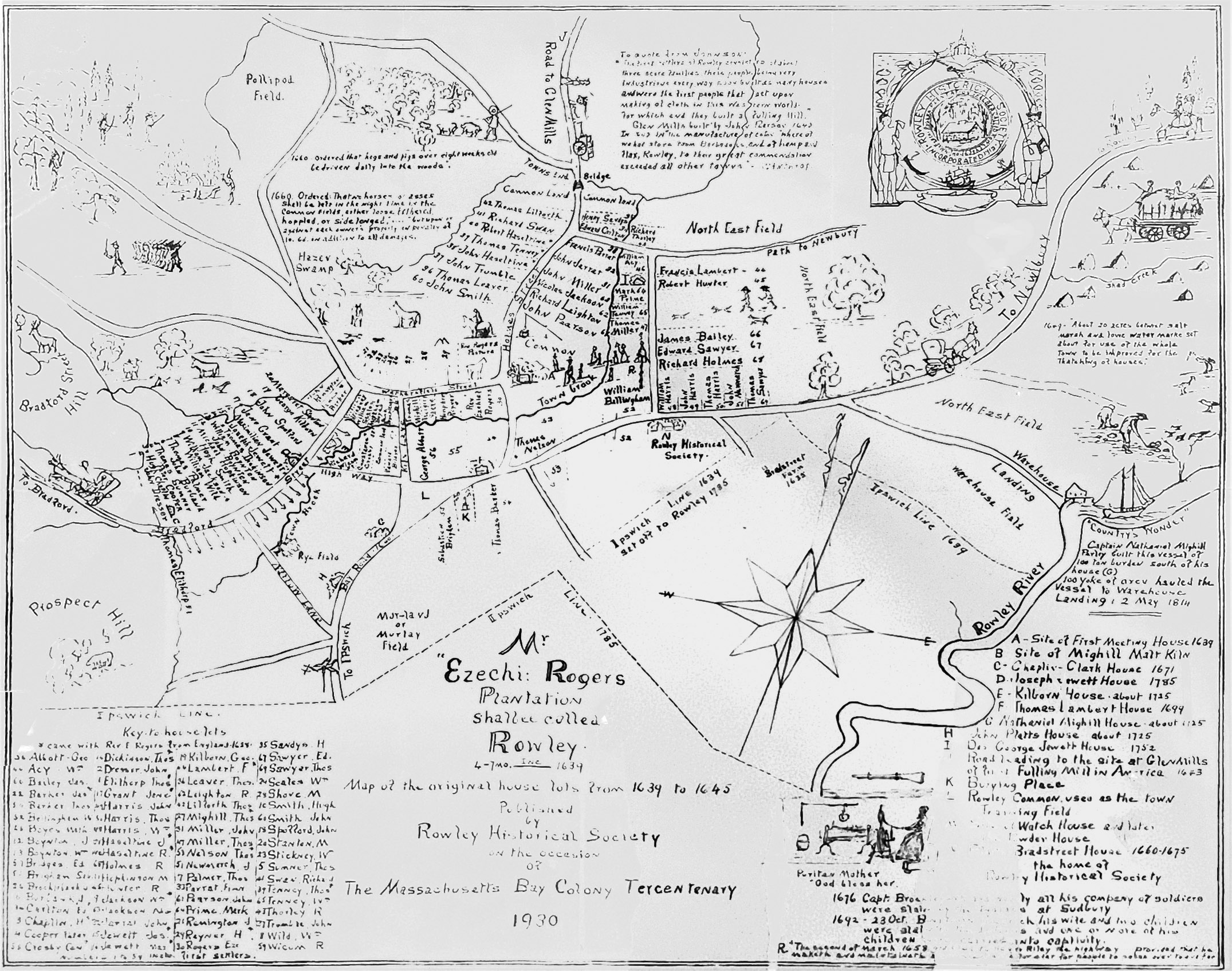
This page displays the First Period, Georgian, and early Federal houses of Rowley, MA, settled in 1639 as a plantation by Reverend Ezekiel Rogers, who had arrived from England on the ship John of London with approximately twenty families. The town was named after Rowley, East Riding of Yorkshire, where Rogers had served as pastor. At the time it was incorporated, the town included portions of Byfield, Georgetown, and Haverhill.
Unless further researched, the following images and text were provided by the Rowley Historical Society in 1977, with much of the text written by Ruth S. Gardner, and are available online through the Massachusetts Historical Commission site (MACRIS). Further information is from Land and Houses of Rowley by Joseph N. Dummer. House images are displayed alphabetically in order of street name. House numbers may have changed. Click on any image to view a larger photo. Click on the ROW link to view the house at the MACRIS site.
Recent research
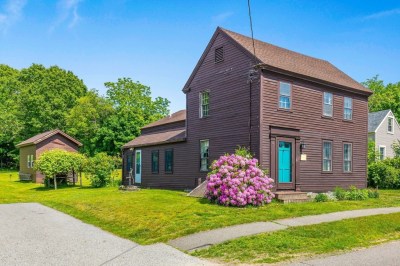 The Jewett-Cressey House, 39 Pleasant St., Rowley MA (1732) - The house at 39 Pleasant St. was built for Joseph Jewett in 1732. Ownership by Jewett heirs continued by inheritance and marriage through the Hale and Cressey surnames until 1947. The following information is from the MACRIS site of the Massachusetts Historical Commission: ROW.46 Langley – Jewett – Hale – Cressey House 39 Pleasant St.,… Continue reading The Jewett-Cressey House, 39 Pleasant St., Rowley MA (1732)
 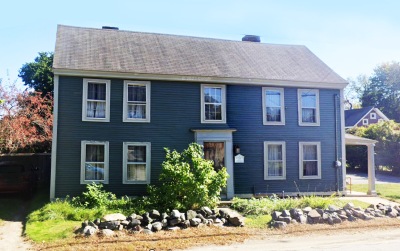 Wicom-Pickard-Todd House, 215 Main St., Rowley MA (c. 1684/1725, moved in 1845) - Information from Land and Houses of Rowley by Joseph Dummer This house originally stood on Summer Street in Rowley. One and a half acres were granted to Richard Wicom, an early settler of the town (whose son, Capt. Daniel Wicom, was Quartermaster in King Phillip’s War). In 1661, Richard Wicom willed it to John Wicom… Continue reading Wicom-Pickard-Todd House, 215 Main St., Rowley MA (c. 1684/1725, moved in 1845)
  Platts-Wheeler-Chaplin-Stuart farm, 204 Dodge Rd., Rowley (c. 1700 and later) - The farm at 204 Dodge Rd. in Rowley is associated with several mills on the nearby Mill River. A chamfered First Period summer beam indicates that the oldest part of the house was constructed by Isaac Platts in the late 17th Century. The rare New England Dutch gambrel-roof barn has a ceramic tile silo. Nearby on the Mill River, several water-powered mills were constructed. … Continue reading Platts-Wheeler-Chaplin-Stuart farm, 204 Dodge Rd., Rowley (c. 1700 and later)
  202 Main St., Rowley MA, the Deborah and Rev. John Pike house, 1839 - The 1720 Northend house now at 169 Main St. was moved from this location in 1838, after which the present house was constructed. For much of the 19th Century this was the home of Rev. John Pike and his wife Deborah.… Continue reading 202 Main St., Rowley MA, the Deborah and Rev. John Pike house, 1839
  Mighill-Perley House, 100 Main St., Rowley MA (1737 /c. 1820) - The the house at 100 Main St. in Rowley was built for Capt. Nathaniel Mighil in 1737, and was updated by his grandson Captain Nathaniel Mighil Perley in the early 19th Century.… Continue reading Mighill-Perley House, 100 Main St., Rowley MA (1737 /c. 1820)
 Resources:
- History of Rowley (download)
- The history of Rowley, anciently including Bradford, Boxford, and Georgetown, from the year 1639 to the present time – Gage, Thomas
- Early Settlers of Rowley, MA with a few generations of their descendants
- Mr. Ezechial Rogers Plantation, 1639-1850 / by Amos Everett Jewett and Emily Mabel Adams Jewett
- Plan of Rowley surveyed by Joseph Chapin, dated December, 1794. (map)
- 1872 Rowley map
- 1856 Rowley map
- 1830 Rowley map
- Publications of the Rowley Historical Society (Volume 1)
- Publications of the Rowley Historical Society (Volume 2)
- Publications of the Rowley Historical Society (Volume 3)
- The early records of the town of Rowley, Massachusetts, 1639-1672 : being volume 1 of the printed records of the town
- Ipswich village and the old Rowley road – Waters, Thomas Franklin, 1851-1919
- Copy of the record of deaths of the First Church in Rowley, Mass. – Blodgette, George B. (George Brainard)
- The Agawam manual and directory: a directory of the Agawam district: first part, Ipswich, Rowley, and Hamilton – Perley, M. V. B.
- Land and Houses of Rowley / Joseph N. Dummer, used as source for MACRIS listing. (Rowley Library archives)
- Rowley 1640-1936. v. II / Joseph Dummer. published in recognition of the celebration of the 350th anniversary of the founding of the town. (Rowley Library archives).
- Rowley Vital Records: marriage, Northend Cogswell of Berwick and Elizabeth Lambert of Rowley, Nov. 1, 1794
- Descendants of Ezekiel Northend of Rowley.
- History and Genealogy of the Perley Family by M. V. B. Perley
- Rowley (Images of America) at Google Books


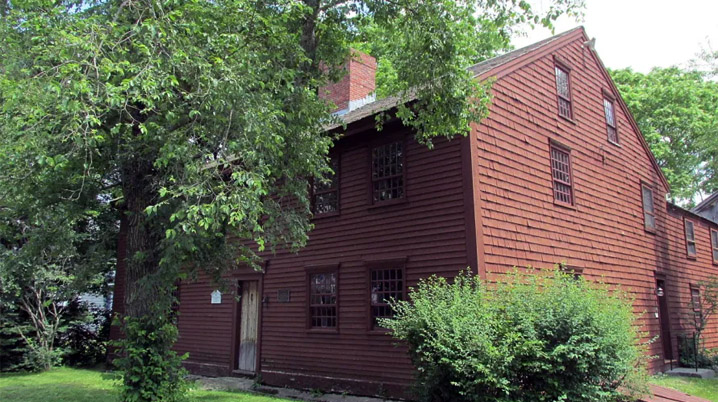
The oldest portion of the Platts-Bradstreet House is a two-story hall and parlor house that was probably built before 1677 by Samuel Platts (1617-1682)/ He purchased the land in 1660 and was charged with a tax on a house in that year. In 1677, Samuel Platt Jr. was taxed for his “new house.” About 1710, a lean-to section with a very large cooking fireplace was added, which would have given the house a classic New England saltbox appearance. In the late 1760s, Moses Bradstreet (d. 1786) raised the lean-to section to a full two stories by raising the ridgepole and extending the front rafters, giving the house its present form as a two-room-deep New England large house. The front right room has a large fireplace, indicating that it was the hall. The house was designated for demolition in the early 1900s, but was restored, which included the replacement of the hall summer beam. The plaster in much of the house appears to be original, but the hall appears to be decorated with replica feather-edge paneling. This house is owned by the Rowley Historical Society, 233 Main Street (PO Box 41). Rowley, MA 01969.
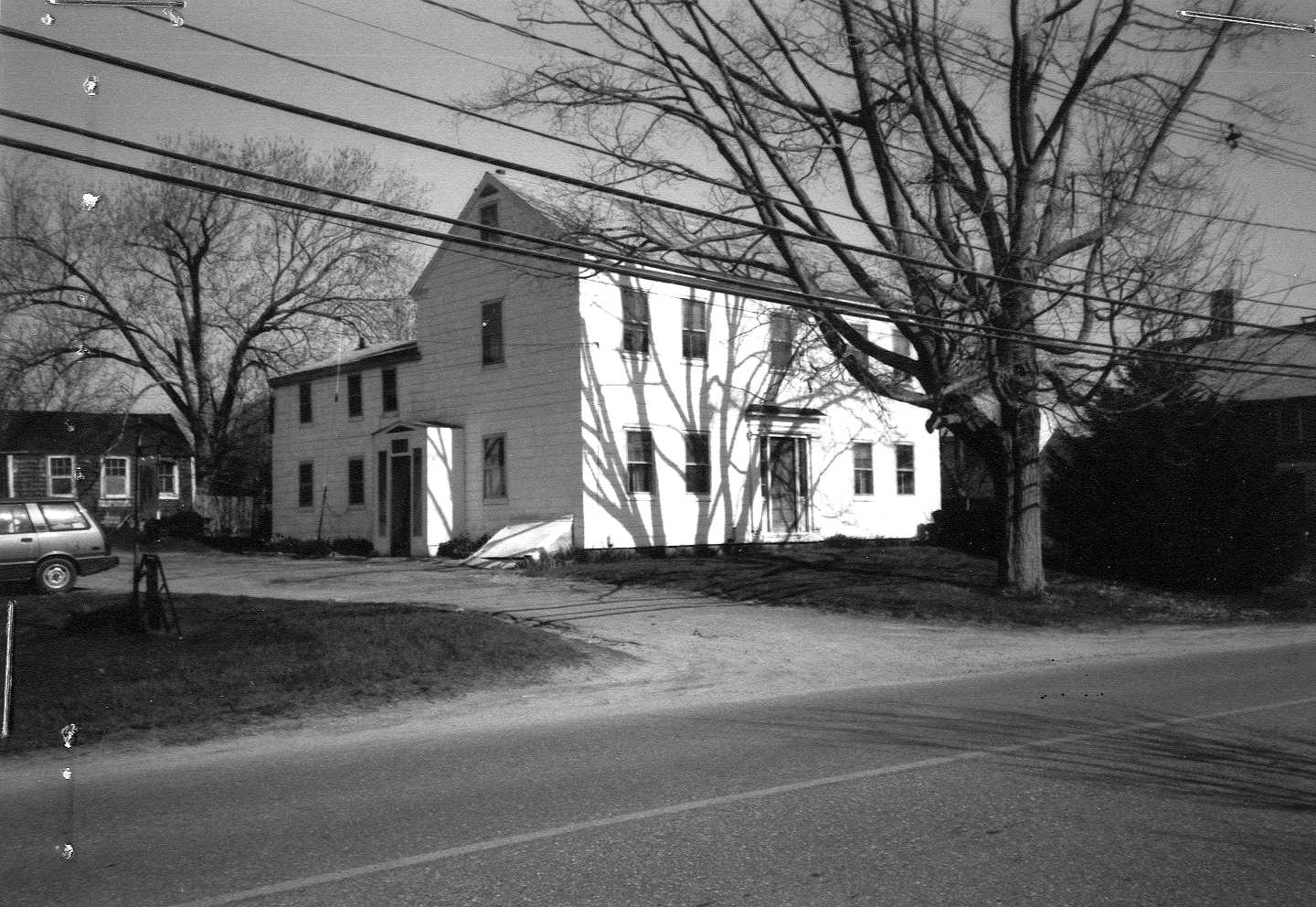
ROW.8 Cressey, Mark C. – Perley, Capt. Allen House, 30 Bradford St., c 1800: The exact age of this house is not certain. However, part of the original grant of Michael/ Hopkinson was sold to Thomas Palmer in 1718, and in 1722, Palmer sold a house and seven acres to Ephraim Nelson, innkeeper in Rowley in 1736. Price Hidden, a grandson of Mr. Nelson, sold the homestead in 1768 to Mark C. Cressey, who fought in the Revolution and had the heel of his boot shot off in the battle of Bunker Hill. Mark Cressey’s daughter, Martha, married Capt. Allen Perley in 1816, and the homestead remained in the Perley name until the 1940’s. The last Perley to live here was Charles N. Perley, grandson of Capt. Allen Perley. He served the town as selectman and his wife as librarian for many years: Many people in town and military affairs have lived in the dwelling.
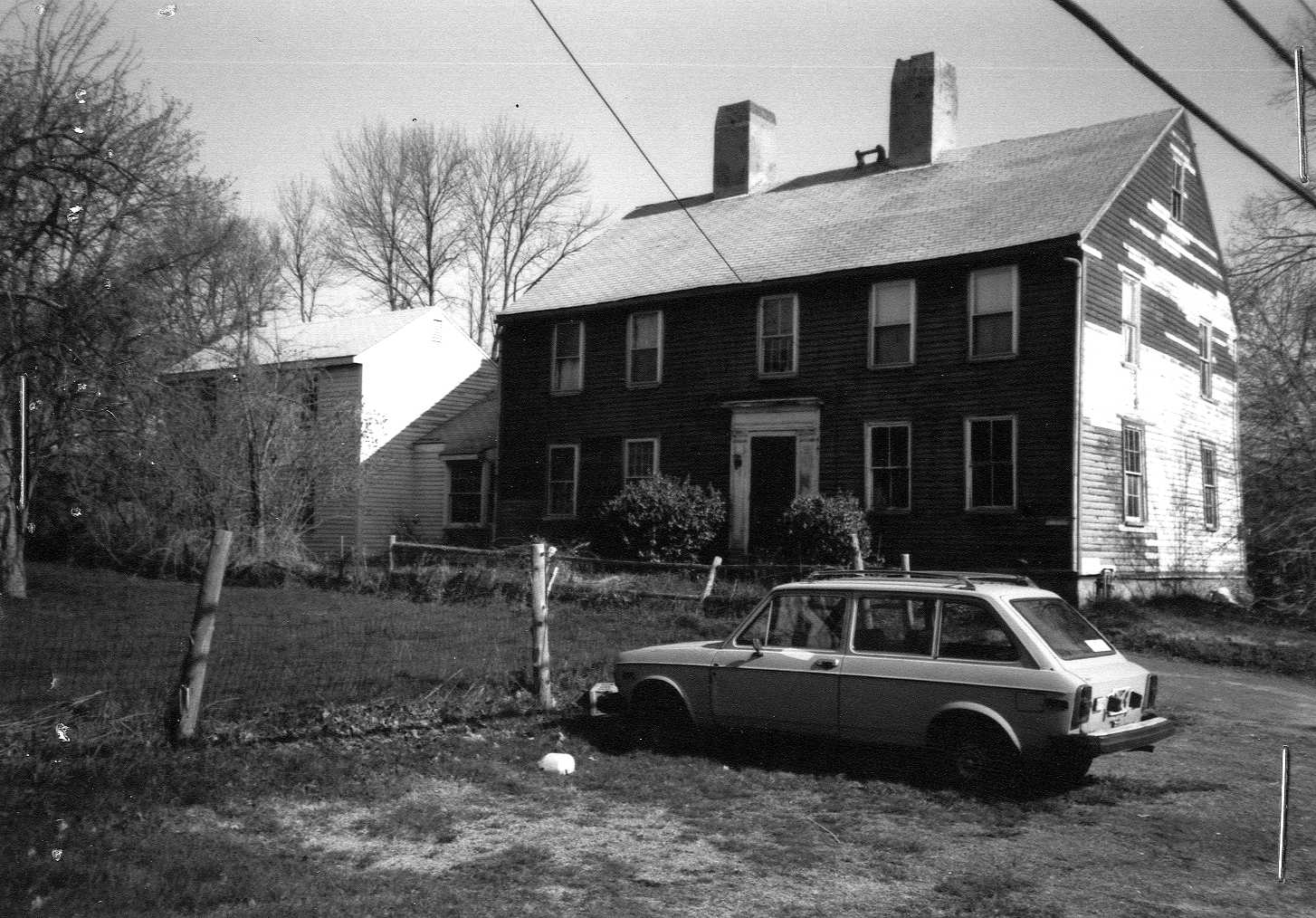
ROW.9 Richards, Moses House, 34 Bradford St., c 1740. The Moses Richards Homestead was built upon the lot granted to John Boynton, one of the first settlers. His lot was one of twenty recorded in the first survey of lots set apart on Bradford Street, one of the first three streets laid out. Like many of the first settlers, Boynton was listed as a trooper in Rowley about the time of the outbreak of King Philip’s War in 1675. There were three tailors who came in 1639; John Boynton was one of them.
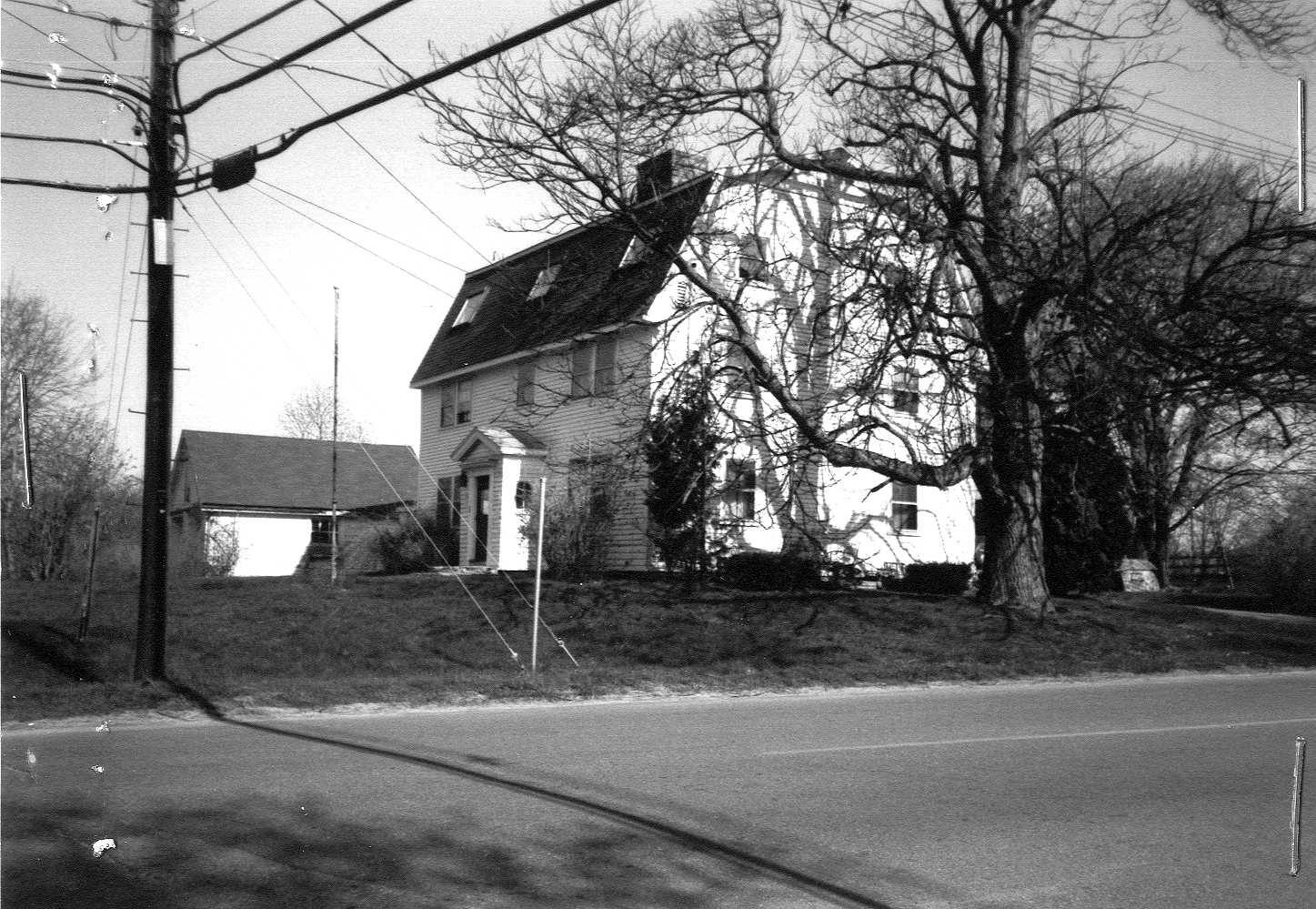
ROW.10 Jewett, Joseph House, 46 Bradford St., 1785: Built on the original lot of John Spofford in Bradford Street, one of the first streets laid out in the town. This 18th-century gambrel-roofed dwelling has seen many renovations over the last forty years! However, the original architectural lines of the house have not been disturbed. In 1927, fire destroyed the large ell on the back of the house, which served as separate living quarters, and about 1900, fire also destroyed the barn. The present overhang on the roof, the entry over the front door, and the ell on the side of the house are 20th-century vintage: This 18th-century house, with a large center chimney, is not too common in the Town of Rowley. Early photos show a fine wraparound porch, which was removed sometime after the 1927 fire.
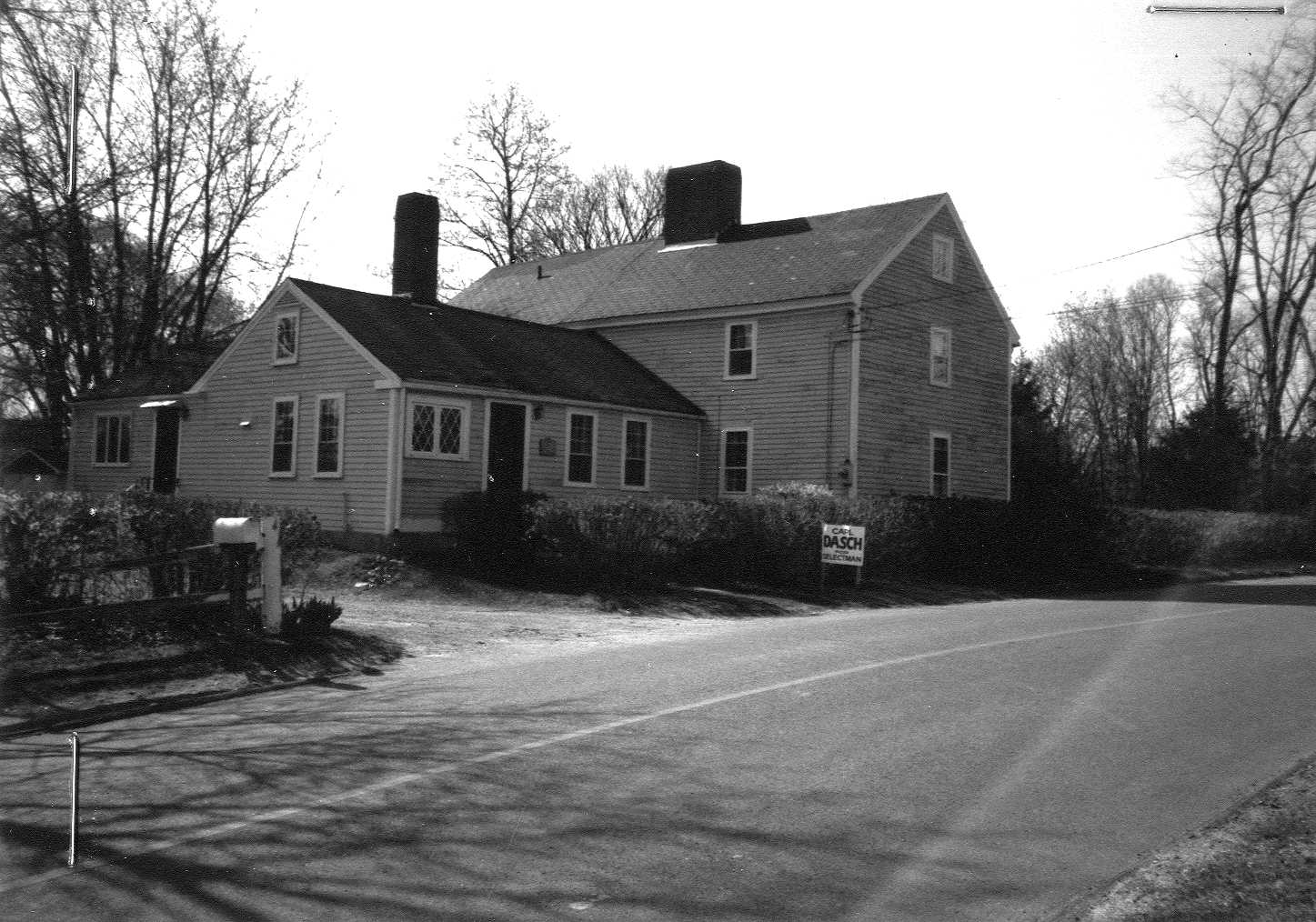
ROW.11 Kilbourne, Isaac House, 53 Bradford St., c 1709: Built on Lot registered to George Kilbourne. Isaac Kilbourne was living on the lot in 1709 and may have built this early home on one of the first streets laid out in the town.
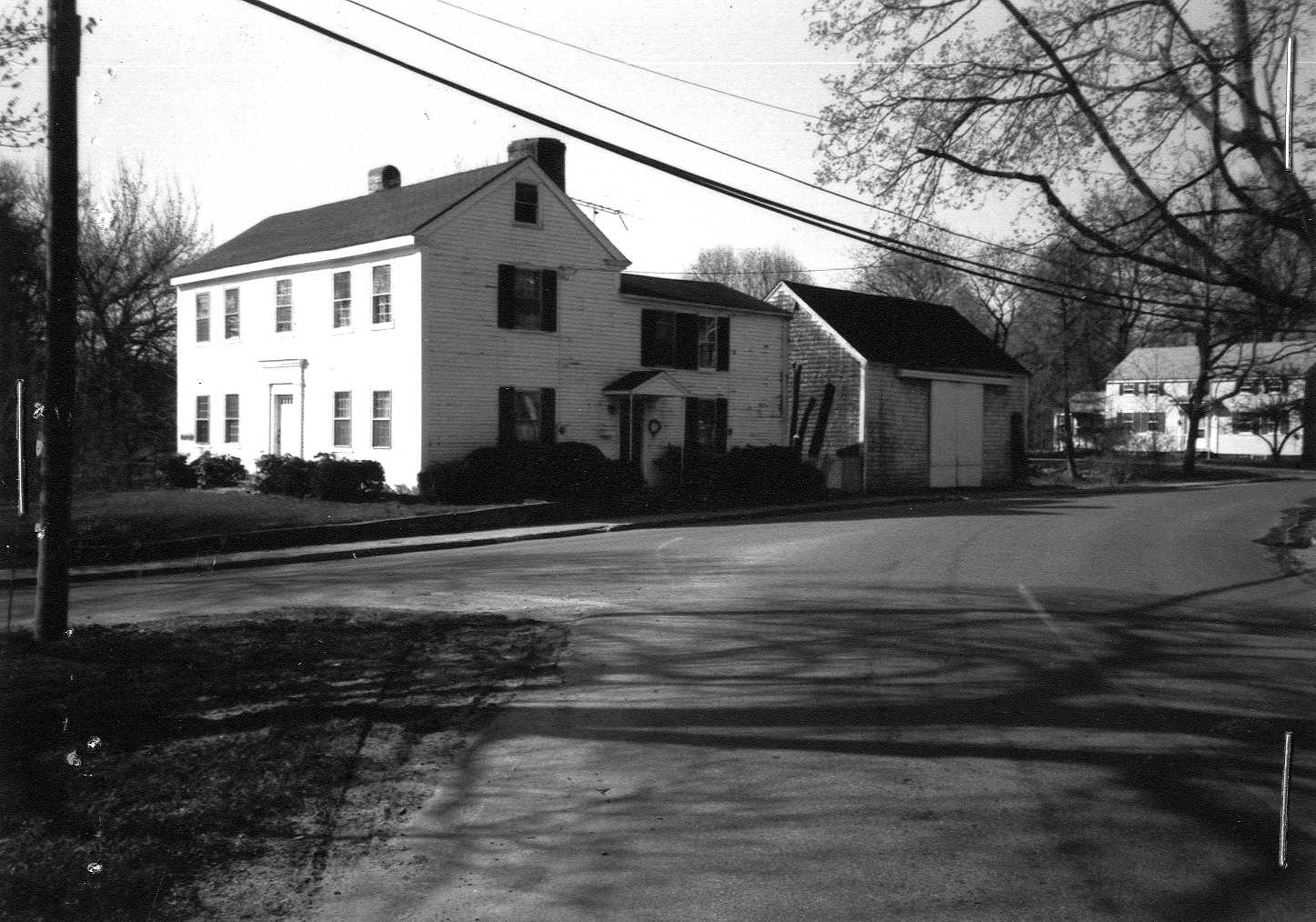
ROW.16 Jewett, S. P. House, 34 Central St., c 1750. The house was built on the lot granted in 1665 to Rev. Samuel Shephard, pastor of First Parish. His house lot was a “Peace of land about two acres, be it on the west and north-west on all other parts, also bounded by the common or highway.” This lot adjoined that of the Rev. Ezekiel Rogers’ lot and the site of his homestead. Ezekiel Rogers, being the founder of the town, Rowley was formerly called Ezekiel Rogers Plantation and was incorporated as Rowley in 1639. This pertains to the first settler’s lot, which is the site of the present house built by Farley in 1814. Ell has evidence of an earlier structure, possibly part of a former house on the site in 1750.
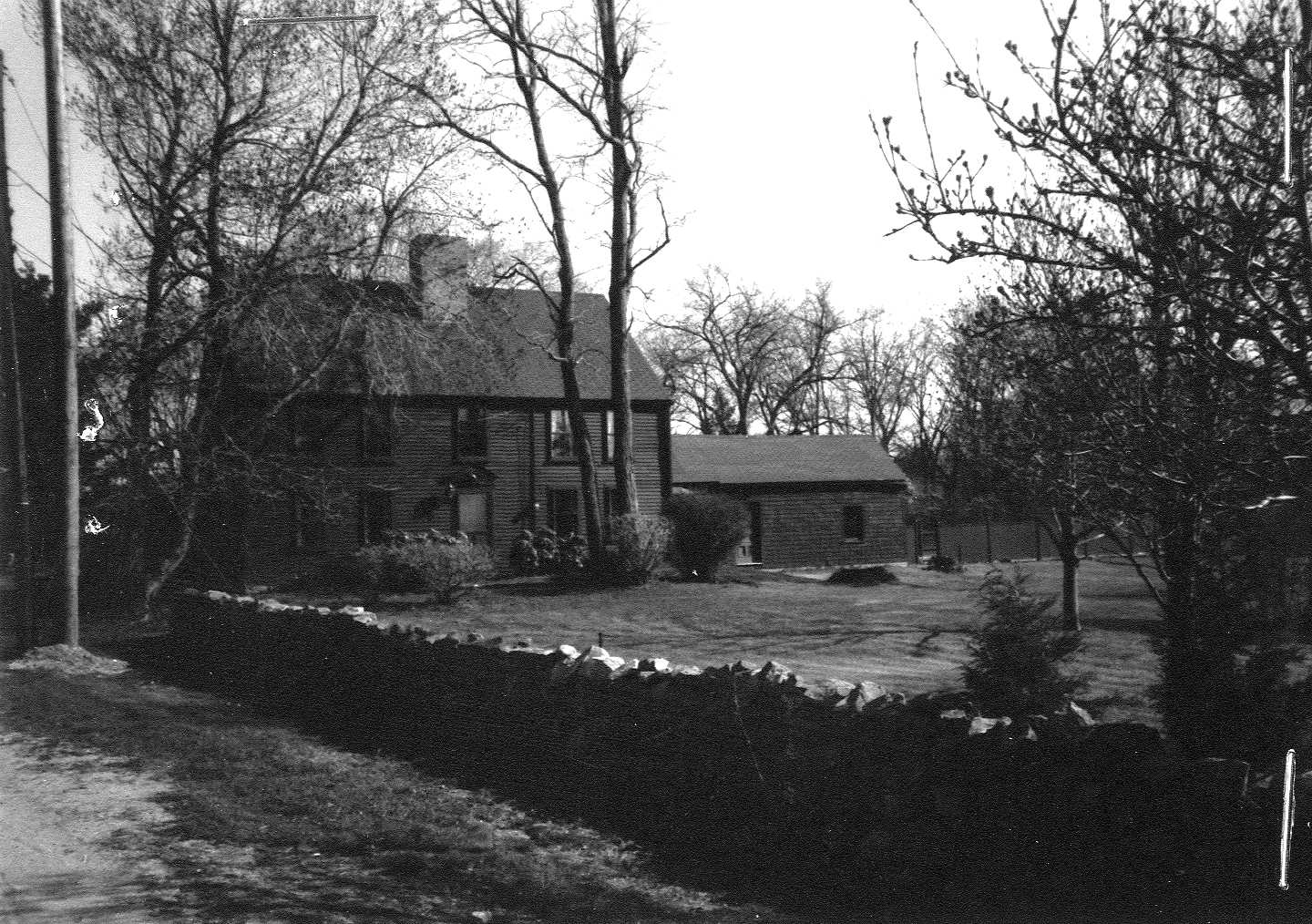
ROW.48 Scott, Benjamin Jr. House, 187 Central St., 1676: Built by Benjamin Scott Jr. on a lot granted to him or his father Benjamin, between 1662 and 1673. Margaret Scott, wife of the Senior or junior Benjamin Scott, was executed at Salem in 1692 for witchcraft. This is one of six seventeenth-century houses, and is the second or third-oldest house standing in the town. The house is on the site of early settler, John Remington, who was granted a parcel of land “lying upon a hill out-of-town and joining the side of Thomas Crosby, his lot and upon the highway.”
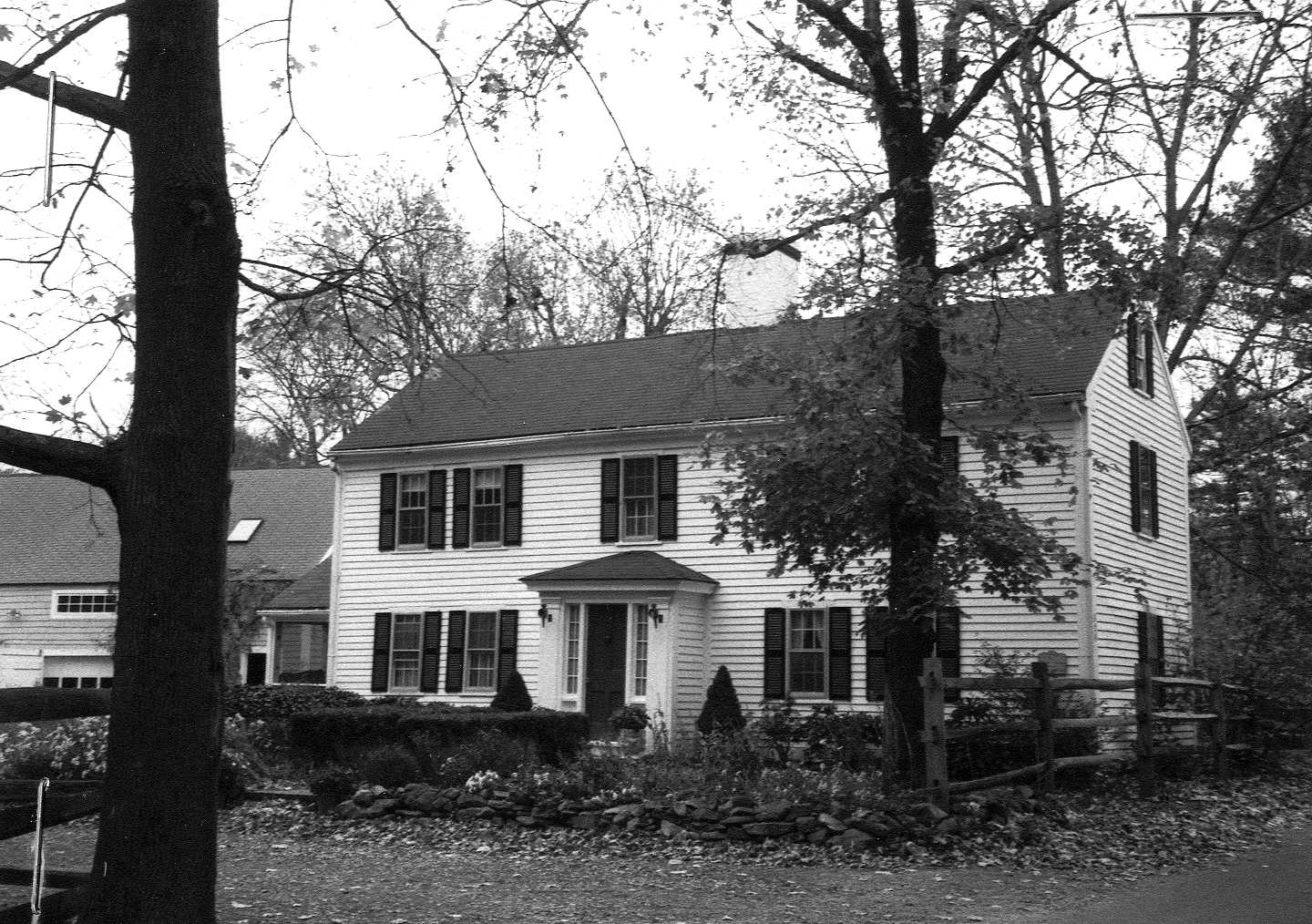
ROW.94 Searle, Dea. Joseph – Moody, Luther House 320 Dodge Rd, 1772: Deacon Joseph Searle and his wife Ruth bought land on the southwest corner of Dodge and Long Hill Roads and had this house erected in 1772. A residence is reflected on the 1794 Chaplin map with multiple grist mills adjacent to the south. These mills were most likely associated not with the Searle-Moody House but with the Pearson and Stickney Dummer Mills. The Searles lived on the property until the deacon’s death around 1838, when it transferred to Luther Moody, a carpenter, state legislator, and trustee of Governor Dummer Academy. The Moody family retained ownership until well into the 20th century. The size and apparent age of the barn on the property are indicative of the agricultural activity that occurred throughout the life of the house.

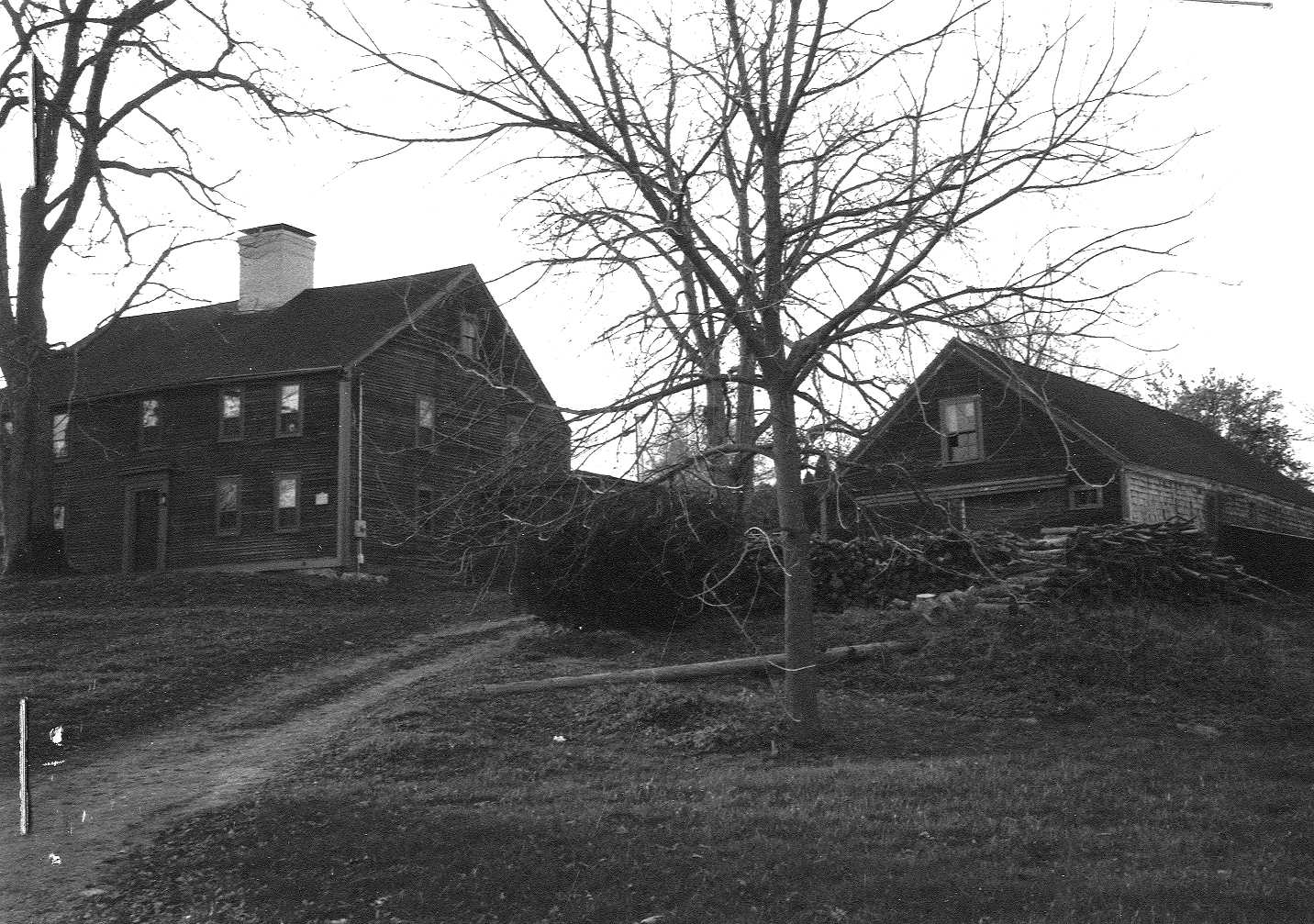
ROW.137 Todd House, 152 Fenno Dr., c 1725. The Todd House may have been built around 1725, according to the book Rowley, Massachusetts, 1639-1850. The site is occupied on the 1794 Chaplin map of Rowley, and the 1830 map indicates the resident to be D. Todd, probably Daniel, born 1757. Members of the Todd family continued to occupy the house until 1872. By 1888, it was owned by Woodbury Smith, a farmer, who sold the property to John Joyce, who sold it to Edward George, clerk of the Essex County Courts. Mr. George sold to Lawrence and Pauline Shaw Fenno in 1933, who built a mansion on the hill west of 152 Kittery Avenue (Inv 138). Mrs. Fenno was active as a philanthropist and lent financial support to the Rowley Historical Society. She was a descendant of the Boston Shaws. The house was in poor condition in 1946, but was restored around 1950 and remains in good condition.

ROW.38 Pearson – Dummer, Joseph N. House Glen St. 1780. The Pearson-Dummer House was the home of Joseph N. Dummer, selectman, school committee member, trustee of Dummer Academy, and the author of “Land and Houses of Rowley,” an unpublished work, which has been used as a reference in compiling much of the material for research on Rowley’s old houses. It sits on a knoll overlooking the picturesque Mill River, earlier called Easton’s River, which enlarges to a pond on the opposite side of Glen Street. When the Turnpike was built, in 1806, one of the toll gates stood on this lot, near the entrance to Glen Street. It was moved in 1895. The house is situated on the triangular lot on the right side of Glen Street, upon entering the valley of the historic Glen Mills area. The boundary on the east is the Turnpike. The boundary on the north is the Mill River, which flows under Glen Street, along the lower edge of this property, and under the Old Stone Arch Bridge, which was built in 1642-3.
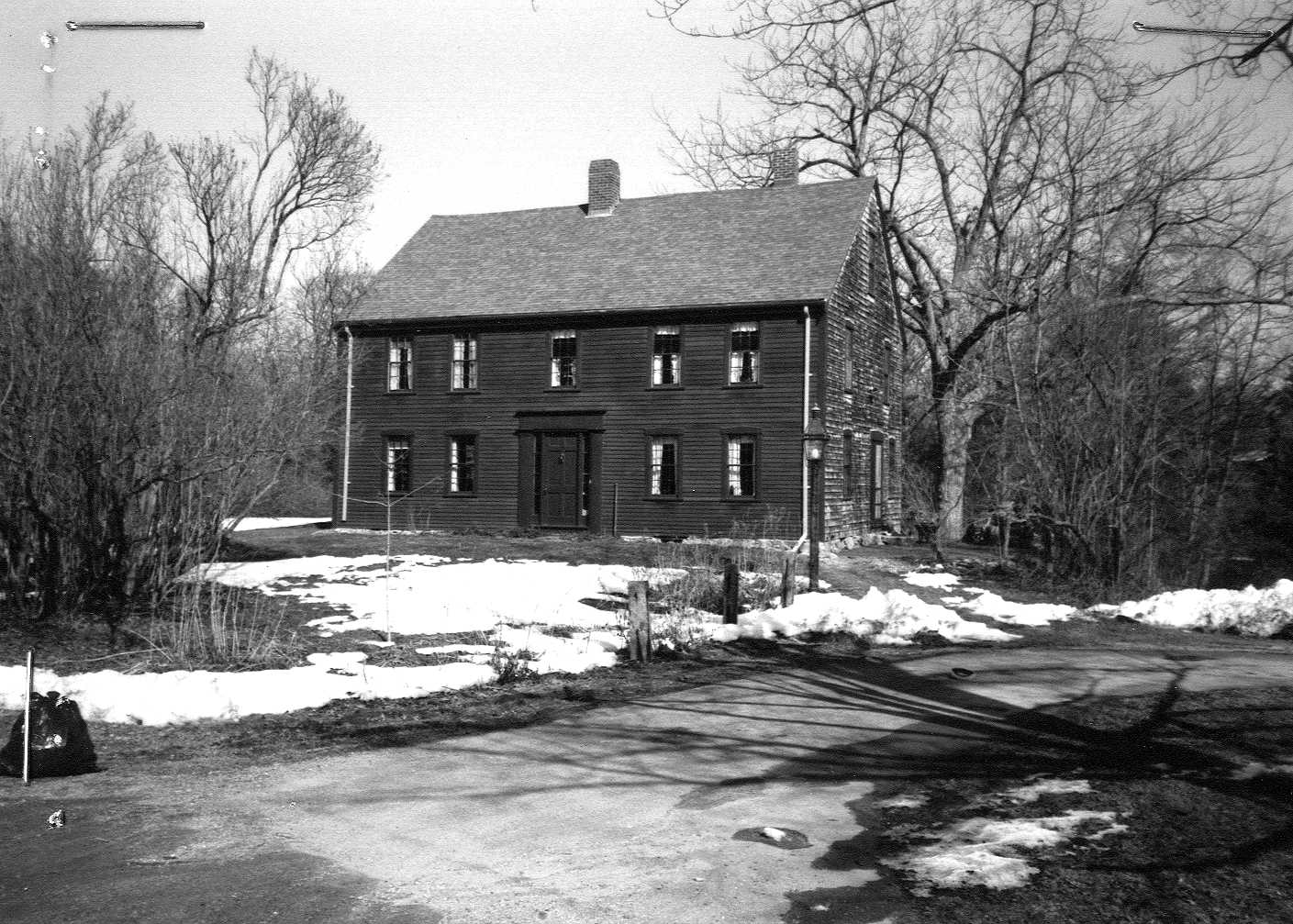
ROW.39 Pearson, Capt. John House Glen St., 1714. The Capt. John Pearson House was built in 1714 on the old 1640 Bay Road (now Glen Street) just beyond the present Jewel Mill and the site of the First Fulling Mill in America, Capt. Pearson, being a descendant of the earlier John Pearson, who built the fulling mill. It was originally a salt-box, but when it came into possession of the Dummer family along with the mills, alterations were made. In 1858, Nathaniel N. Dummer remodeled the house by raising the rear roof to the same height as that in front. The three shallow dormers could have been added at that time. This fine early home has dark-stained, narrow clapboards and six-over-six windows. The old central chimney was removed and two others built. The millstones at this house are serving this generation as doorstones, and date back to the early part of the 17th century, and probably were those wrought by Holmes, dam and bridge builder at Glen Mills. This house has been beautifully restored and contains many unusual examples of early architecture, such as the panelling, cornices, and the very unusual and beautiful corner cupboard, considered to be one of the finest of its kind in New England.
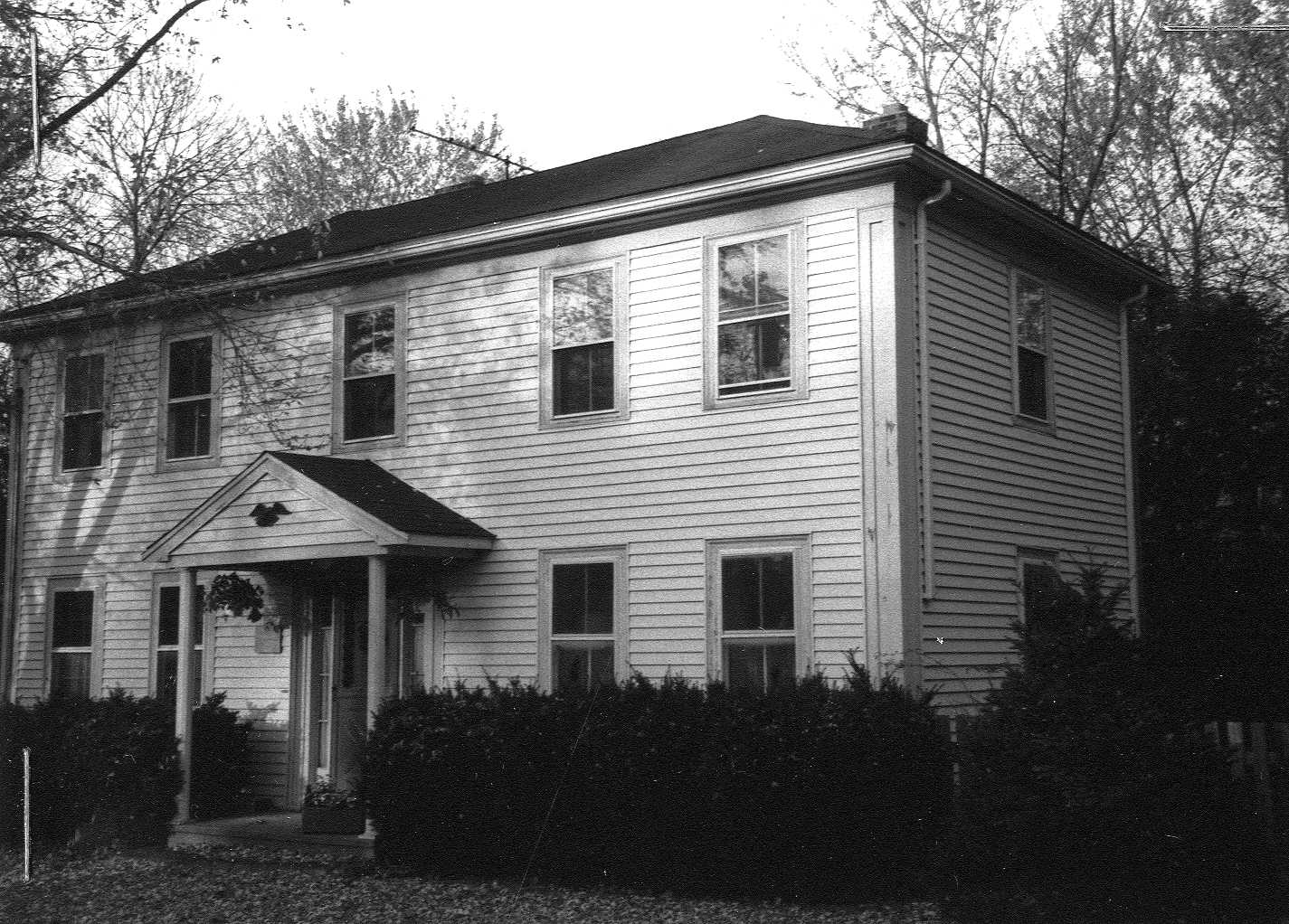
ROW.101 Pickard, Joshua House 22 Hammond St., 1798: The Joshua Pickard House at 22 Hammond Street was built around 1798 for Joshua Pickard. It is unknown who lived there in 1856, as the map is illegible. The 1872 and 1884 maps indicate the resident was M. Jewett, probably Mark Jewett. According to Rowley historian Dummer, the next owner was Albert Bailey, but his name does not appear in the directories on Hammond Street. The house was built as part of a school on Central Street, which was dismantled, moved to Hammond Street, and adapted for use as a dwelling in 1847. Another part of the school was used to build the Grange Hall on Central Street
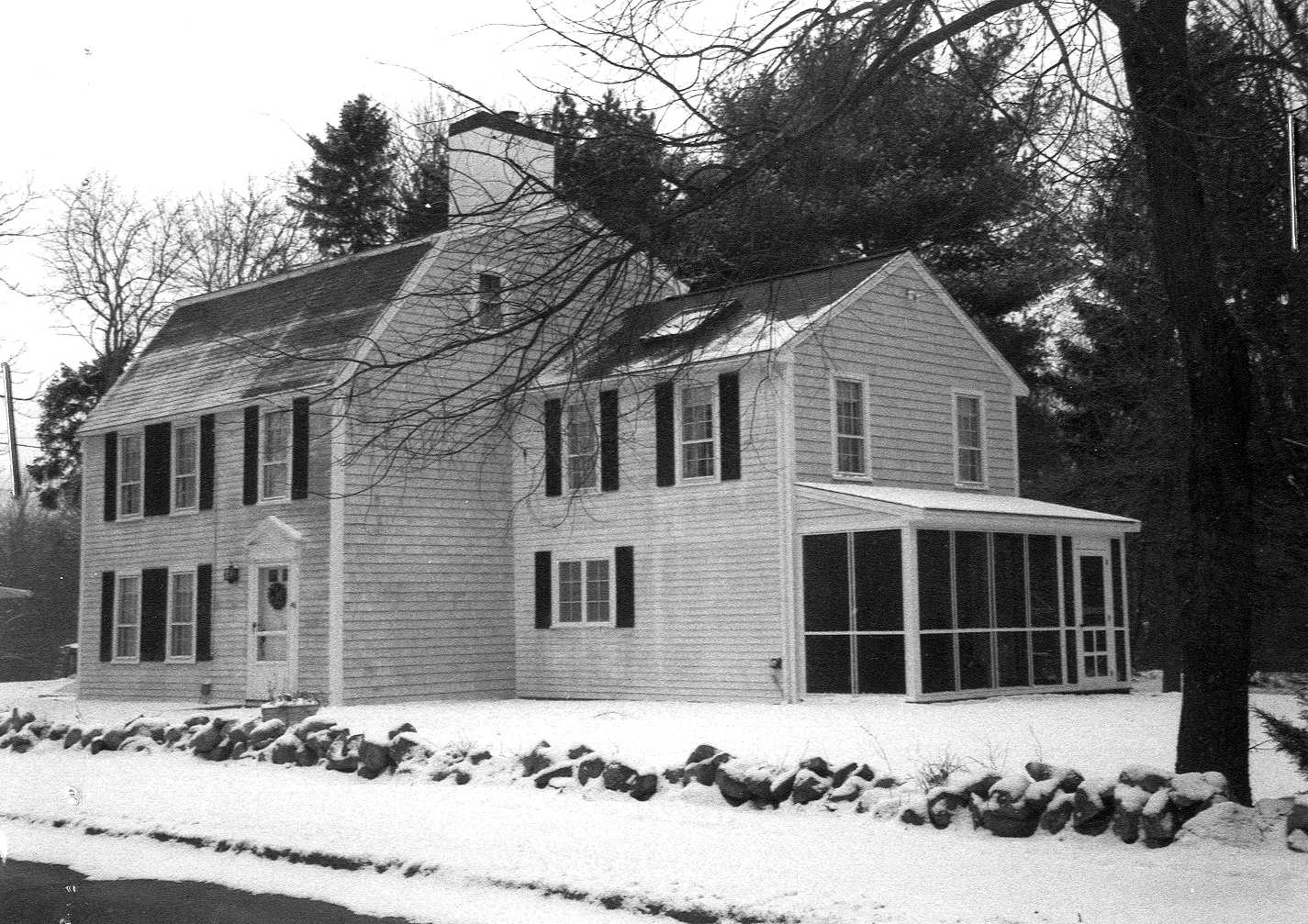
ROW.102 Harris, John Jr. – Jewett, Dea. Joshua House, 46 Hammond St., c 1765: The Harris House was built in 1765 by John Harris Jr., who probably farmed the surrounding land and built the tidal mill in the adjacent marsh in the late 1700s. The subsequent owners were John Harris’s daughter, Phebe, and her husband, Deacon Joshua Jewett, from 1796 until 1861. Deacon Jewett sporadically kept a diary during the period and recounts many of the activities he performed on the property, which include stock raising and butchering, carriage rental, and crop raising. Deacon Jewett also performed services as town clerk for 22 years, selectman, assessor, school committee member, justice of the peace, town clerk and musical composer, physician, and teacher. After his death, the house passed to Deacon John Plummer, who may have been responsible for building the large barn in 1876. Deacon Plummer’s will left the house to the Congregational Church in 1902, after which it was bought by the liveryman Augustus Boynton and used by the town as a poor farm from 1903 to 1917. The property was vacant for a period, but remained in the Boynton family until 1934, when it was sold to the Realtor George Barker, who rehabilitated it and sold it to Mason and Beatrice Blatchford. Mr. Blatchford was an accountant for the United Fruit Company on Federal Street in Boston.
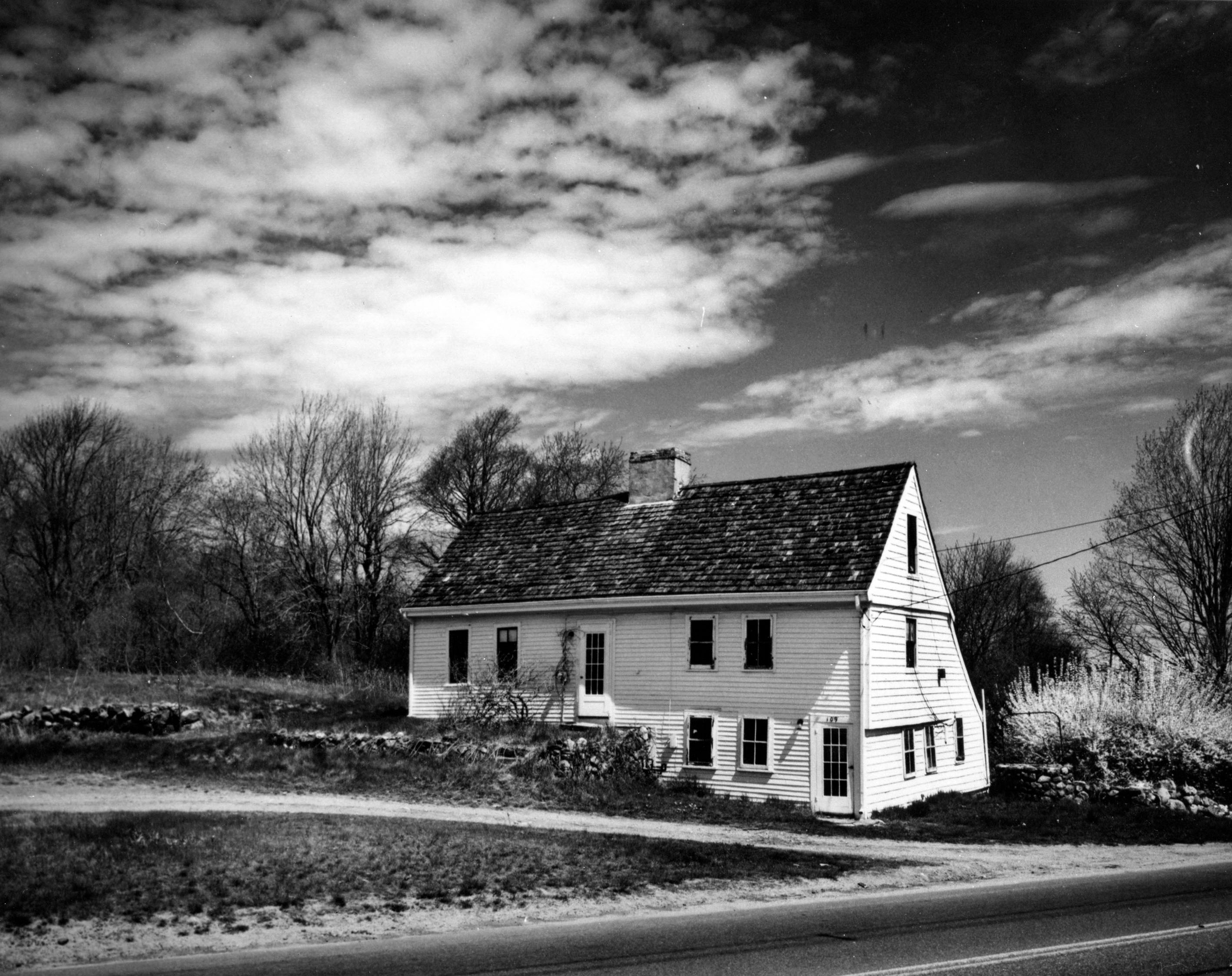
ROW.37 Chaplin – Clarke House 121 Haverhill St, 1671: This first-period house, built in 1671, is Rowley’s oldest dwelling, built on the original house lot of Hugh Chaplin. It faces south, and the west end is set into the bank, being perhaps a continuation of the “shelter” spoken of by Johnson, at a later date becoming the cellar of the house, reached by one step down from the kitchen. “They (the settlers) burrow themselves in the Earth for their first shelter. under some Hillside, casting the Earth aloft upon timber, they make a smoky fire against the Earth, at its highest side. They kept off the short showers from their lodgings, but the long rains penetrated through to their disturbance in the night season, yet in these poor Wigwams they sing Psalms, pray, and praise their God till they can provide them houses.” It has a central chimney built on a stone foundation. There is a slight overhang on both the first and second stories at the east end, but none in front. It has a lean-to, a later but very early addition, and is the only house standing in Rowley having both overhang and lean-to. In 1946, Jewett writes that there are two small rooms, a cellar under the first floor of the main house, and two large rooms, one over the cellar, on the second floor. In 1937, when the house was undergoing repairs, some of the original clapboard was disclosed at the back of the building. These were nailed directly to the studs, with the space between them and the lath filled with nogging. In the east gable end, there was once a window containing four small lights. Chaplin’s History also stated that the house was a single-story of two rooms, with a lean-to later added. The present restoration has not altered the architectural lines of this very fine first-period home in any way. In fact, it has uncovered many of its unique 17th-century features that have been hidden for many years.
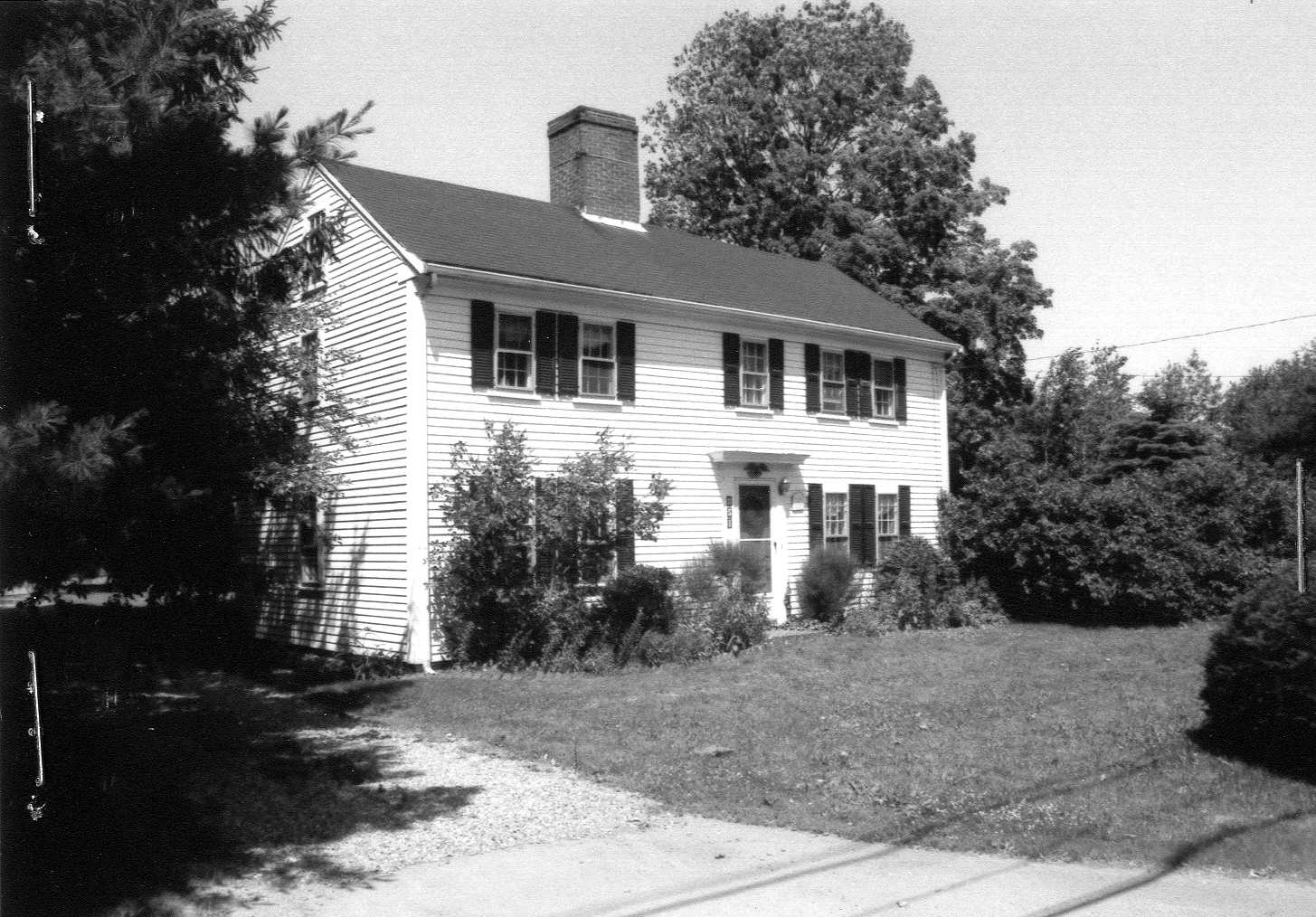
ROW.59 Dickinson, Joseph House 851 Haverhill St., 1732: The Dickinson House, situated on the western side of Dickinson brook, was built on a portion of the homestead of eight acres which belonged to James, son of Thomas Dickinson, first settler. It remained in the Dickinson family until 1832, when it was sold to Amos M. Dodge. Amos Dodge sold it to Calvin Hubbard. His son, Orrin A. Hubbard, was one of the founders of “the Lampson and Hubbard fur and hat company,” of Boston and New York. This house, which is situated next to the 1723 Jonathan Dickinson House, has been carefully restored and is a fine example of a house of its period, it is part of a small cluster of seven homes along this section of route 133, called Millwood, which are all historically significant and meet the criteria to be part of a small historic district in this area of town, now called “Millwood” and previously called “Rooty Plain.” Further evidence that Millwood was a thriving little community that revolved around the nearby Mill River and its early mills is recorded by historian Dummer, who states that a community hall, an institution in its day, stood on the north side of the road (Rte. 133) opposite Boxford road. It was sold in 1928 to Daniel O’Brien, who removed it to the Turnpike (Rte. 1). This gathering place stood on the east side of Dickinson Brook, which flowed into the Mil River, whereas the Dickinson house still stands on the west side of the same brook today.

ROW.63 Dickinson, Jonathan House 865 Haverhill St., 1723. This two-story early colonial has evidence of many additions and changes throughout the past three hundred years, but retains many of the very early features of an early 18th-century edifice. At some time, the center chimney was removed and twin chimneys erected, but the early “reverse cottage” nine-over-six windows remained throughout the house. Inside, the exposed beams, wide pine floors, paneling, and old fireplaces are visible evidence that helps to date this house. Also, the early workshop, which was whitewashed, could even predate the dwelling. The early barn, with its dry-laid stone foundation, has been recently restored and is in excellent condition. This restoration was done by the previous owner, Samual Streiff, as well as the moving of the house to its present location. This dwelling is typical of many others through Rowley, which helps to mold its character and keep its history alive.
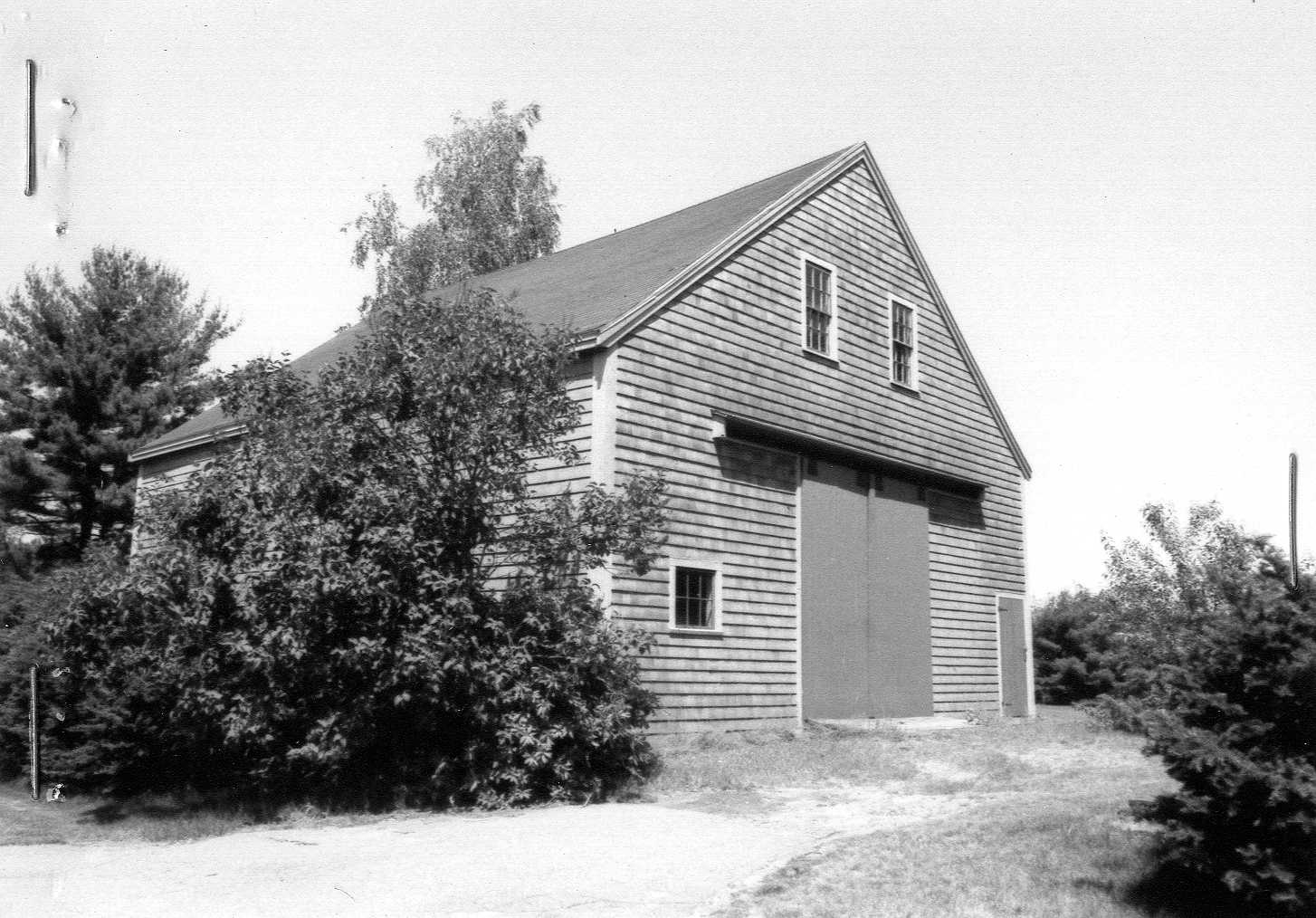
ROW.64 Dickinson, Jonathan Barn, 865 Haverhill St., c 1723
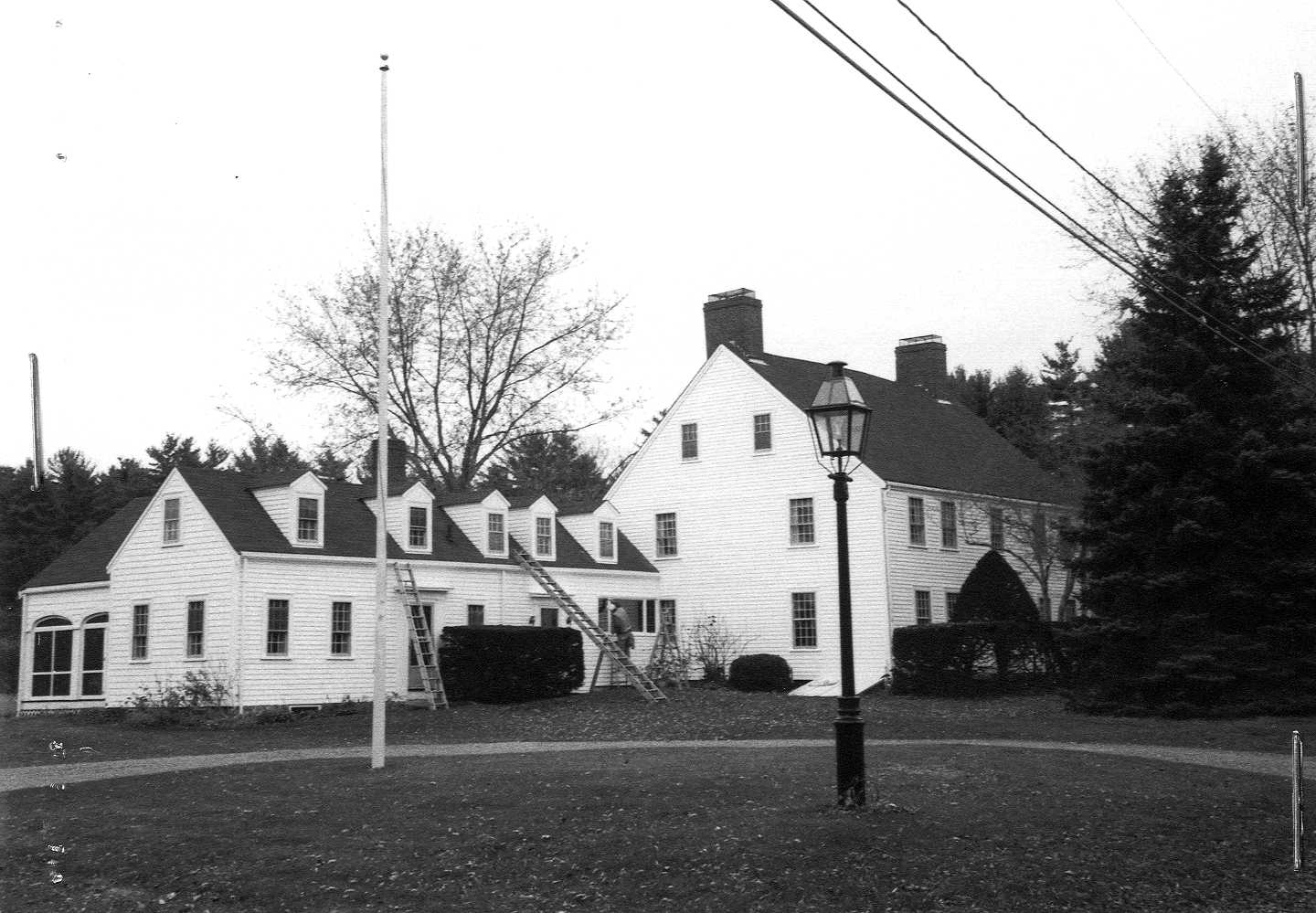
ROW.114 Tenney, Nathaniel – Dummer, Nathaniel House 66 Long Hill Rd., 1747: The house at 66 Long Hill Road was built in 1747 for Nathaniel Tenney, who was the son of Daniel Tenney, both millers whose mill was south of the house on Mill River. Gage notes that a mill was built in the Mill River near this location around 1700, and that it remained in use for approximately 100 years, after which it was torn down. In the Late 19th century, the property may have been rented to Charles Walker, who is listed in the 1888 resident directory as a lumber dealer and mill sawyer at this location. The house remained in the Tenney family until 1892, when it was sold to Nathaniel Dummer, who also owned the sawmill south of the farm and operated it until around the turn of the century, according to the book Rowley Revisited. Dummer worked at the Glen Mills Cereal Company (Inv B) in addition to operating the mill. He sold the property in 1908, after which it changed hands many times until 1916, when Margaret Howie bought it for use as a summer home. The 1925, 1933, and 1944 resident directories indicate that Cambridge residents Harriet and David Howie, a secretary in Boston, owned the house and used it as a summer residence. Dummer states that the house was significantly remodeled in 1929, which may be the construction date of the formal gardens and many of the decorative elements. The large barn across the street may also have been built at this time.
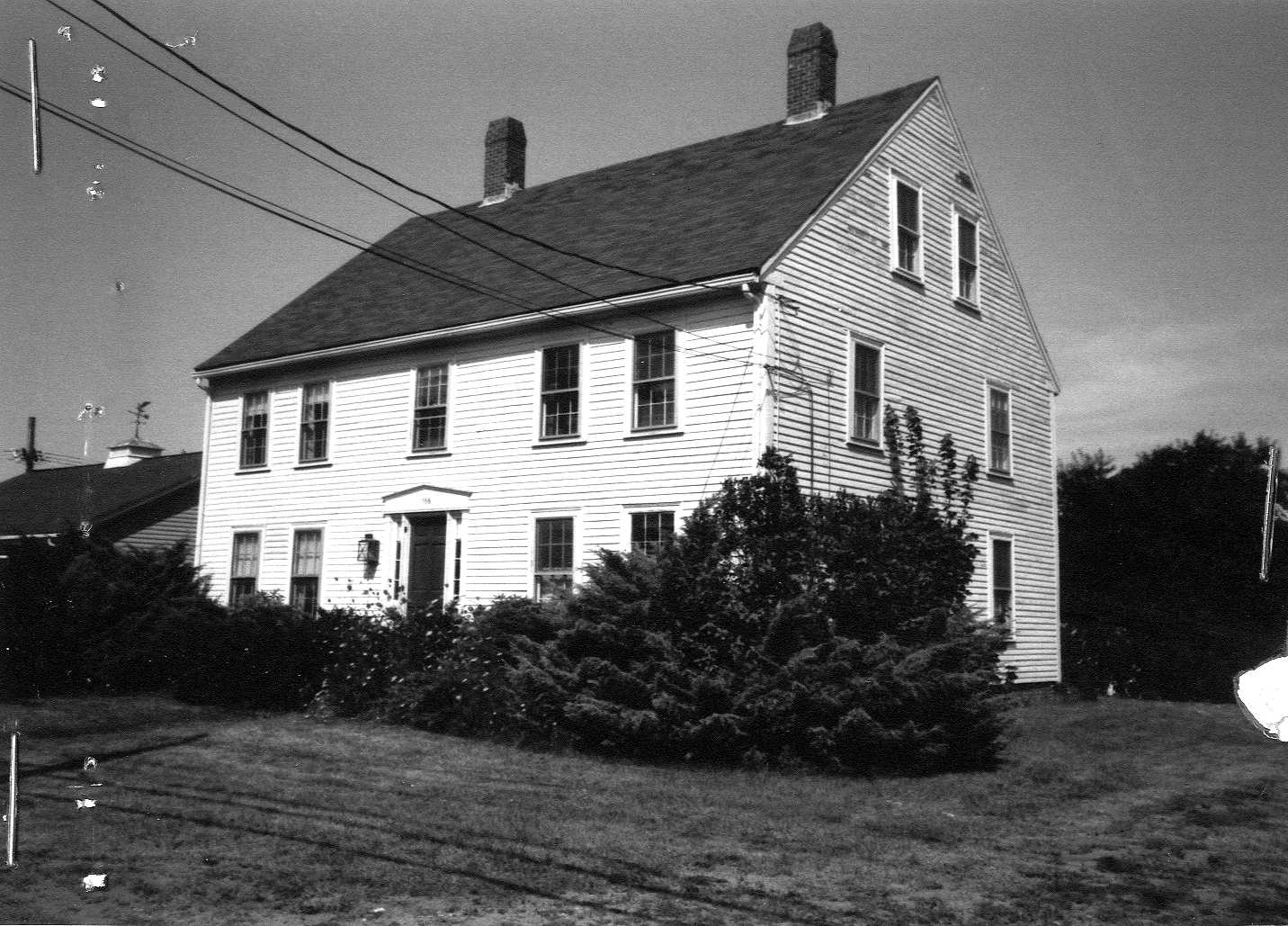
ROW.22 Reindeer Tavern – Gage House Main St., 1760: The Reindeer Tavern was built on the lot granted to early settler Thomas Nelson. It served as a dwelling and tavern during the early years. The sign that swung in front of the tavern is preserved in the Rowley Historical House. Dummer states in his description of the place that men just back from the French and Indian Wars gathered here and recounted their hairbreadth escapes and told again and again what the officers should have done or should not have done in various engagements with the enemy. Later, the house was known as the Gage-Todd House and used as a dwelling. Today, the colonial structure is being effectively used for commercial purposes in the downtown area.
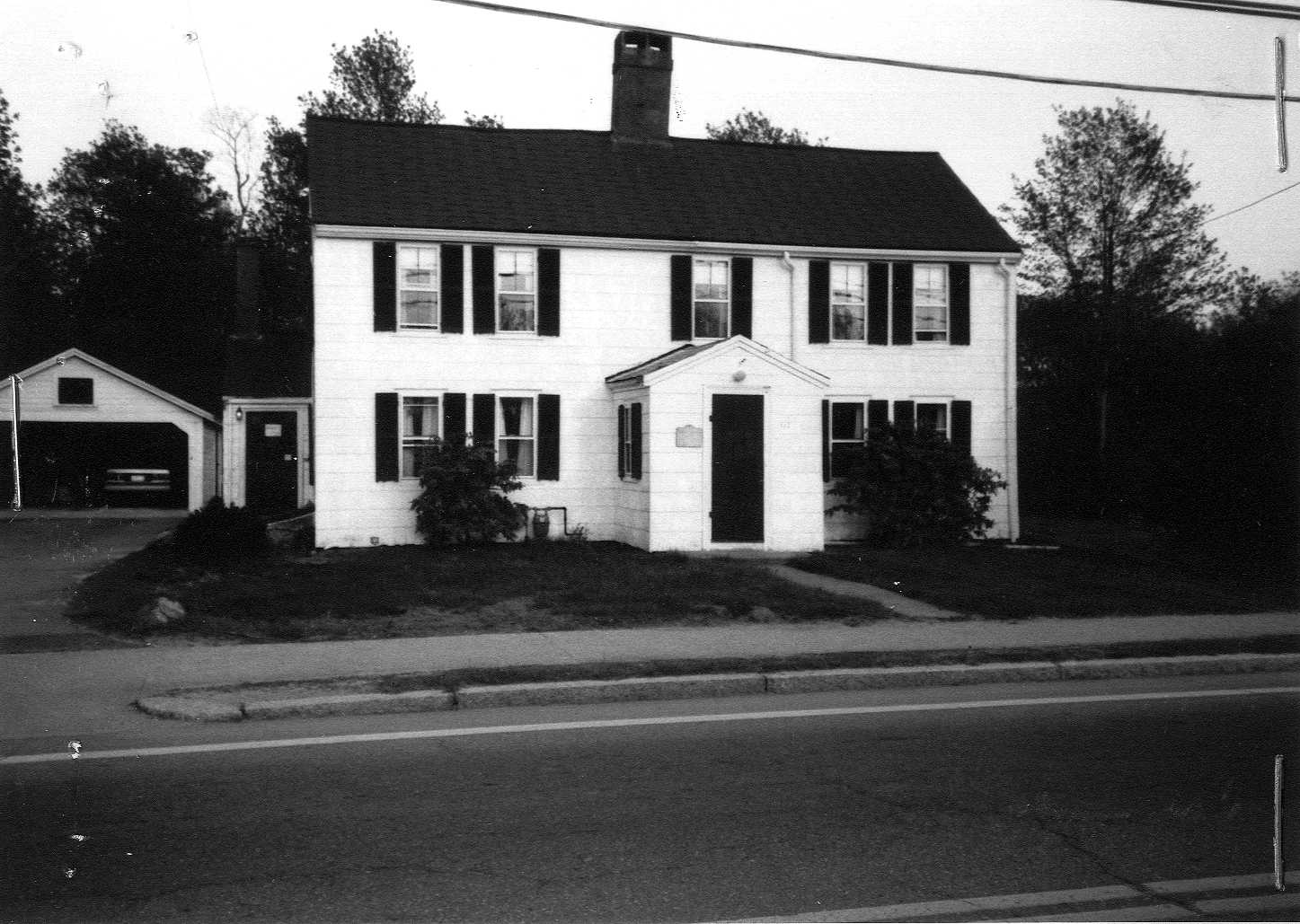
ROW.29 Lambert, Nathan – Hobson House Main St., r 1725: This salt-box house is situated east of the “Training Field,” directly opposite the tablet describing the setting apart of the “Training Field” soon after the % settlement of the town, for the purpose of drilling and training of Rowley’s early militias. The tablet also tells of the encampment of Arnold’s Expedition to Quebec in 1775, on this very same “Training Place.” The House is very architecturally significant because of its unique salt-box design, and other interesting features, such as its low-sloping roof and two leaning chimneys, which are incorporated into one chimney in the attic of the house. Possibility, also, that this house was the one used for the smoking of passengers and luggage coming from Boston on the stagecoach, during the smallpox epidemic of the Revolutionary War years. Rowley had passed this law on incoming travelers to help prevent the spread of the dreaded disease. It is recorded in the town records that Nathan Lambert, Jr., who lived in this house at that time, was paid for a ‘Smoke House’ in 1775, for this purpose. It is not clear whether Nathan Lambert, a selectman in 1758, or his son, Nathan Lambert, Jr., who was married in 1775, built the house. Therefore, the questionable date on the house. It has the definite style of an early 18th-century house, however. Mention should also be made of the beautiful corner cupboard in one of the front rooms of the house, it being very fine for this type of country home.

202 Main St., Rowley, MA, the Deborah and Rev. John Pike House, 1839: The 1720 Northend House, now at 169 Main St., was moved from this location in 1837, after which the present house was constructed by Hannah and John Francis Jamin. A decade later, they sold the home to Rev. John Pike, pastor of the First Church, and his wife Deborah, in whose possession the house remained until the end of the 19th century. Until fairly recently, the house served as the Catholic Church rectory.

ROW.34 Pickard – Hale House 35 Main St., Rowley, c. 1800. The house is located in what was formerly called the “Murlay Field” by early settlers. Although the house appears to be late Federal / Greek Revival, it may contain within it the 17th-century dwelling of Capt. Samuel Pickard, which was moved a few rods south of the present location and was added to it in the early 1800s.
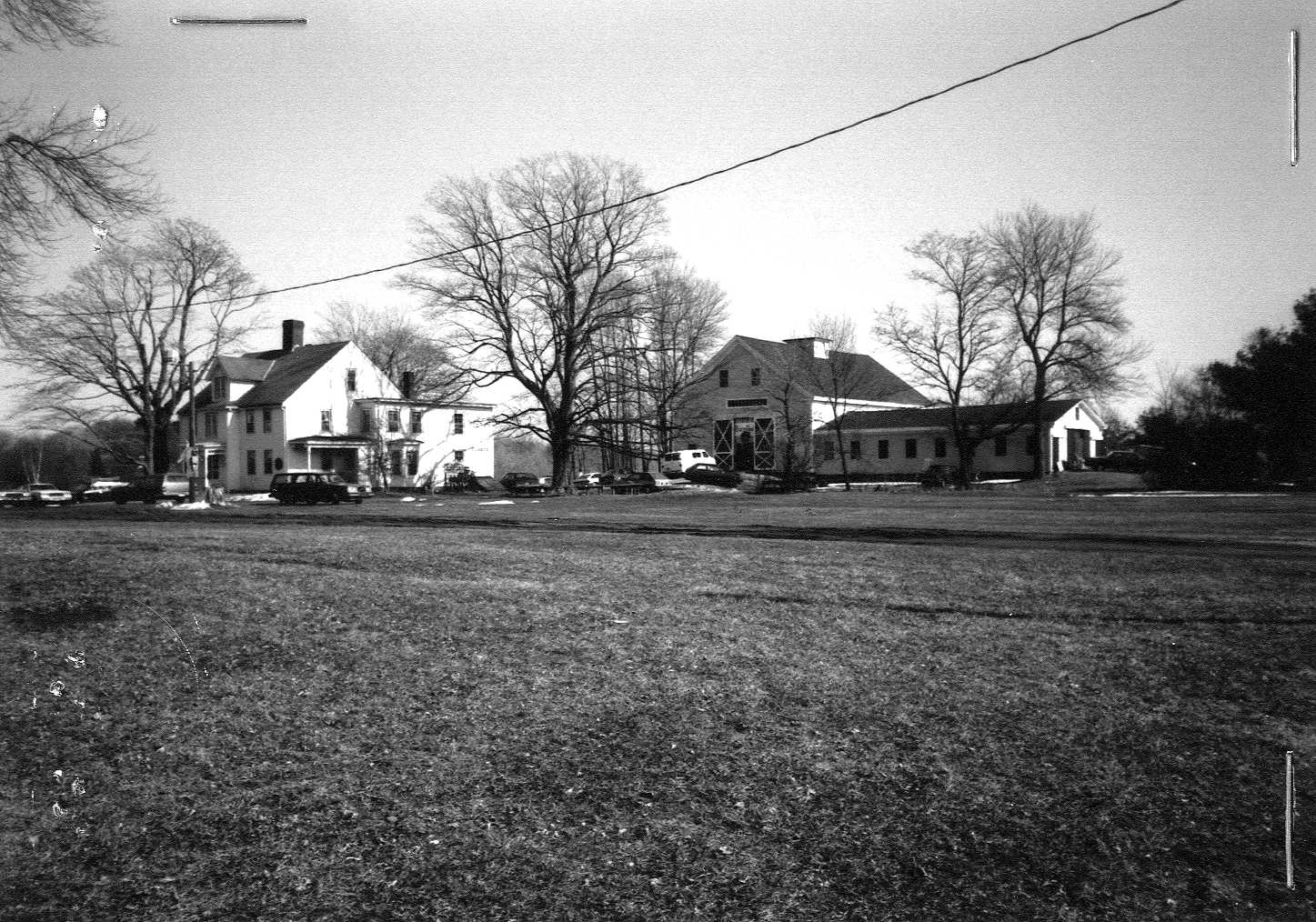
ROW.54 Gage, Thomas House, Main St. 1790: The Thomas Gage House was the home of Thomas Gage, Town Clerk from 1822-1837, and was the author of the “History of Rowley,” published in 1840, immediately following the second centennial of the town, in 1839. He was also a Trustee of Gov. Dummer Academy from 1819 to 1828. By inheritance and purchase, this estate came down to the Todd family in 1848. The Todd family has also been very active in public affairs. George A. Todd was also a Trustee of Dummer Academy from 1870 to 1880. The homestead came to his son Frank P. Todd, who was a selectman for several years and a member of the Legislature in 1909. After he died in 1918, the farm came to his son, George A. Todd, who owned it until his death. The property then came to his son, F. Payson Todd, who served the town for many years as Town Moderator.
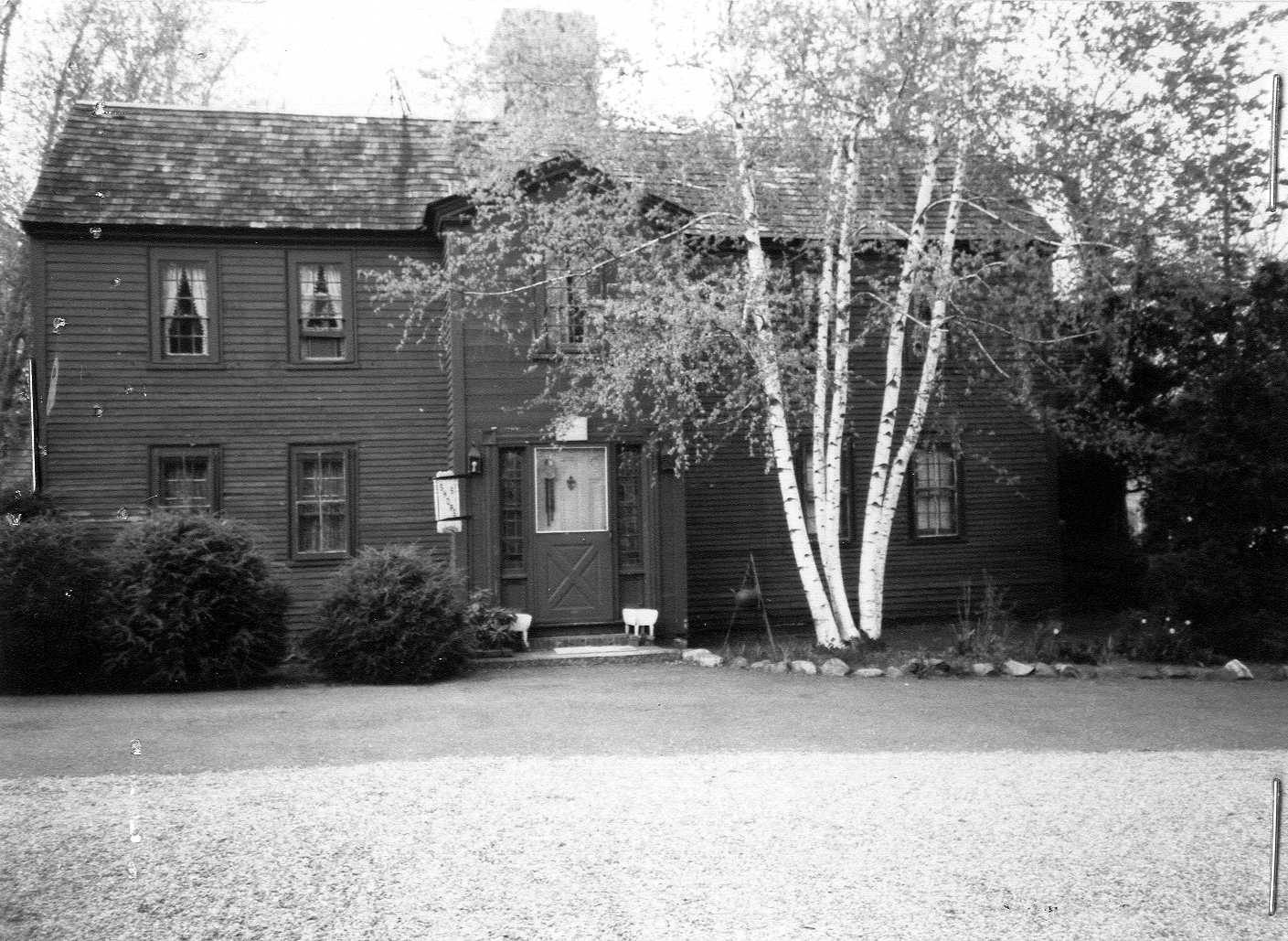
ROW.33 Platts, Jonathan House, 52 Main St. 1680: One of the six 17th-century houses in Rowley, built on the “Rye Field Lots” on the Old Bay Road,1640. The house faces south, like many of the earlier houses in Rowley, but with the end of the house facing the street, and it contains the original 17th-century framing, which is exposed in the library. The living room has, within the original walls, a later set of walls that include Indian shutters. Upstairs, the two early bedrooms have fine examples of raised paneled walls. A one-story ell containing the kitchen was added to the house around 1800. Subsequent additions date from 1972. Jonathan Platts, the builder of the house, appeared in Rowley in 1653 as a “keeper of cows.” He wooed and won Ezekiel Rogers’ maidservant Elizabeth (Johnson) and served as “tithingman,” “judge of delinquents,” and selectman between 1665 and 1677.

ROW.31 The Mighill-Perley House, 100 Main St., is traditionally said to have been built for Capt. Nathaniel Mighil (1684 – 1762) at about 1737. The paired chimneys, corner quoins, and central hallway would suggest a house constructed after 1750, the second half of the Georgian era. The house has natural crook oak rafters reaching from the eaves to the ridge. Nathaniel Mighill’s grandson was Captain Nathaniel Perley. Captain Perley built the “Country’s Wonder” in 1814 across the street on the common. This ship was then hauled with 100 yoke of oxen to the warehouse landing. This was a remarkable feat of the times, the vessel being of 100 tons burden, and the Warehouse Landing being over 2 miles from the common, where it was built. An account of the “Country’s Wonder” was published in both the “Essex Register,” a newspaper published at Salem under the date of 7 May, 1814, and the “Salem Gazette” of 10 May, which gives a more complete account of the building and hauling of the vessel.
In 1845, William Kilham of Boston, a 40-year-old merchant, married 25-year-old Lucy Ann Perley, the daughter of John and Anna D. Kilham. The 1872 Rowley map and the 1780 directory show the owner of 100 Main St. as “Mrs. Lucy Killam.” This house has an account of 1861 written on the paneling in the attic, which tells of men staying the night and departing from this place to go off to the Civil War.
References: Wikitree, Ward Maps, Vital Records of Rowley
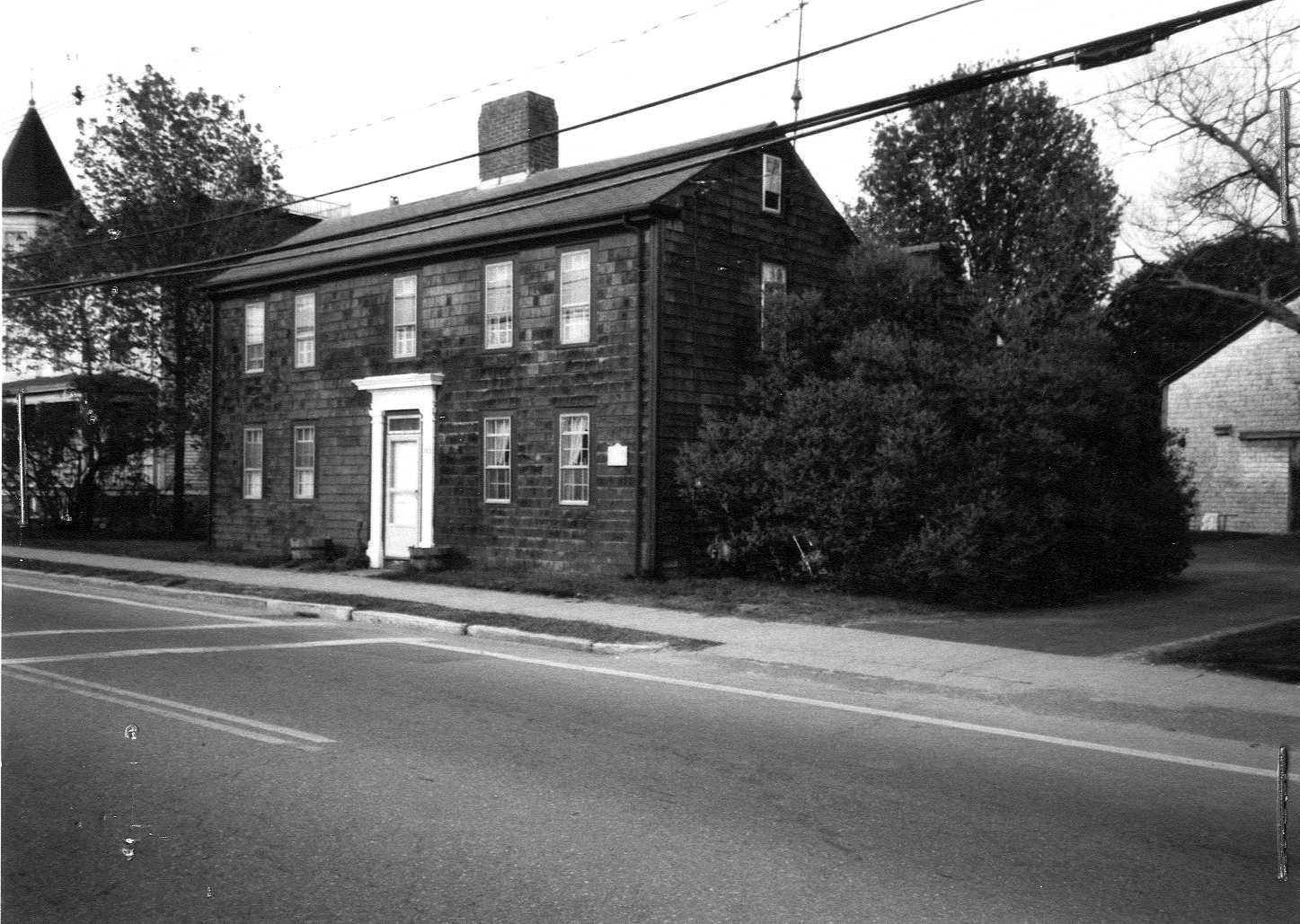
ROW.30 Hobson, Moses – Perley, Capt. Ebenezer P. House, 103 Main St., 1725: House borders the “Training Field” on the east at the southerly end, on the Old Bay Rd. This was the first road ordered laid out by the General Court in the colonies in 1639. The road was built in 1640. The house was built on Sebastian Brigham’s planting field, one of the first settlers. It was also the home of Ebenezer P. Perley, sea captain, and other Perley and Lambert heirs for nearly two centuries. Mrs. Greta Lambert (Jewett) Metcalf, the last heir of the Perleys and Lamberts to live in the house, died in 1976. A store was operated in 1830 by Lambert & Harris on the property.
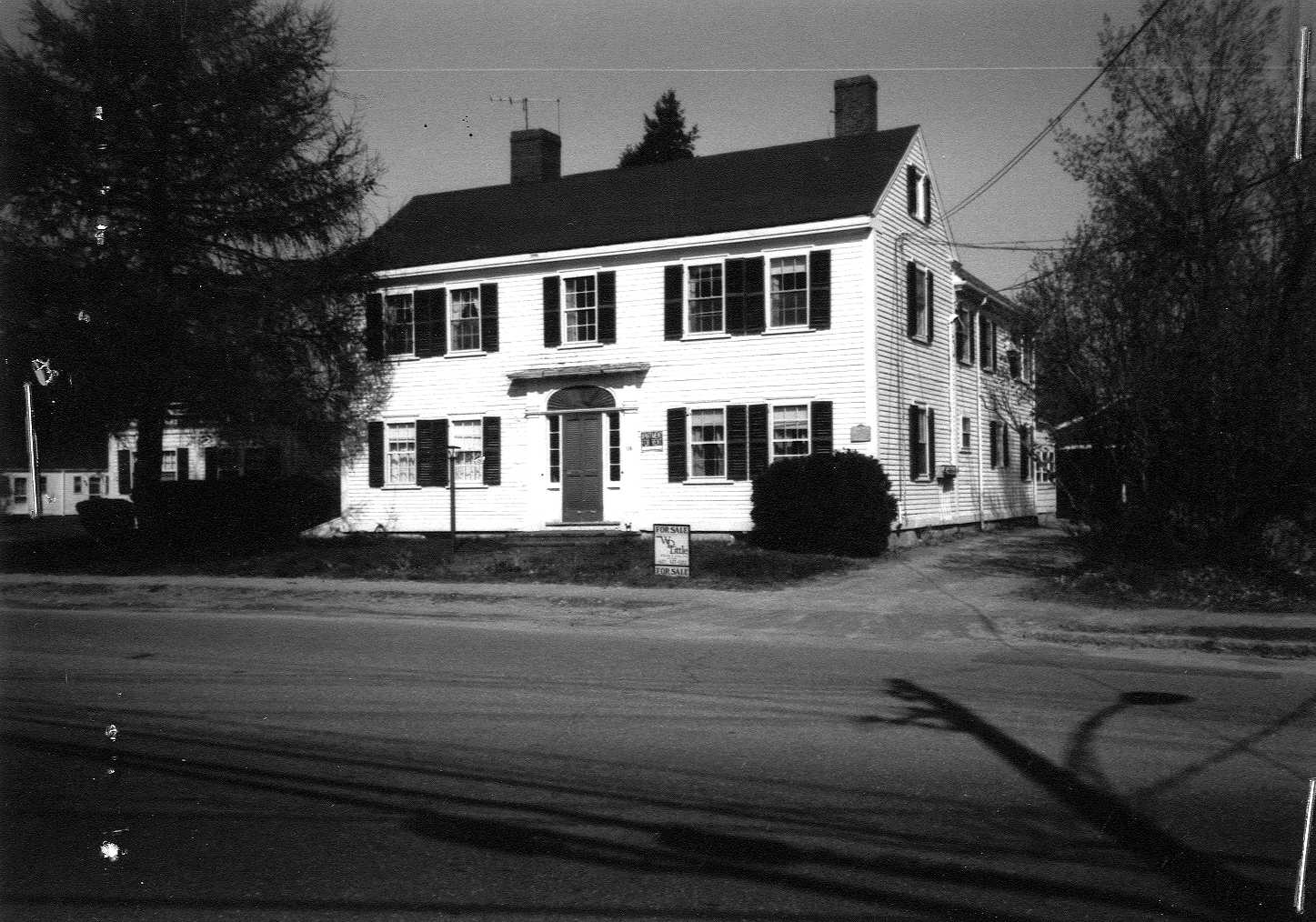
ROW.28 Smith, James – Billings House, 136 Main St., c 1790. Built in 1790 on the original lot registered to Sebastian Brigham, l643. Later operated as a tearoom for the benefit of the Rowley Historical Society, it was known as the Rowley Tea House.

ROW.26 Lambert, Thomas House, 142 Main St., c 1699: The Lambert house was built by Thomas Lambert, Jr., who took his bride there in 1699. The house remained in the hands of the Lambert family until 1977. The decoration and oak wood of the frame are representative of First Period frames at the turn of the 18th century. There is no way to be certain of the construction date of the left-hand rooms and chimney bay, without examining the frame in those areas, but the fact that joist spacing in the left-hand room is a conservative 17 1/2 inches on centers as opposed to 19 1/2 inches on centers in the right-hand room suggests a contemporary, if not earlier frame. The presence of a cellar under just the left-hand room might also suggest that the side of the house was the original single-cell structure.
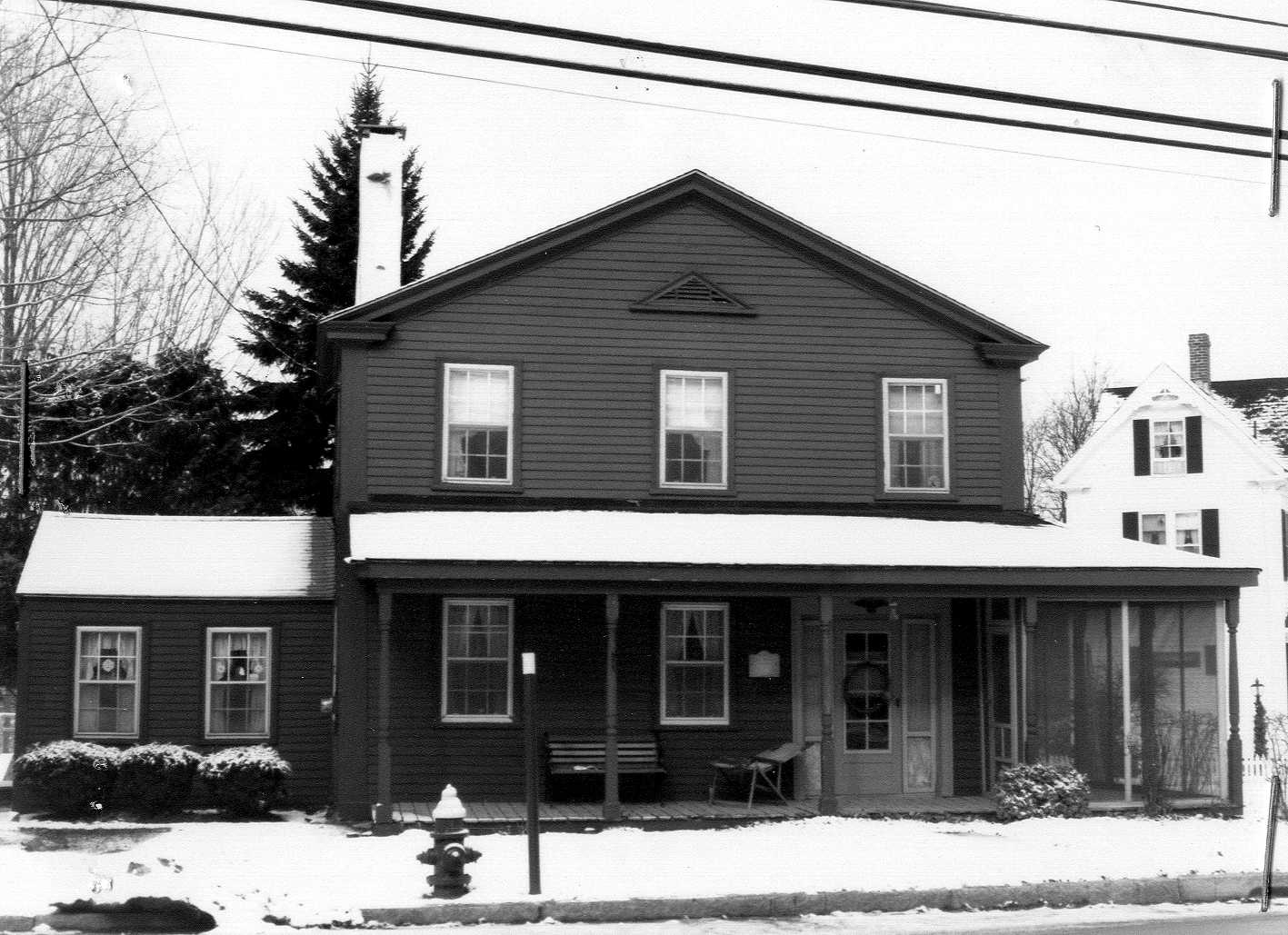
ROW.23 Bailey, John – Proctor, Dr. Charles House 156 Main St., 1763: The John Bailey House was sold in 1839 to Moses T. Whittier, carriage builder.

168 Main St., Rowley, MA., 1785. The Rowley Assessors database gives a date of 1785 for this house, but it has not been confirmed: The 1872 Rowley map shows the owners as “Miss S. Payson” and “M.P. Payson.” The 1884 map shows the owner of the property, extending to the intersection with Central St., as “Sarah Payson.” She is likely related by birth to Rev. Edward Payson (1657 – 1732), who also had a daughter named Sarah.
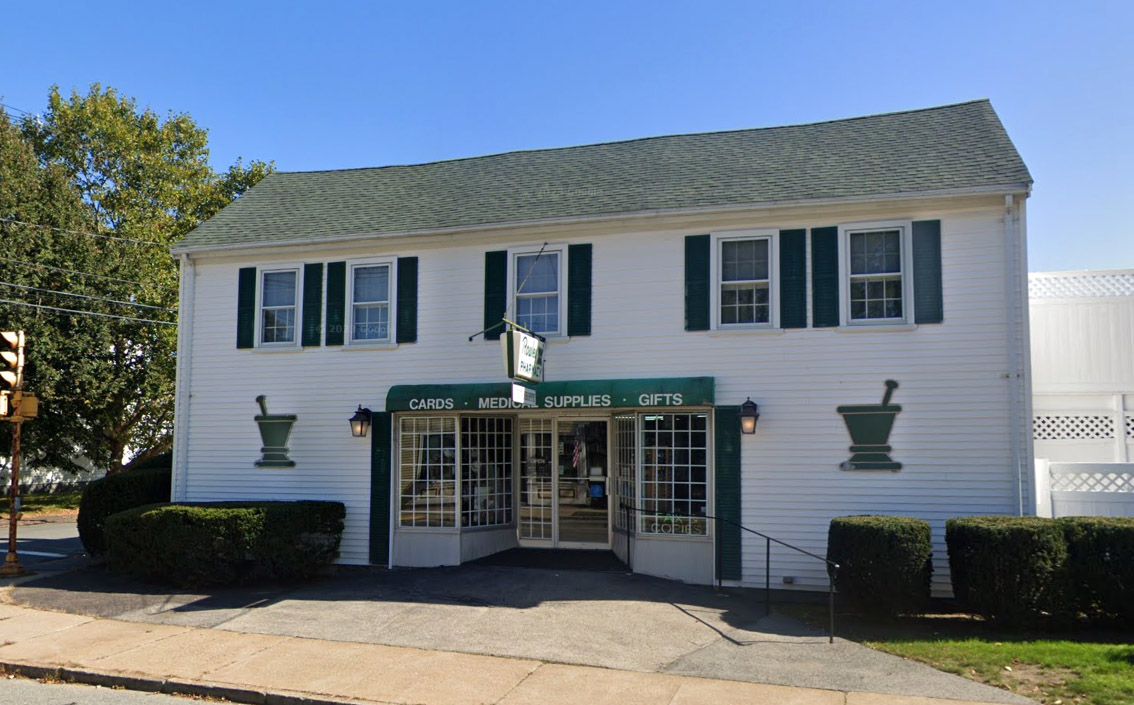
ROW.21 Northend, Ezekiel House, 169 Main St., 1721: Joseph N. Dummer wrote the following in Land and Houses of Rowley / Joseph N. Dummer: “The house lot at the corner was a part of the land granted to Thomas Nelson. His son Thomas Nelson in 1700 sold six acres to Gershom Nelson (24-151), who in 1732 sold it to John Pickard (49-120). His son Ephriam Pickard sold it in 1799 to Benjamin Todd (148-95). Abigail, the widow of Benjamin Todd, sold 1/3 acre to Louise H. Dole (339-101). He bought the Dr. Northend Cogswell house of Captain Jamin and moved it to this corner.”
Joseph N. Dummer wrote that the Northend house was removed from its original lot at 202 Main St. in 1839, and the Jamins built the present house: “Abigail, widow of Benjamin Todd, sold 1/3 acre (at the corner of Main and Hammond Streets) to Lewis H. Dole” (Salem Deeds book 339 page 101). The deed states a sale of 1/3 acre to Mark R. Jewett, but in 1844 Jewett transferred the property to Dole, and in the same year Dole transferred it to Jewett’s wife, Mary. Mark R. Jewett is shown as the owner of that corner lot in subsequent maps. (Salem Deeds book 341, page 47, and Salem Deeds book 409 page 202)
In 1843, they sold a house lot down the lane to Samuel Durgin (403-113) and in 1849, two lots to Mark R. Jewett (341-47) (*shown on the 1872 map). One of these lots, sold to Mr. Jewett, included the land on the western side of the lane to Mr. Durgins (403-113), and in 1849, two lots to Mark R. Jewett (341-47). One of these lots, sold to Mr. Jewett, included the land on the western side of the lane to Mr. Durgins, and the other from Mr. Durgins to the land of John F. Todd. Abigail Todd in 1855 sold nine rods of land adjoining the corner lot to Mark R. Jewett (565-101). In 1881, there was a division of the Jewett property. The corner lot went to Gorham P. Jewett, and the lot beyond Mr. Durgin’s went to Mary E. Putney, sister of Mark R. Jewett (1074-74). In 1883, Gorham P. Jewett sold the house and lot to Charles R. Dole (1120-206). His son Charles L. Dole sold it to Edward A. Cullum (1604-42), and he in 1900 sold it to David E. Kent (2037-347). The heirs of Mr. Smith sold it in 1910 to Phineas A. Dodge (2519-67), whose heirs in 1923 sold it to Frank L. Burke (2367-67).
The Ezekiel Northend House, built about 1721, formerly stood on the present site of the St. Mary’s Rectory. It was moved by Louis Dole in 1838 to the present site in the downtown area, the corner of Main and Hammond Streets. It most recently housed the Rowley Pharmacy, downstairs.
Research notes:
- The Deed 339-101 is a sale of 1/3 acre to Mark R. Jewett, not to Louis H. Dole as Dummer wrote. Perhaps Dole was the contractor?
- Abigail, widow of Benjamin Todd at 169 Main St., sold “so much of the real estate of the said Benjamin Todd as should amount to $1600 for the payment of his just debts” to Lewis Dole (Salem Deeds book 298, page 166). No house is mentioned in the deed.
- The MACRIS site identifies 169 Main St. (Rowley Pharmacy) as the house that was moved from this location.
- The 1830 map shows a house near the corner, the 169 Main location, owned by Mrs. A. Todd, and an adjoining house owned by J. Todd Jr.
- The 1856 and 1872 maps show a building on the corner of Main and Hammond Streets owned by Mark R. Jewett.
- Abigail, widow of Benjamin Todd at 169 Main St., sold “so much of the real estate of the said Benjamin Todd as should amount to $1600 for the payment of his just debts” to Lewis Dole (Salem Deeds book 298, page 166). No house is mentioned in the deed.
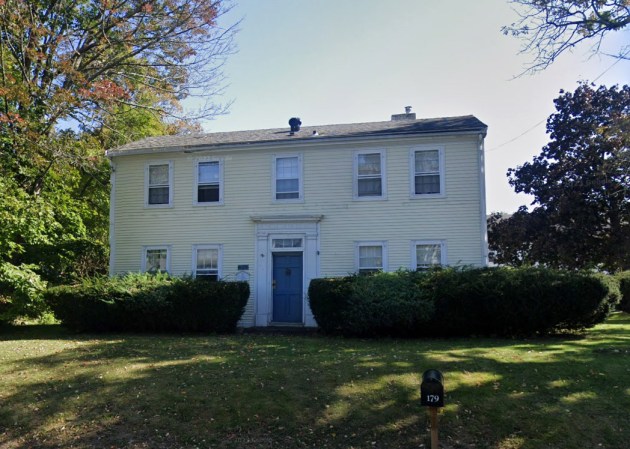
ROW.19 Tullar, Rev. David House 179 Main St., c 1803: Originally built for the seventh pastor of the First Parish in Rowley, this dwelling now serves the present minister and his family, the Rev. Paul Millin. In 1862, it was sold by the Rev. Holbrook’s heirs to Edward Richardson and was sold many times again to different families, including Adams, Grover, Hackel, and lastly to Kenneth Spurling, who sold it to the church for a parsonage again.
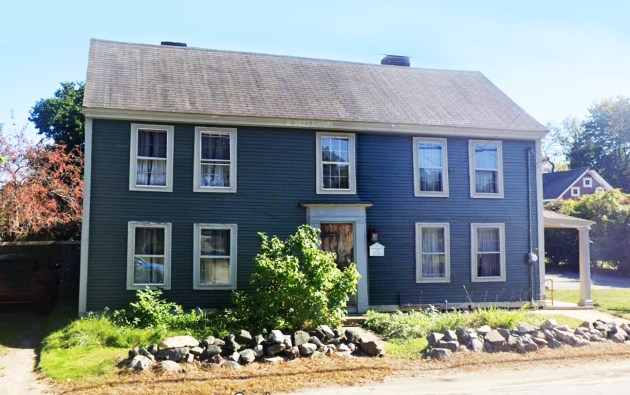
ROW.51 Wicom, Daniel – Todd House 215 Main St., r 1750:
View an updated history of this house. This 18th-century, two-story house, with a lean-to and a side porch, is one of the few of its kind in the town. The fact that the house was originally two separate houses on different streets in town, moved to this location at the same time, and incorporated into one house with such pleasing style, demonstrates the capabilities and engineering knowledge available among the settlers at that period in history. Several persons connected with the military lived at one time in this house, or in one half of it. Another was a blacksmith. All played equally important parts in the development of the community in their individual ways. Dan Wicom was listed as a carpenter. He was a direct descendant of Richard Wicom, one of the First Settlers. One half of this house was moved from the original lot on Summer. The other half of the house was moved from Pleasant Street and was called the Todd House. A part of the old meeting house was used in building the barn, which has since been taken down.
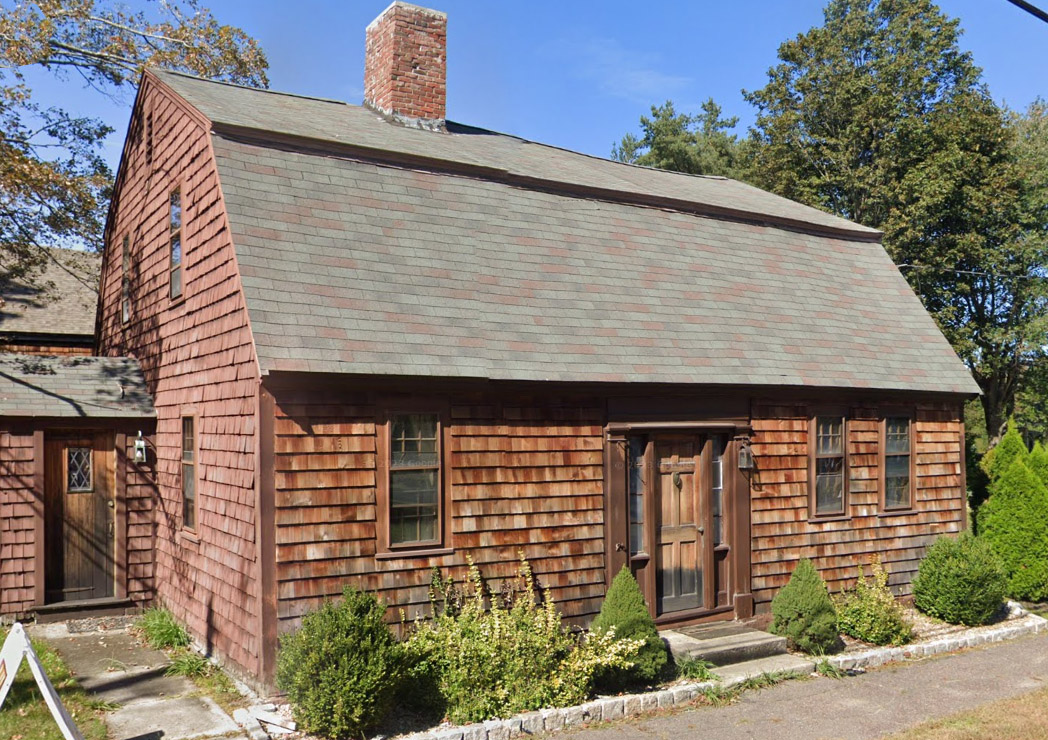
ROW.50 Saunders House, 238 Main St., 1750: Although known as the “Saunders House,” it was built long before it came into possession of that family of shipwrights. The house could have been built as early as the first half of the 18th century, as stated by Jewett in his history of Rowley. Only one other house of this gambrel type still stands in the town. It is the Ewell house near Great Swamp Brook.

ROW.55 Todd – Ellsworth – Hale House, 234 Main St., c 1750: This is one of the 3 original land grants to the Harris brothers. This house is a typical half-house with an ell and porch on one side.

ROW.53 Armitage Tavern – Saunders, Edward House, 316 Main St., c 1724: Edward Saunders was on the next lot before 1717. He is said to have built this house before 1724, although he was listed as a “shipwright.” Structurally, the house as it appears today was constructed or greatly modified in the latter half of the 18th Century, with double chimneys, frieze board, and much greater depth than a late First Period house.

The Saunders were shipbuilders for several generations, building schooners, both near their houses and at the ship yard near the Warehouse Landing. Edward Saunders came from Scituate to Rowley, married a Rowley woman, and reared six stout sons, most of whom worked with their father in his shipyard. The business at the water-side declined, but the Rowley carpenters or ship-builders adopted a very novel method. They built in their door-yards or neighboring fields fishing craft, from thirty to fifty tons burden, which were drawn by oxen down to the launching place.

ROW.95 Dodge, Phineas House and Farm, 16 Mill Rd., c 1772. The house at 14 Mill Road was originally owned by Thomas Dickinson, who sold it to Phineas Dodge in 1772. While the house does not appear on the 1794 Chaplin map of Rowley, the mills are depicted, and it is possible the house was overlooked by the cartographer. The 1830 and 1856 maps indicate that Solomon Dodge was in residence. By 1872, Moses Dodge was the owner, and in 1884, the owner was I. S. Dodge. By 1888, the occupant according to the resident directory was the farmer Hanison Nelson, who may have been an heir or tenant of the Dodge family. The Dodges assumed proprietorship again since Phineas A. Dodge advertised the sale of lumber, shingles, and sawdust in the 1907 resident directory. Dummer states in his 1939 work that the property was still owned by the Dodge heirs. Directories indicate the 16 Mill Road house was occupied but not owned by the farmer Frank G. Ramsdell and his family from approximately 1925 until 1944. The Herrick family are descendant of the Dodges and acquired the property in the 1950s.
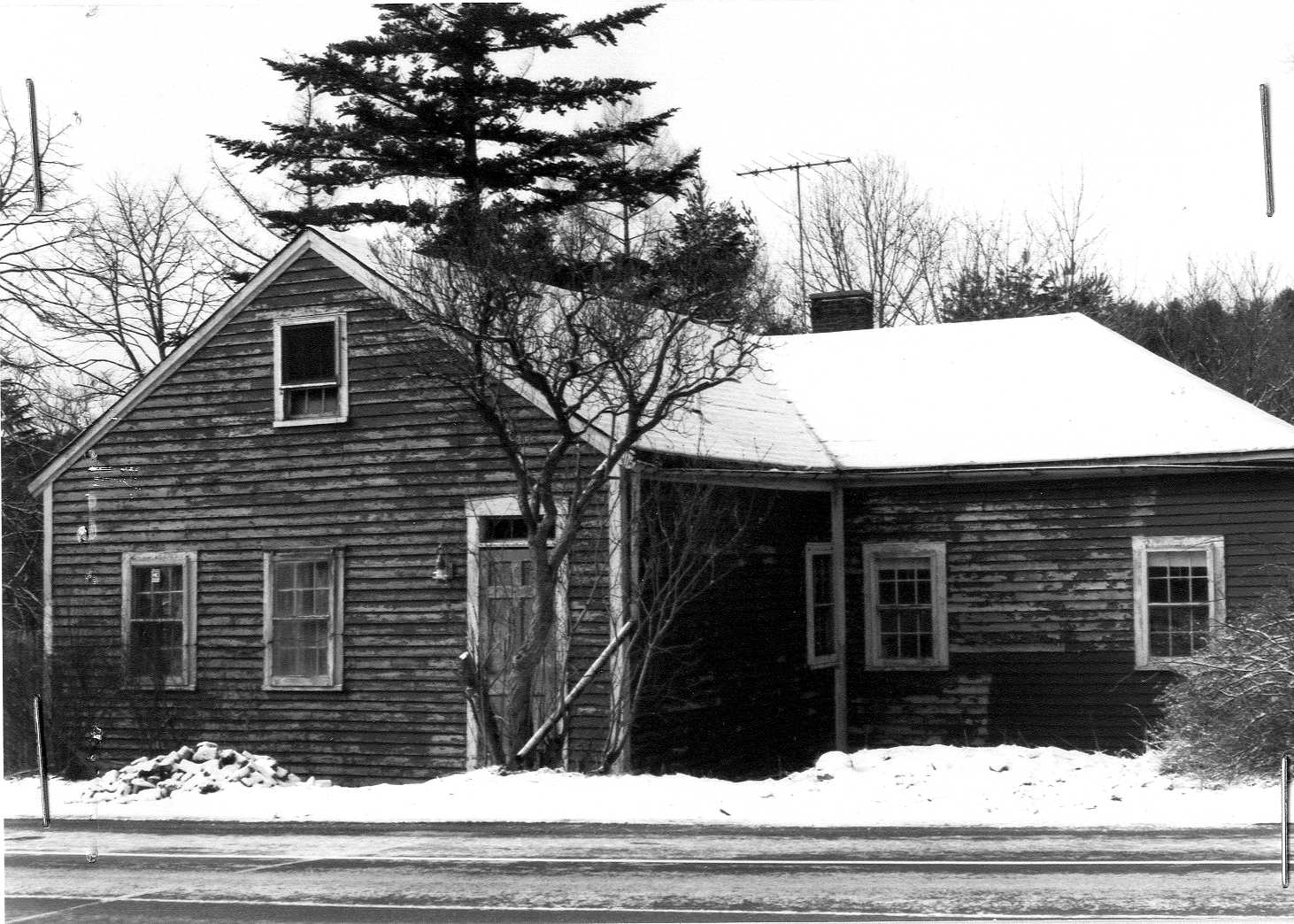
ROW.40 Glen Mills Cereal Company Boarding House, 676 Newburyport Tpk., c. 1790: “The Boarding Rouse,” as it was called in the days of the Glen Mills Cereal Company, was built about 1790. It was used as a boarding house for the men who worked at the mill. In 1872, the Glen Mills Subscribers Business Directory lists N. N. Dummer as the owner of the house, and a “Manufacturer and Dealer in Flour, Meal, Feed, Grain and Lumber.” The house is situated on the corner of the mill property, off Glen St., and the corner of the Turnpike. This house is part of the complex, which includes the Jewel Mill, which was built on the original foundation of the First Fulling Mill in America, 1643.
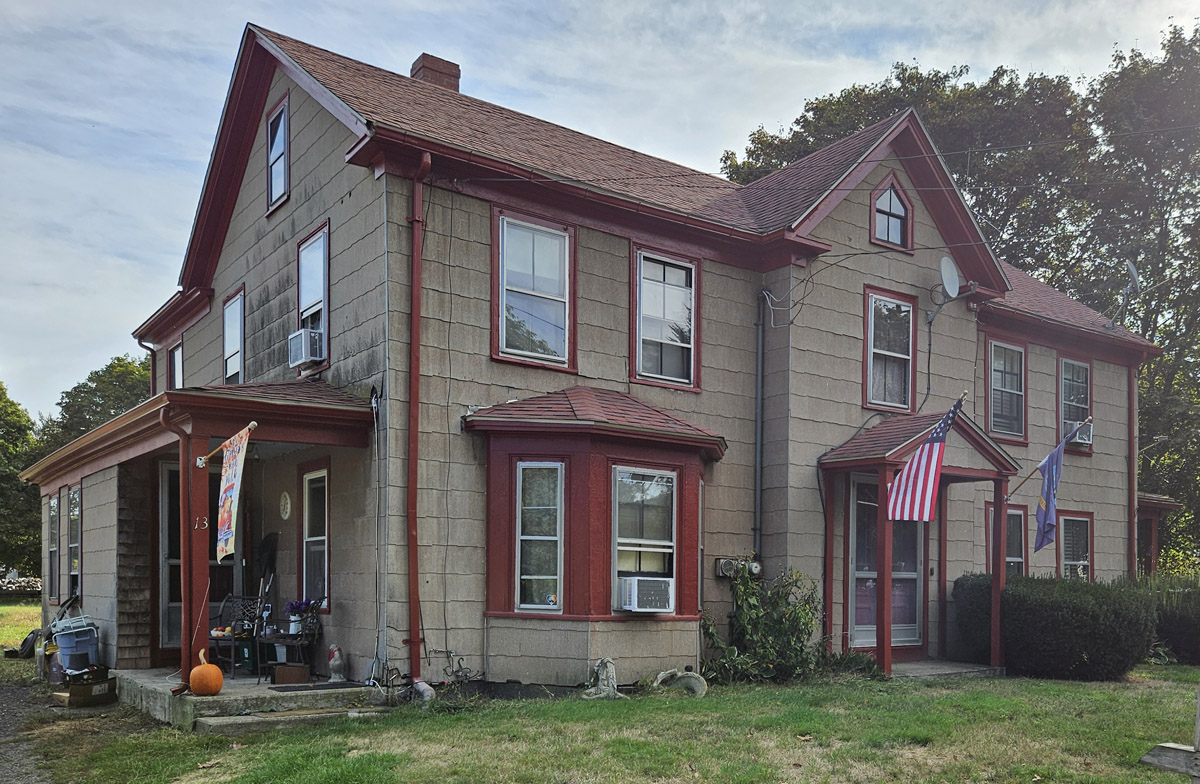
ROW.44 Lancaster, Samuel House 13 Pleasant St., c 1787. An earlier house on this site was once owned by Lieut Abel Platts, who died in 1690 on the Expedition to Quebec. Hannah Platts married Samuel Lancaster in 1701, who drowned in the Rowley River in 1710. Nathan Todd, in 1787, sold land to Samuel Lancaster. The house was probably built about that time. Dummer wrote in his “Land & Houses of Rowley” that Oliver A. Rundlett and his son James P. both lived in the house. Oliver purchased half of the homestead in 1875 from Asa Todd. Later, Mrs. Merrill, in 1880, sold her half to Mr. Rundlett. Members of the Rundlett family were noted carpenters in town and built many houses throughout the area. Heirs of James P. Rundlett sold the house to Arminta Daniels in 1938.

ROW.43 Todd, Nelson House, 23 Pleasant St., 1775: This house, built during the Revolution by Nelson Todd, later called the Doc. B. Proctor House, and more recently called the Pickard House, was called by many at the time it was built, as “Todd’s Folly.” It was built on the lot granted to Richard Holmes, “millwright,” who was responsible for building the Old Stone Arch Bridge at Glen Mills, and many dams about town. This house, with its large square rooms and a chimney centered in each half, was built during the period of foreign trade during the Revolution and is similar to the Federal sea captain’s houses built about the same time in Newburyport and Salem. Schooners sailing along the Plum Island coast could be seen from the skylight on the roof during the sailing days, from the third floor. The house originally contained 13 fireplaces. A cream room and a large barn have since been razed. This was the home of two prominent physicians, Dr. Benjamin Proctor and his son, Dr. Charles Proctor. Also, the home of John Proctor, a member of the legislature in 1864 and 1868, and a trustee of Dummer Academy, 1851-1858.


ROW.46 Langley – Jewett – Hale – Cressey House 39 Pleasant St., 1732: This house sits on the two-acre house lot, which was granted to Robert Hunter, a first settler, who died in 1647. His will mentions his wife, Mary, to have lifetime use of the house and lands; the remainder went to Abel Langley, “if he shall settle here & carry well towards his Dame”. Otherwise, the remainder of the house was to be for the use of the poor of Rowley. In 1732, Mark Quilter and other heirs of Abel Langley transferred the entire estate of Abel Langley to Joseph Jewett.
Nathaniel Cressey (1800-1875) and his wife, Sarah Jewett Cresey, the daughter of Pemberton Hale, inherited the house in the early 19th century, and it stayed in the Cressey family until 1947. Read the entire research on this house.
Architecture of the House
The Rowley assessors’ page provides a date of 1732 for the construction of this house, which is compatible with physical observations. The house at 39 Pleasant St. is a two-over-two “half house” constructed in the early Georgian era, and features 1″ Georgian / Federal doors throughout the house. The front entry is typical of early half houses with a landing and a winder stairway. The front, original part of the house is three bays on the front side (one door and two windows) and a single bay (one window for a single room) on the side. The house is slightly deeper than First Period houses. At one time, it had a central chimney stack, which was later removed, and a smaller brick flue was installed as the chimney for the boiler in the basement. The back walls of the rooms on either side of the house have decorative fireplace mantels attached to plaster walls, with no indication of a previous fireplace.
An ell on the rear of the house appears to have been added not long after the construction of the front of the house. On the wall facing the rear of the former central chimney is a very wide mantel, which again is attached to a plaster wall, which may indicate the early existence of a large cooking fireplace before the chimney was removed. These three phantom mantels are quite an enigma.
Later Ownership
In the 1884 map, the house was owned by George Cresssey. In 1947, the estate of Bertha L. Holbrook (nee Cressey) sold the “Old Place” to Joseph and Lucy Dubuque. (Deed 3560:560)
Further Source: Dummer’s “Land & Houses of Rowley”, (unpublished) 1640-1936, available in the Rowley Library archives room
The present owner provided the following deeds, but their relevance is unclear.
- Deed 53:149, Samuel Prime to Thomas Wood (1699/1728), three acres of land
- Deed 41:224, Thomas Wood to Samuel Johnson, upland and meadow
- Deed 127:186 Daniel Johnson to Thomas Lancaster, ten acres of upland and meadow
- Deed 154:224 Nathan Lambert to Thomas Gage (1784), four acres of land

ROW.47 Prime, Joshua House., 48 Pleasant St., 1753: Built on a lot granted to Mark Prime in 1645.
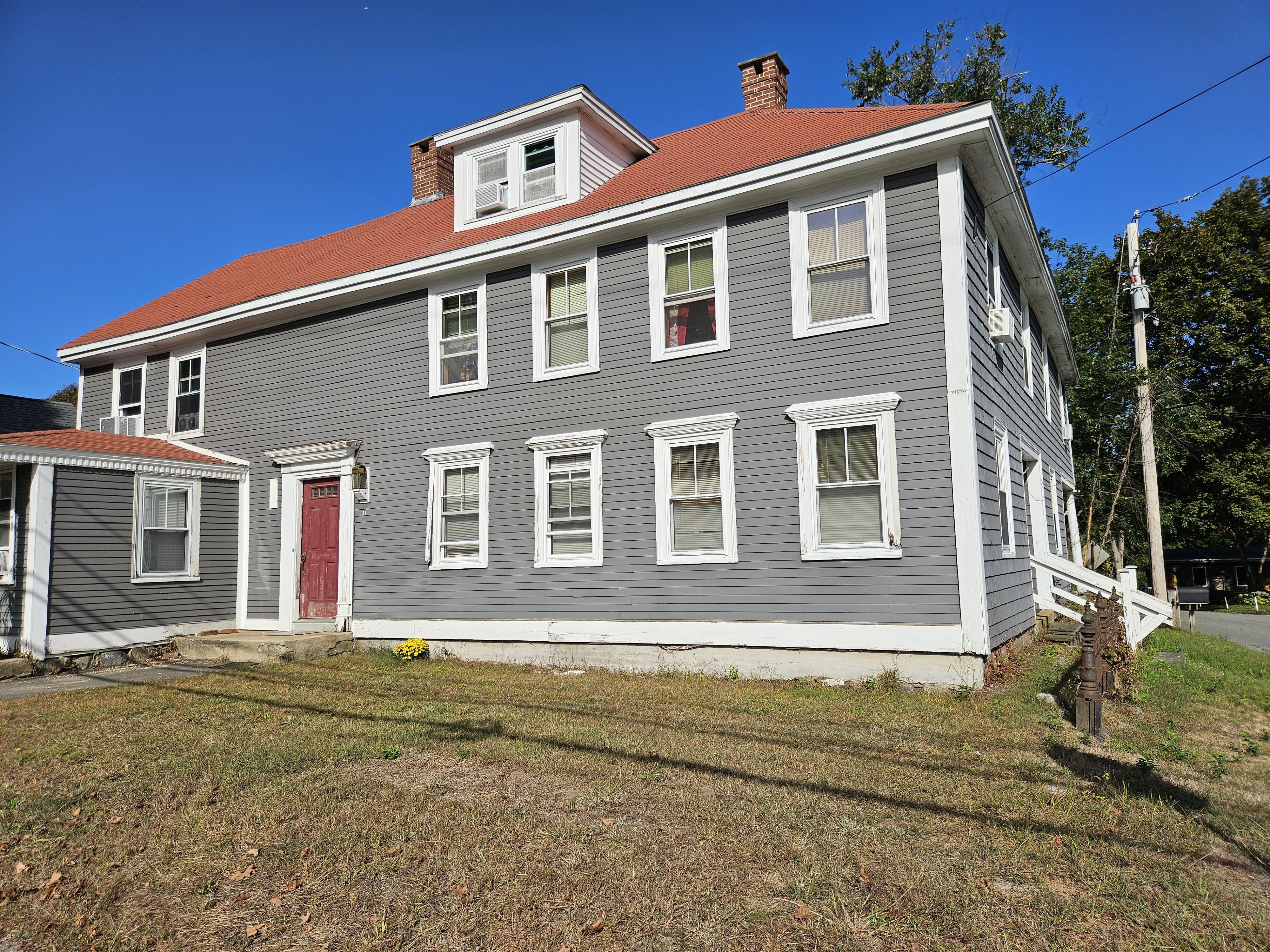
ROW.5 Hale, Dr. William House, Summer St., c 1780: This house was built upon the corner lot granted to the first settler, Edmund Bridges, blacksmith. It has also been the home of Dr. William Hale, a physician and teacher during the Revolutionary years. Dr. Hale was responsible for caring for the smallpox victims who stayed at the pest house, which was built in the Metcalf Rock Burial Ground, near the site of the pest house. The doctor made daily visits to the pest house on horseback, as this dread disease had reached epidemic proportions, and people were fleeing from Boston to escape it. All people and their baggage had to be smoked upon entering the town on the stagecoach, at the smokehouse nearby. Many died, and their graves are marked with a granite stone erected at the Metcalf Burial Ground by the Rowley Historical Society in 1945.
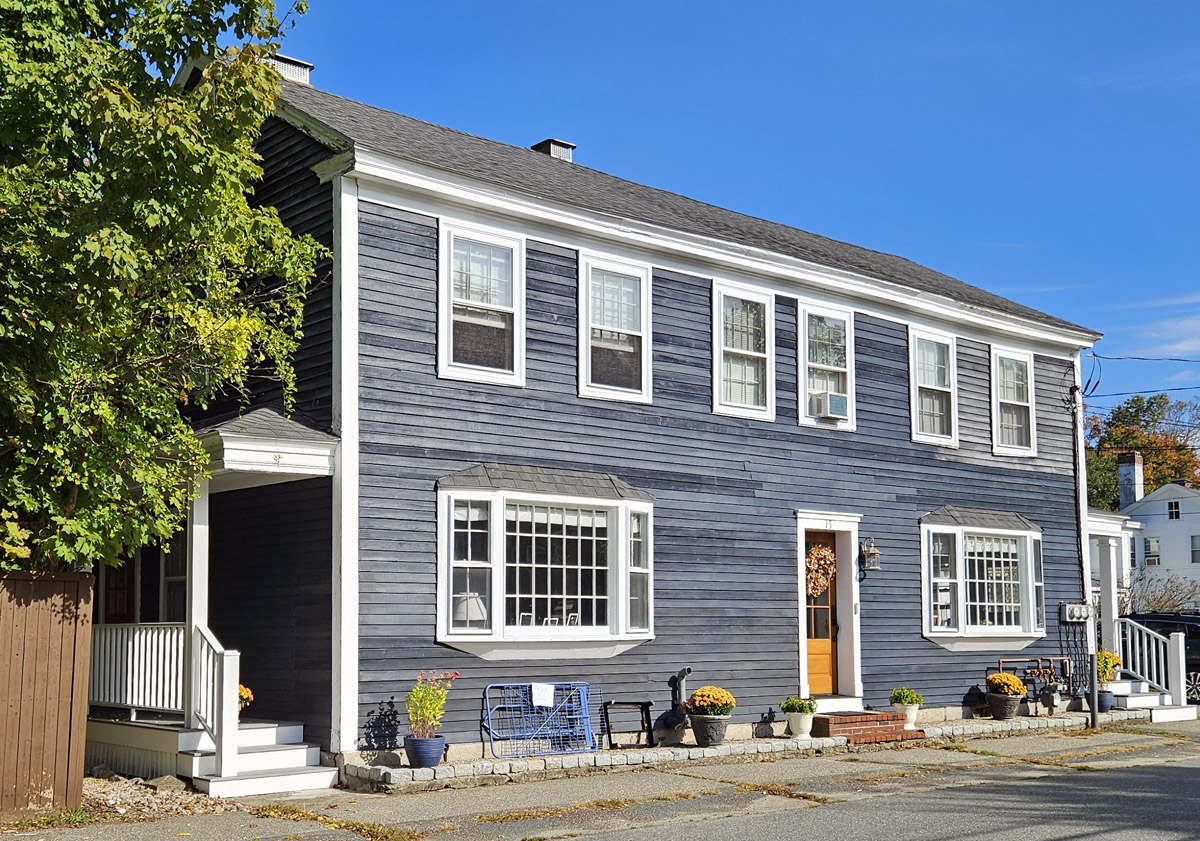
ROW.2 Cressey House, 15 Summer St., c 1750: Dummer describes the moving of this house in his “Land and Houses of Rowley.” On page 121, he wrote: “William Hobson in 1810 sold a strip of land to William Boynton. The house was moved here with the intention of placing it back from the street, but it got stuck in the mud and was left just where it landed. Mr. Boynton sold one acre of buildings to William and Charles Boynton, cabinet makers (361-242). Some of their handicraft may be found in Rowley houses.” The barn on the property was made into a dwelling by Frank L. Burke in 1918 and is situated next door.
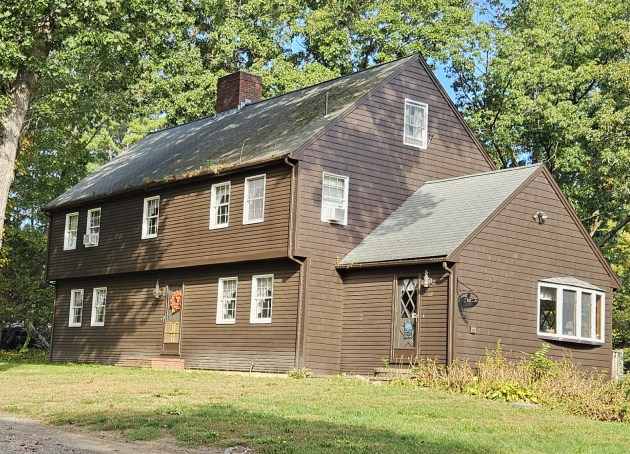
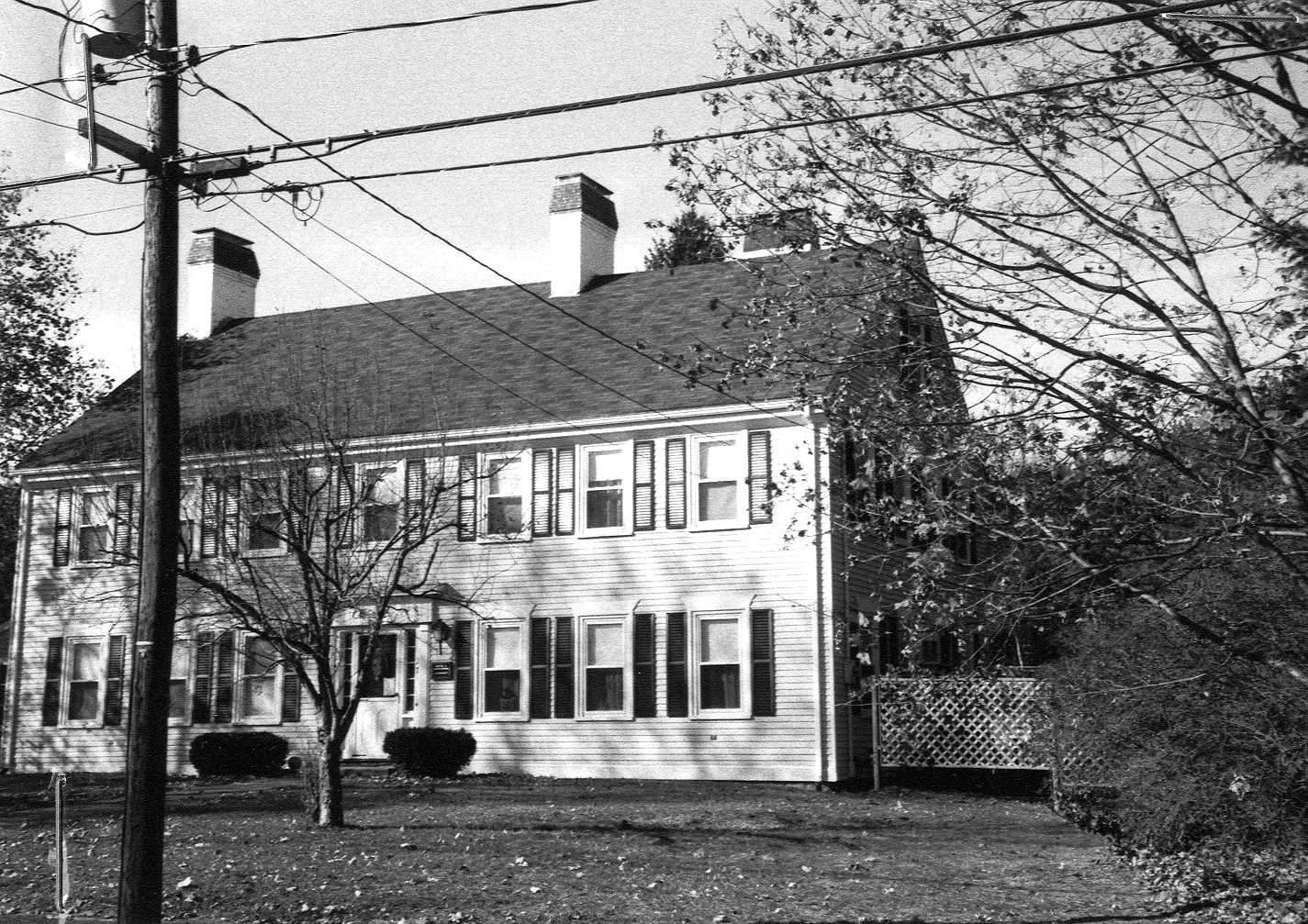
ROW.164 Hobson, Humphrey House – Fairview Hotel, 27 Wethersfield St., 1787: 27 Wethersfield Street was built on land owned in 1643 by one of Rowley’s original settlers, Humphrey Reyner. The house was constructed in 1787 for Revolutionary War veteran Humphrey Hobson, and appears on the 1794 Chaplin map of Rowley. Mr. Hobson sold land behind the house to the town in 1794 for the site of the round brick powder house, built in that year. By 1822, it was owned by Richard and Elizabeth Kimball, whose ownership is reflected on the 1830 Philander Anderson map of Rowley. Richard Kimball was listed as a school teacher and a 1810 graduate of Dartmouth College in Gage. Jewett states that he taught school in the house from 1822 until his death in 1842. The property changed hands again in 1858, 1869, and in 1888, when a bootmaker named John Hazen was in residence. By 1890, Annie Mitchell had bought the house and opened a hotel called the Fairview in the building and two others, since removed from the lot. In 1913, it was bought by Pauline Shaw Fenno, a summer resident from Boston and a local philanthropist, who used the house as a kindergarten and a site to make supplies for the World War I effort. By 1925, it was a rest home for nurses, still called the Fairview which continued through 1944, afterward stood vacant and was restored to use as a residence by 1954 by Joseph Fitzpatrick, a construction company owner.
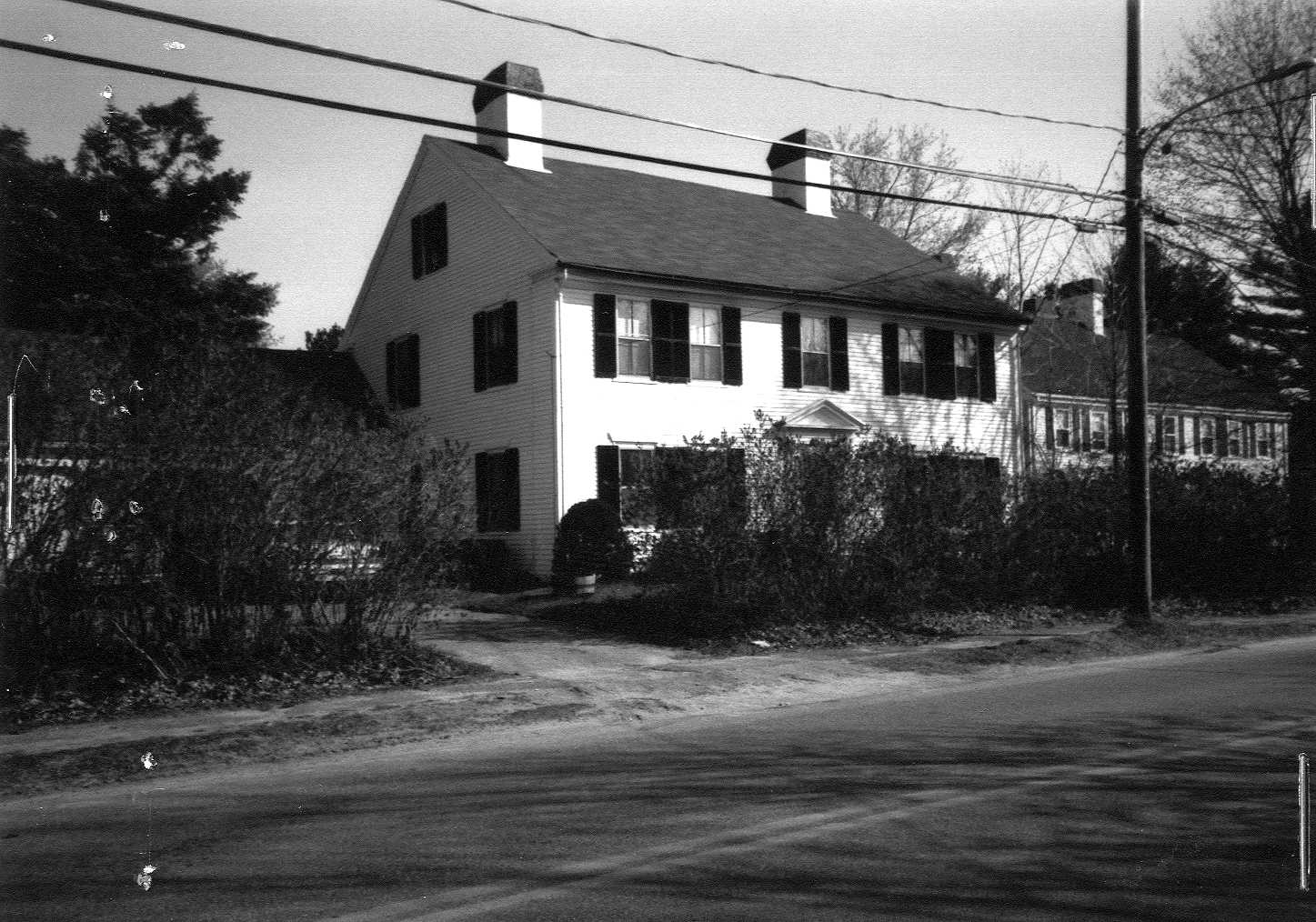
ROW.15 Hobson, Humphrey House, 31 Wethersfield St., c 1742: The Hobson House is a typical mid-Georgian “double-house” built before 1742 by Humphrey Hobson, deacon, town clerk, and member of the General Court. This house was built upon the original grant of Elder Humphrey Reyner, registered in 1643, and adjoined the Rev. Ezekiel Rogers’ grant on the northern side of Wethersfield Street. Improvements were made to the original house in 1787 by Humphrey Hobson, son of Humphrey and Priscilla Hobson. This fine, two-story, wood-frame dwelling has two chimneys and a central entrance of pleasing design. Added in recent years are a breezeway and a connecting garage, which blend in nicely with the early architecture. The Rev. Tucker, Rowley’s 7th minister, lived in this house in 1812. Richard Kimball, early schoolmaster, also lived here in 1821. In 1798, Humphrey Hobson sold a small parcel of land on the hill behind the house for a powder house, “near unto the place of the watch house.” In later years, this house was part of the “Fairview,” one of a complex of three houses, which operated as a hotel, boarding house, and later as a place of rest for nurses. Annie L. Mitchell, operator of the “Fairview,” sold it to Pauline S. Fenno, who used it during World War I as a community center for making supplies for the French wounded.
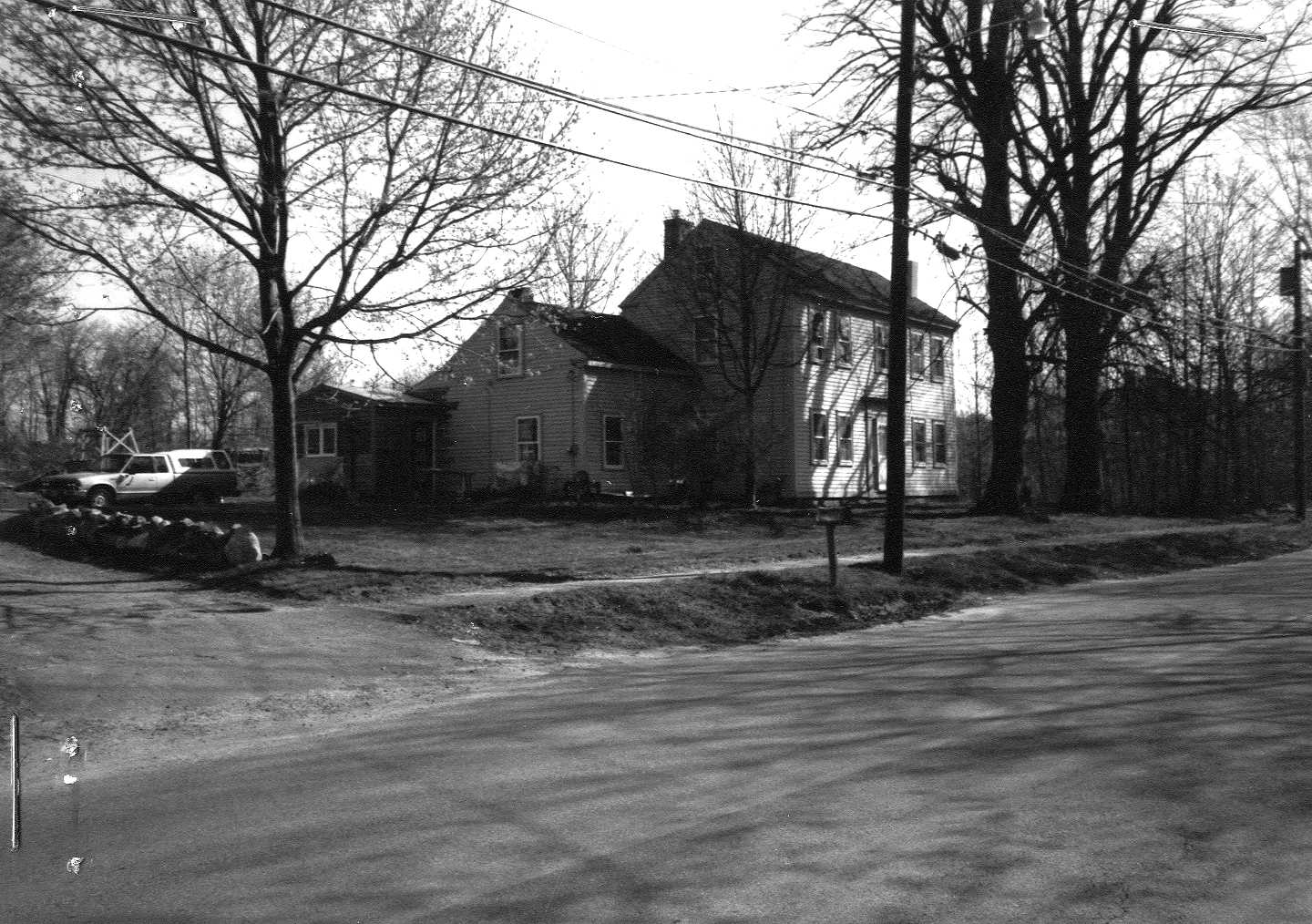
ROW.13 Bailey House, 71 Wethersfield St., 1794. This house is believed to have been built upon part of the original house lot of settler Mighill. The land was sold to Bailey about 1718.

ROW.155 White, John – Saunders, Amos N. House, 137 Wethersfield St., 1750: The house at 137 Wethersfield Street may have been built for John White before the publication of the 1794 Chaplin map of Rowley. Mr. White was a founding member of the Baptist Society in Rowley in 1830 and is reflected as the occupant on the 1830 map of Rowley. Dummer notes that Mr. White sold the house to Richard Cressey in 1847. Mr. Cressey had died by 1867, and his heirs sold the house at that time to Hiram Harriman and Oliver A. Blackington, who was on the building committee for the Baptist church in 1830. By 1888, the occupants were farmers J. Q. A. Carter and Amos N. Saunders, and a blacksmith named James E. Saunders, according to the resident directory of that year. James Saunders is listed as a carpenter in the 1925 directory. His widow, Amy, remained through 1944, with Melvin, her son, boarding at the house and working as a market gardener. Melvin Saunders remained in residence through the 1950s. The house was renovated in the 1990s.

ROW.162 Duty, Moses House, 243 Wethersfield St., 1765: The house at 243 Wethersfield Street was built by 1765 for Moses Duty, whose son, William, was the first child to be baptized in the second Congregational meetinghouse, builtin 1749. Moses Duty sold the house in 1765 to Asa Todd, who sold it in 1840 to Moses and James Pickard, born 1793 and 1800 respectively, and shown on the 1856 Walling map. Moses is listed in the 1888 directory as a farmer and was living with Charles Pickard, a heel manufacturer. The subsequent owner, according to Dummer, was George W. Blatchford in 1895. The house was transferred many times until 1930. By then, the residents were Chester and Helen Anthony who farmed on the property. Mr. Anthony was also a fence viewer, and Mrs. Anthony was a nurse and a Fenno greenhouse employee. They lived in the house until 1979. The barn was moved to this lot from the Platts-Bradstreet House (Inv 41) on Main Street before 1918.
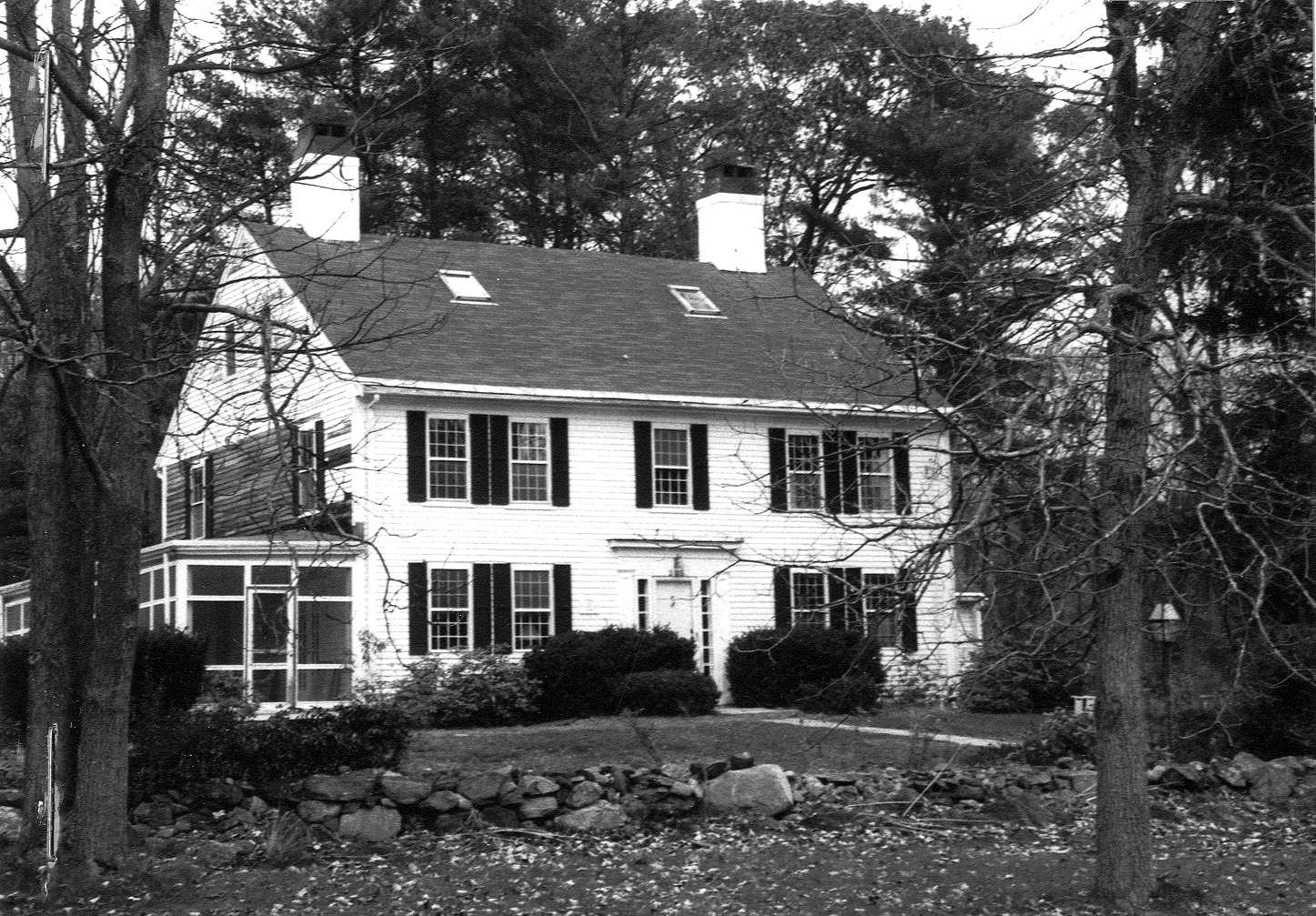
ROW.161 Palmer – Todd, Lt. James House, 283 Wethersfield St., r 1800. The Palmer-Todd House at 283 Wethersfield Street was constructed between 1795 and 1806 for Lieutenant James Todd, who died in 1886 with an estate worth over $4000, which is a higher than average amount of wealth. By 1856, according to historic maps, J. P. Todd was in residence from 1856 through 1884. By 1888, Leander Johnson is in residence and working as a heel cutter at Ellsworth’s Shoe Factory to the east on Wethersfield Street. Dummer says the house was sold to Joseph Dodge, who may have rented it to Johnson. Mr. Dodge sold to Charles and Sarah Allen of Essex Street in Salem, Massachusetts, who used the house in the summer. Mr. Allen worked in Boston at the State Street Trust Company. In 1930, Mrs. Allen sold to Frank S. and Lynn Haskel,l who occupied the house through the 1940s. Mr. Haskell was treasurer at the T. H. Haskell Lumber Company in Lynn. The Haskells sold to a military officer named Andrews, who remained into the 1960s.
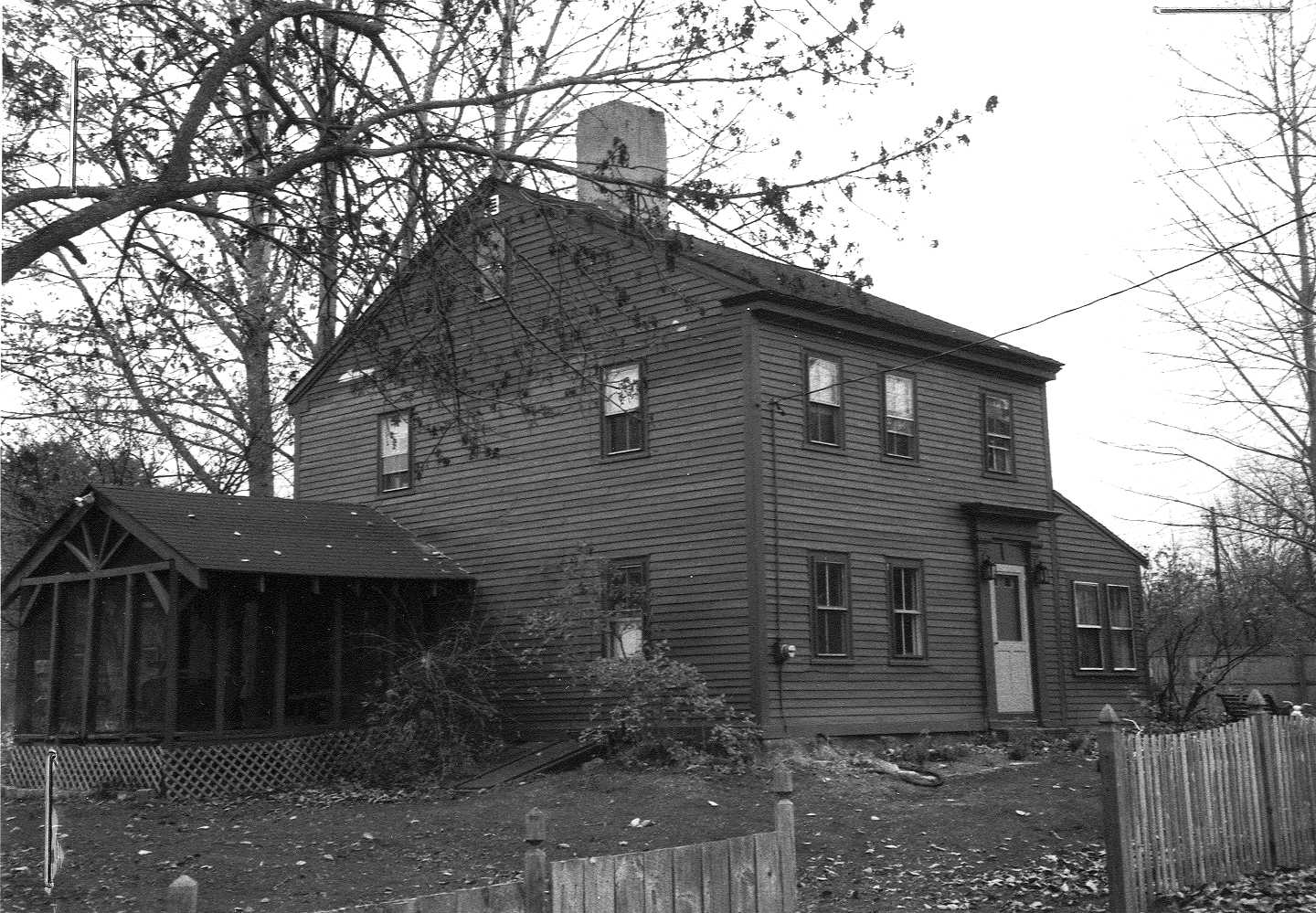
ROW.153 Dole, Joseph – Dodge House, 305 Wethersfield St., 1750: The first owner of the house at 305 Wethersfield Street may have been Joseph Dole around 1750, according to Dummer. The 1856 map is illegible on this topic, but Dodge family members are present in 1872 and in 1884. The 1888 directory indicates that the farmer Joseph Dole Dodge was in residence, and his descendants remained until at least 1939, according to Dummer.
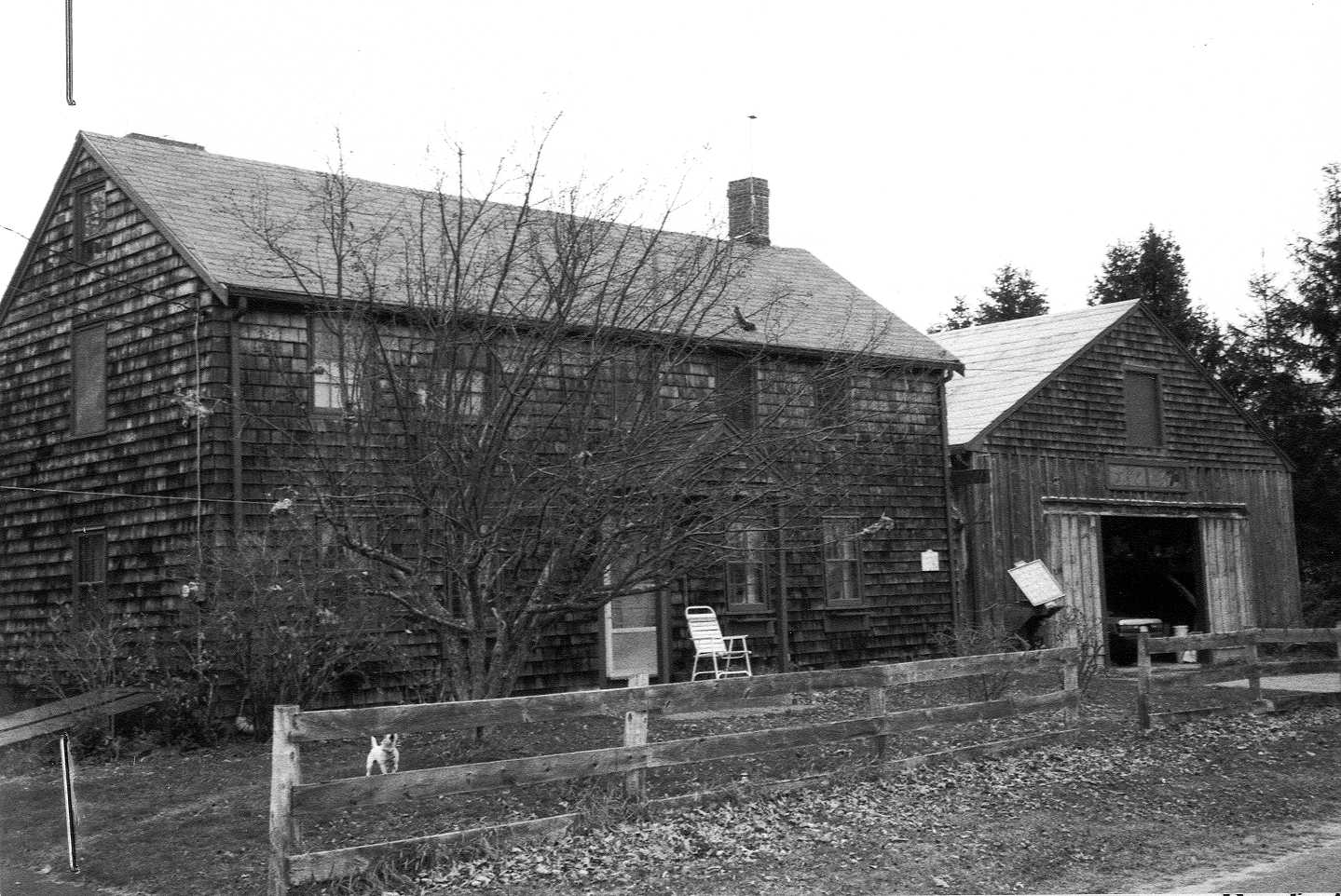
ROW.115 Gage – Dole, Stephen House, 517 Wethersfield St., 1750: The Dole House was built around 1750 by Stephen Dole and incorporated part of a building moved from across the road in 1780, according to Dummer. A house is present on the location on the 1794 Chaplin map of Rowley. By 1830, the occupant was E. Dole, and from 1856 until 1888, Amos W. Howe was the resident, according to maps and the directory printed in 1888. The resident directories say that Dole was here from approximately 1914-15 until 1933. In 1937, land around the house was used to grow fruit trees, hay, market garden crops, and for pasture. The 1944 directory shows Theodore P. Houle, a welder, and his wife, Floranna, as the occupants. Russell Copithorne, an engineer and library trustee, bought the house in 1959 and had the barn built in 1961 by Roland Dyment.
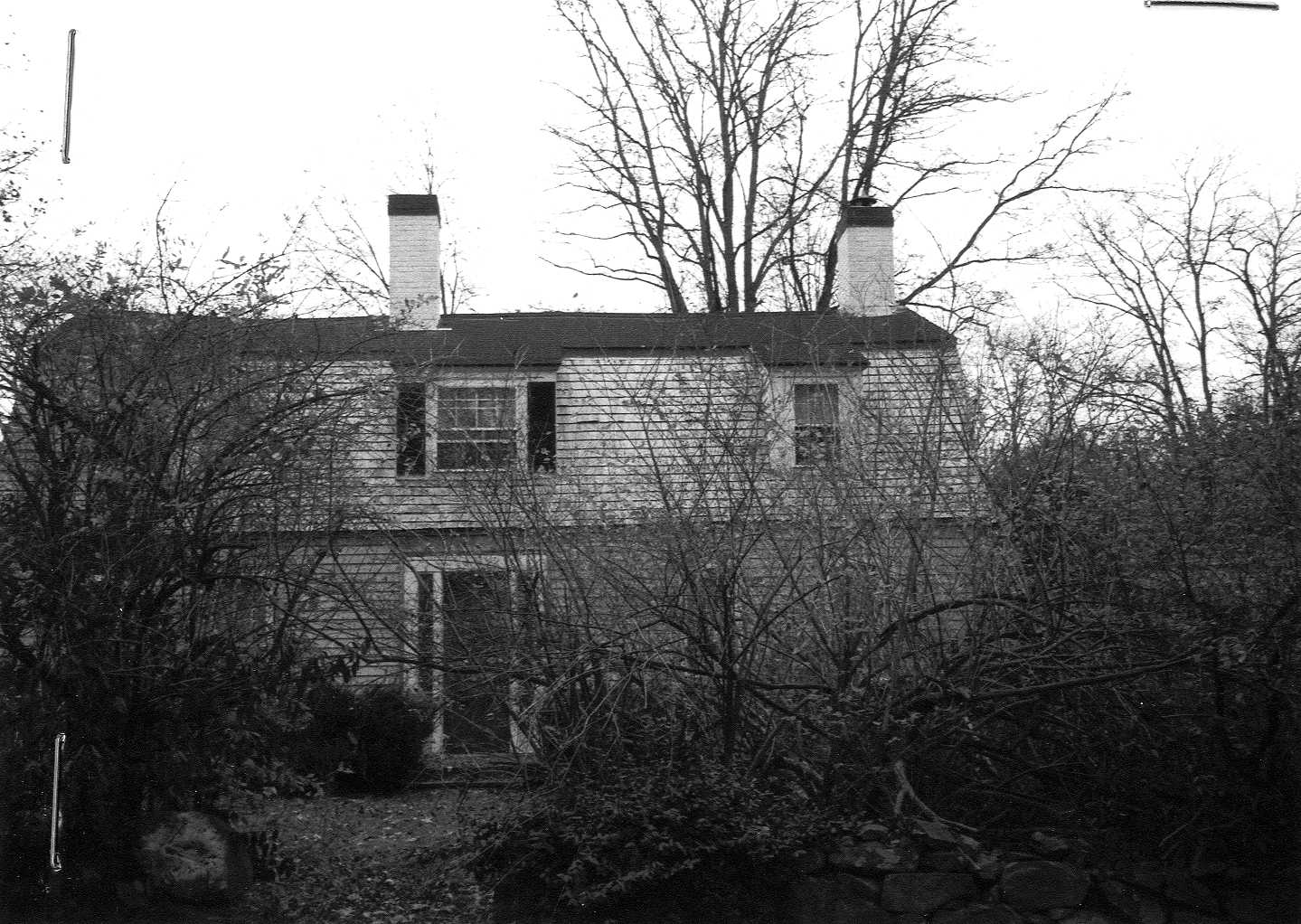
ROW.163 Ewell, Samuel House, 705 Wethersfield St., 1750: The present house at 705 Wethersfield Street was built between 1707 and 1723 by Andrew Stickney, according to Dummer. Andrew’s son, Amos, sold it to John Lull in 1723, and subsequent owners included Thomas Jewett, Henry Dole, Moses Dole, who hosted a town meeting in the house in 1780, and Sewall Dole, whose ownership is reflected on the 1830 Anderson map. Dummer states that the house was moved to this site in 1797 from Taylor’s Lane, which is approximately one and a half miles southwest of the current location. Samuel Ewell acquired it in 1840, and it remained in the family until at least 1944. S. Ewell appears as the owner on the 1856 Walling map and on the 1872 Beers map, which notes that a store is also on the property. The 1884 Walker map shows Mrs. Ewell as the resident. The 1888 directory indicates that the farmer Paul Floyd was the resident, and he may have rented the property from the Ewells since they appear to have retained ownership. In the 1925 resident directory, William S. Ewell was the owner but resided here only during the summer, which continued until 1944. Another inhabitant of the house was Reverend John L. Ewell, former dean of Howard University in Washington, DC. The Ewell’s permanent residence was in Auburn New York. The barn was adapted for use as a residence in the late 20th century and is currently occupied by descendants of the Ewells.

ROW.36: The Abraham Jewett House, circa 1660, on Rt. 1A just past the Ipswich town line dates back to 1660: Jewett’s History reads: “In 1660, Abraham Jewett purchased the lot on the corner of Main and Prospect Streets and built a small house that year. The building has undergone so many alterations that it is difficult to determine the original structure.” 17th-century construction is visible in the right front, which is the earliest section of the house. The building is now the Village Pancake House, on the left when entering Rowley from Ipswich.
 17th & 18th Century Houses of Essex County, Massachusetts


Oops! I see that I missed it – it is there! I had the spelling of Pickard wrong when I did a search.
LikeLike
I am a descendant of the Nelson family of Rowley MA. I love seeing all the pictures of the historic houses in Rowley and reading the stories. Very interesting!
Cheryl Nelson
Illinois
LikeLike
Do you have any information on a Nelson relative that lived at 91 Nelson street Georgetown around 1802?
LikeLike
The West Midlands in the U.K also has town of Rowley Regis which was a tiny village before the Norman Conquest…. The Regis proclaims that the land once belonged to the Kings of England. The Parish Church was recognised as a Royal Chapel by Henry VIII his cousin Isabella who owned land here took Mass here. Once upon a time all churches and chapels in the U.K. were Catholic …
LikeLike