
The Claflin-Richards House at 132 Main St, Wenham, is listed on the National Register of Historic Places. The house presents a First Period dwelling room, a late 17th-century minister’s parlor, a circa 1750 bed chamber, and a Victorian-era chamber. The house is named for the first owner of the lot and the last resident before it became part of the Wenham Museum.
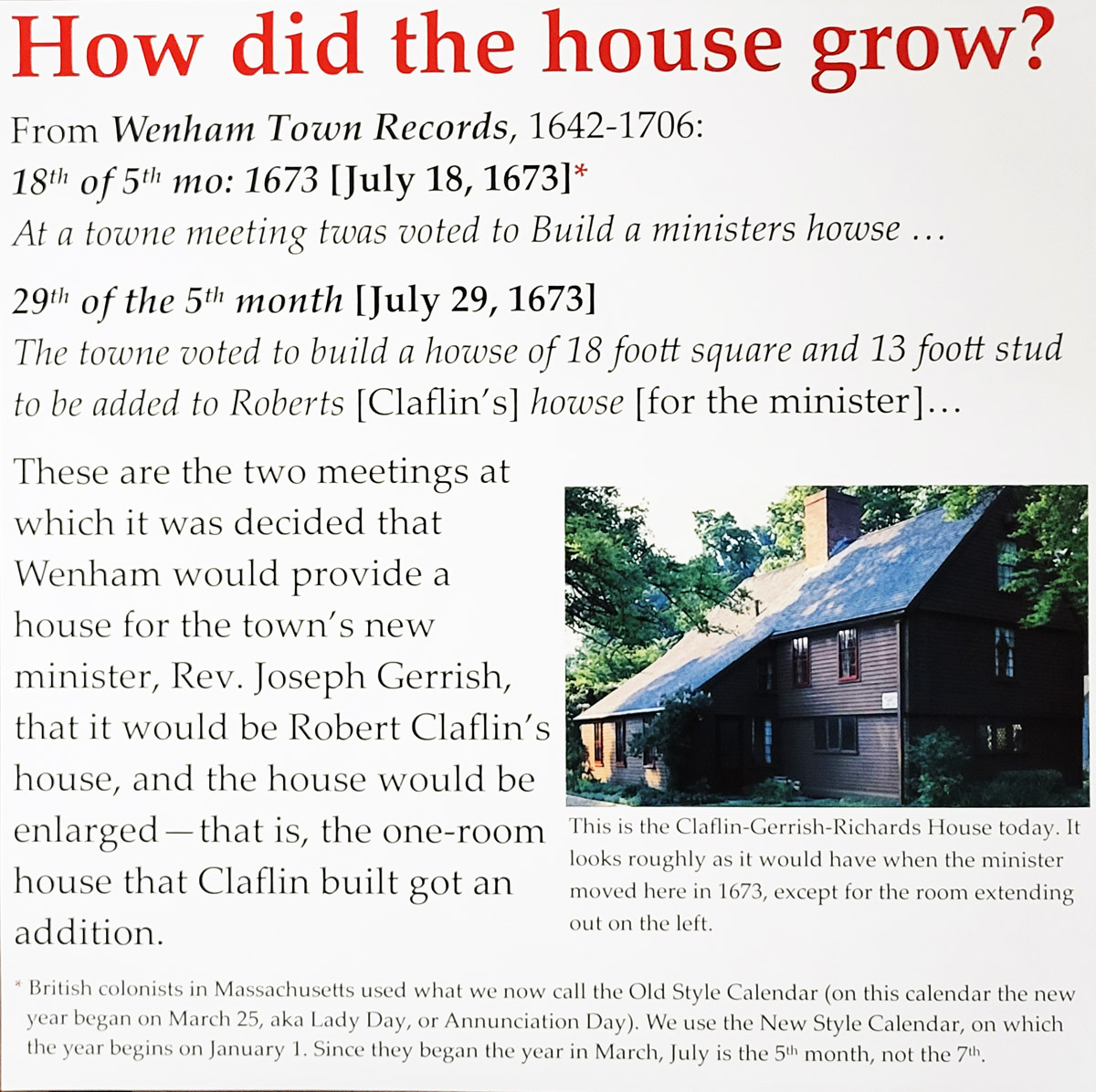
The first property owner of record, in 1661, was Robert Macklafflin (aka MacLafflin), who, according to family tradition, was a Scottish soldier and was among those taken prisoner and sent over to New England by Cromwell after the border battles of Dunbar in 1650 or Worcester in 1651. He is believed to have been transported to this country on the ship “Sarah and John” and worked here first in the iron works in Saugus, Massachusetts for 10 years, then removed to Wenham where he married. In the records of the town of Wenham, Mass., is the following entry: “4th of November, 1661, Robert Mackclothlan is accepted as a townsman”. Robert Claflin’s will was inventoried 19, Sept. 1690 by Richard Hutton and John Batchelder Sr., who found its value to be £101.9s.6d. A sign at the Wenham Museum as you enter the first room of the house states that it was the 18 ft. square Clafflin home.
Around 1690, the lot was acquired by Capt. Thomas Fiske, the leader of the town’s militia. Capt. Thomas Fiske Jr, 1693-1757, was the leading military man in town and was repeatedly elected to the legislature. In 1700, he was appointed to keep the first school here in the house.
Architectural Features
Exterior
In 1697, the selectmen of Wenham granted Thomas Fiske “pine Timber for building his house and for planke and board,” suggesting that at least part of the Captain’s house was constructed at that time. Architectural historian Abbot Lowell Cummings observed that all major framing members in the oldest part of the Claflin-Richards house, with the exception of posts and a chimney girt. are indeed pine, and that the walls are planked rather than studded.”
The earliest incidences of plank wall construction in Essex County was fairly rare, and are usually found along with overhangs. The demolished 1684 William Story House and the late 17th-century Giddings in Essex, and the White-Ellery House in Gloucester are other local examples of plank framing.

When you enter the Wenham Museum, the rear of the Claflin-Richards house is on your right. The front of the house faces south, as was more often than not the orientation of First Period Houses. Dendrochronology testing has dated the left side of the Whipple House to 1677, and the right side to 1790. Dendrochronology has not been done to determine the actual age and builder of Claflin-Richards House.
The framed overhangs on the Claflin-Richards house are examples of the “Post-Medieval Revival” period of the late 17th century.
Interior


Sources and further reading:
- Wenham Museum: Historic House
- Historic Homes, Places and Genealogical and Personal Memoirs Relating to the families of Middlesex County, Massachusetts. William Richard Cutter, A.M. Vol IV, 1908)
- Treasures of Wenham History: A History of the Claflin-Richards House Residents From 1660 to 1922
- Following the trail of the 1650 Scottish Prisoners
- Claflin–Richards House (Wikipedia)
- MACRIS: Claflin-Richards House
- Land given to Robert Macklafflin , 1661 , Wenham Town Records, Vol . 1 , p.26
- Addition for Rev. Joseph Gerrish , 1673, Wenham Town Records, Vol . 1, p.3
- Cummings, Abbott Lowell, The Framed Houses of Massachusetts Bay, 1625-1725
United State Department of the Interior, First Period Buildings of Eastern Massachusetts
- United States Department of the Interior, National Park Service, National Register of Historic Places, First Period Buildings of Eastern Massachusetts, Thematic Resource Nomination
 17th & 18th Century Houses of Essex County, Massachusetts