Gordon Harris is a local historian living in Ipswich, Massachusetts, and publisher of the Historic Ipswich site. Follow him at https://www.linkedin.com/in/gordonrharris/
The Tristram Coffin House (Massachusetts Historic Landmark; HABS: MASS 472) was continuously occupied by the Coffin family from 1654 when it was built by one of Newbury’s first settlers, Tristram Coffin, until its acquisition by SPNEA in 1929.
Dendrochronology conducted by the Oxford Tree-ring Labratory found that the earliest part of the Coffin House was built in 1678 on land owned by Tristram Coffin, Jr., though how he acquired the land is not recorded. The property remained in Coffin family ownership until it came to SPNEA in 1929 and was for a time divided in ownership among several members of the Coffin family. The traditional date of c. 1654 was assigned by Joshua Coffin, author of the 1845 history of Newbury, who resided in the house (Coffin 1845, 391).
The earliest portion of the Tristram Coffin House represents one of the outstanding examples of First Period architecture in New England and is the most important seventeenth century house in the District. It is set in deeply from High Road on a lot with a creek just beyond its western edge. Architectural analysis proceeds on the basis of dendrochronology, documentation and style. The original portion is the earliest example in the area in which the architectural treatments of both interior and exterior have been preserved. The portion facing south was enlarged with a First Period addition.
18th Century fireplace in the Coffin House
A more extensive enlargement occurred after 1750, expanding the house to its present size while establishing a new orientation facing east. By 1785 all major elements of the house as it now stands were named in a division of the property. The east facade facing the High Road continues the seventeenth century use of unpainted clapboarding, vertical chimneys and vernacular character of the original portion; its organization is now regularized and classicized so that its entrance and fenestration are symmetrically disposed into five bays, two and one-half stories in height. The placement of windows on the south facade reflects the additive nature of the house.
Summer beam and girt over a wall with clay and straw plaster in the Coffin House.
A remnant of our Colonial roots in Massachusetts is the word “Commonwealth,” the principle that a political community must act for the common good, with power vested in the citizenry. This ideal was reflected in Puritan self-government for the sixty-three years of its existence.
Image courtesy University of Massachusetts
When the first Puritan colonists arrived here in 1626, the land, lakes, and rivers in our area were collectively owned by the Indigenous family group known as the Agawam people. With the exception of burning fields to plant corn, tribes relied solely on the seasonal but bountiful produce of the land, rivers, and ocean. The Native Americans were unfamiliar with the English concept of land ownership when in 1634, John Winthrop Jr. purchased all of the traditional Agawam land, stretching from Salem to the Merrimack River from the sachem Masconomet for the sum of £20.
Founded as a trading company, the Massachusetts Bay Colony was self-governing, treating its charter as if it were the constitution of an independent state. The Massachusetts Bay Company was set up as a joint stock venture. Any man contributing £50 to the venture was promised 200 acres of land. By 1642 the town of Ipswich and the general court handed out 9000 acres of land, leaving 3000 acres in the common pastures and 7000 acres ungranted.
In the commons, the early Massachusetts towns adopted English institutions of land management that often predated their own experiences in the mother country, reproducing medieval systems whose roots dated back several centuries. Shares of the Commons were granted, sold, and willed by freeholders, while newcomers to the towns were increasingly barred. Disagreements over usage and division of the common lands consumed the business of the towns, which responded with increasingly stringent measures to establish rules and enforce conformity.
Image from “Medieval Times”, courtesy of Google Classroom
During the Great Puritan Migration, Essex County was colonized by people from different regions of England who did not share a universally accepted concept of land ownership. Two major systems of pastoral land management existed in England in the 17th century. Settlers from central and northern England were still accustomed to manorial control over hundreds of acres for use by tenants who lived in the nucleated village. Shown above is an illustration of a manorial system with open fields where serfs farmed slender lots.
The settlers of Ipswich and Newbury came from southerly areas of England where open fields were disappearing and a closed field system had become dominant, in which formerly open fields were fenced and deeded to individual owners. This is an illustration of open fields in Suffolk County England, of which Ipswich UK is a part, in 1300. Image courtesy of the British Agriculture History Society
This second illustration shows Ipswich, Suffolk County in 1550, where enclosed fields had largely replaced the common land system.
The brief Puritan experiment in Massachusetts reproduced the names of English towns, and a hybrid model of medieval land tenure, granting huge farms to the favored and elite immigrants while allocating small house lots to ordinary people, who received tillage and animal husbandry privileges in the large fields beyond the Common Fence that surrounded the settlements. Individually owned land was treated as capital, as it is today, but common land was shared and used, not owned. Cattle and other animals of a given community grazed on portions of the arable land that were not currently bearing crops. The privileges of cutting wood in the commons, harvesting hay, and damming the rivers were strictly controlled by the towns.
Boston Common: The 1722 Bonner map of Boston shows the Common, which as early as 1646 had become overgrazed, and the town was forced to place restrictions on the animals pastured there. Ipswich, Rowley, and Newbury with their extensive meadows and marshland were selling tons of salt hay and “hundreds of beef quarters” to the merchants in Boston. Image from Digital Commonwealth
Titles of Respect and Ownership
Mr. or Master: the highest-ranking man. Their wives were addressed as Mrs. or Mistress.
Freeman: Men who had taken the freemen’s oath.
Goodman: Men who had no other titles. A goodwoman, or “Goody” was the wife of a goodman.
Freeholder: a man who owned land.
Yeomen: one who owns and cultivates land (farmer).
Commoner: a person with rights to the common
Outsiders
In the first year of its settlement, the freemen of Ipswich established “for our own peace and comfort” the exclusive right to determine the privileges of citizenship in the new community, and gave formal notice that “no stranger coming among us” could reside, even temporarily, without their permission. The towns were further able to weed out undesirables by denying them commonage. Inhabitants who had a share in the common pastures sought to limit further distributions of rights to the commons. In 1659 the General Court ruled that no house erected after that year would have any right to common lands without the express consent of the towns, and authorized the towns to demolish and remove the dwellings of unapproved persons.
Great Neck
Before the arrival of the Puritans, William Jeffrey held the right to use a coastal drumlin in Ipswich which today bears his name as a fishing stage. Because he was not a member of the Puritan community, the General Court paid him to leave, and in 1639, the town of Ipswich set aside all of Jeffreys Neck as a common pasture. In the 1650s, the towns of Ipswich and Newbury intentionally developed their sheep industries, with mandated workforces of shepherds and wool spinners. By 1662, there were four hundred sheep on Great Neck, which came to be called the “Ram Pasture.” The common fields on the south side of Ipswich became so burdened with sheep that a hundred were transferred to the north side of town to graze with the cattle. In 1702 the common lands were divided into large sheep pastures. Keeping cattle and sheep on the Necks and the hills surrounding the town continued into the early 20th Century.
North of the gate at what was then the end of High St. was the great North Common Field. This photo of trolley tracks following High St. in Ipswich was taken in the early 1900s.
The “Inner Common of the South Eighth”
South of the Ipswich River was today’s South Green where cattle were herded in the mornings to the Heartbreak Hill common pasture, or further south to the Wilderness Hill common which is today’s Donovan Reservation. The area bounded by County Road, Essex Road, Candlewood Road, Fellows Lane, and Lakeman’s Lane was a part of the common land of Ipswich. When the common lands were divided into eighths in 1709, this area became known as the South Eighth. It included Gould’s Pasture, Ringe’s Pasture, Walker’s Island, and a pasture known as the Inner Common of the South Eighth.
Early land distribution and common fields in the “South Eighth.” Illustration from Publications of the Ipswich Historical Society Volume XVI Candlewood, an Ancient Neighborhood in Ipswich by Thomas Franklin Waters, with common land highlighted.
Today’s Argilla Farm and Maplecroft Farm are part of the huge farm that was granted to John Winthrop Jr. The land shown in white in this illustration was common land in what was known as the South Eighth. Greenbelt’s Donovan Reservation and Sagamore Hill in Hamilton were once part of the Ipswich South Eight Commons.
The rich soil on the south side of town also produced a scattering of large elite family farms in Candlewood and Chebacco. Appleton Farms remains the oldest continuously operating farm in America. Unapproved private enclosure of fields on the south side of town became a frequent issue of contention, and in 1649 the Town ordered the “restraint of inner fences.” The gentlemen farmers, the Symonds, Denisons, Hubbards, Whipples, Fellows, and Appletons, practiced individual agricultural ownership and management, and by the 1650s were no longer participating in communally managed herds. Established in 1638, Appleton Farms is one of the oldest continuously operating farms in America.
Topsfield
Early land grants in Topsfield MA
Topsfield, which was formed from parts of Salem and Ipswich, was initially granted in large parcels as reimbursements to wealthy supporters of the colony. In 1643 the Court granted Misters Endecott, Bradstreet, Symonds, Whittingham, Paine, and others of Ipswich and Salem the liberty to settle a village. The wealthy proprietors divided their lands and induced individuals, many of whom had settled first in Ipswich, to purchase parcels, recovering far more than their initial investments. A list of 31 commoners was recorded in 1661, and over the next 60 years in three separate divisions, the Topsfield common land was divided among themselves or their descendants by inheritance. Several proprietors acquired large farms by receiving abutting shares three times.
View of Mt. Pleasant from Town Hill in Ipswich. Photo by Edward Darling c. 1900
At about the same time, the Town of Ipswich expanded the grazing fields to the hills along Topsfield Rd. On March 15, 1651, complaints were made to the Ipswich selectmen “that the inhabitants of Topsfield do with their cattle feed on our cow common to the great prejudice of the Town herd.” They replied that if any of their cattle were found “feeding upon the cow commons of Ipswich, they shall be acknowledged to be trespassers, and the owners of them bound to make satisfaction.”
Fences
Town Hill looking out at Castle Neck in Ipswich, Cyanotype by Arthur Wesley Dow, ca 1900
When the settlers arrived, many of the hills had already been cleared by the Indians, and the felling of trees was of great concern from the start. In 1639 it was decreed, “No man shall fell any timber without leave from the Constable, under penalty.” A special license from the Selectmen was required before any white oak could be felled on any house lot or in the commons. The felling of timber on Jeffrey’s Neck, Castle Neck, and Hog Island was prohibited in 1650.
Ipswich parishes and land use in the 17th & 18th Century
In Ipswich, every man who built and owned a house became forthwith a commoner and had rights in the common land. Tillage lots of about six acres of commonage were assigned to each householder, and a fence separated them from the “Great Cow Common.”
Residents who owned privileges in the common were to maintain the fence in proportion to their allotments. The town of Ipswich voted in 1637 that “a general fence shall be made” extending from the west end of the town to the Egypt River (today’s Rowley River), from the east end of the town on the way to Jeffries Neck, and on the south side of town from Heartbreak Hill to County Rd. Every morning great herds of cattle were driven out to forage in the woods. Men known for sobriety and carefulness were chosen for the important role of fence viewers. Originally, only grazing was allowed outside the common fence until the privilege of planting crops on Great Neck was granted in return for planting hay, a successful experiment that resulted in tillage privileges being granted throughout the commons.
Newbury
The Lower Green in Newbury MA Old Town
In 1635, the Rev. Thomas Parker led a group of about 100 pioneers from Wiltshire and Hampshire in southern England to found the town of Newbury. House lots, planting lots, marsh lots, and meadow lots were granted and laid out, and a quarter of the freemen of Ipswich decided to move and join their settlement. A house lot of four acres, with the right of pasturage, was assigned to the poorest settlers. Fifty acres were allotted to any persons who paid for their own transportation to New England. Two hundred acres were granted to every family that contributed fifty pounds to the common stock. The tiny settlement on the Parker River was surrounded on three sides by 3800 acres of salt marsh, and in 1645, the entire town relocated north to the Merrimack River to take advantage of more arable land. They maintained an open field at their earlier location, known historically as the Old Town Pasture where cattle grazed.
Sheep were watered in the new location in Newbury at a kettle hole they named Frog Pond, now in Newburyport. Photo courtesy of the Historical Marker database
The Newbury Upper Commons included most of the land now in West Newbury, extending from the Artichoke north to the Merrimack River, and were used primarily for milk cows and other livestock in active use.
The Lower Commons was in today’s Newbury, south to the Rowley line, excluding over 2000 acres granted to Richard Dummer, Henry Sewall, and others at Newbury Falls, now called Byfield Parish. The two commons together comprised about 8000 acres. In 1641 the Newbury freeholders voted to divide the common lands closest to the village into three equally divided separate pasture areas, the cow common, the ox common and the heifer common, and the cattle were divided accordingly. For eight months of the year, the herd grazed during the day and was brought to the village common at night by the herdsman.
The freeholders of Newbury ordered, “that fences shall be made and always kept so sufficient as to keep out all manner of swine and other cattle great or small.” An order in 1653 required freeholders to maintain the fences in good order,” made of pales well nailed, or of five rails well fitted, or of stone 3½ feet high minimal, or a ditch 3-4 ft. deep with two rails, on penalty of a fine.” During the winter, the fence rails were knocked down, and horses and cattle were allowed to run at large in the commons and on Plum Island, where ditches were dug to drain the marsh for the ease of cattle.
Stints
Stinted fields, closes & common pastures. William R. Shepherd, Historical Atlas, New York, Henry Holt and Company, 1923
All land owners were entitled by grant, purchase, or inheritance to own shares in the common and undivided lands, and operated the affairs of the Commons as an independent body of freeholders. Not all commoners were freemen; only those who had taken the freeman’s oath were allowed to vote in the town’s affairs. Five hundred and sixty-three stints in each Newbury pasture were divided among the freeholders in proportion to the number of shares owned by each.
Stints, often called cattle gates, were used in medieval open field systems to balance the number of stock animals with the capacity of the land and prevent overgrazing. In Newbury, Richard Dummer, despite owning a farm, received 62 stints, while the two poorest men received only one. In 1642, the freeholders of the town decreed that the number of stints they had allocated the previous year “shall perpetually belong to the several persons to whom they are allotted and to no other persons whatsoever, except he gets them by purchase or some other legal way.”
Rowley
Rowley was created from parts of Newbury and Ipswich in 1638.
In 1638 parts of Newbury and Ipswich were granted to Rev. Ezekiel Rogers, who led a group of immigrants from Yorkshire in northwestern England who were still familiar with an open field system. The farmers along upper High St. in Ipswich shared a close geographical and social relationship with Rowley and tended to stay longer with communally managed agriculture.
In 1649, The General Court decreed, “Upon the petition of Newbury, this court gives and grants Plum Island to Ipswich, Rowley & Newbury, with Ipswich to have two parts, Newbury two parts, and Rowley to have one-fifth part.”
House lots were granted to the early settlers of Rowley MA, but only a handful of large farms were granted. Every person in town was entitled to receive two acres for every 20 shillings he had paid in the “last country tax.”
In 1643 it was ordered, “that all the commons which belong to the town of Rowley, shall extend five miles from the town every way, where the town has property, which shall not be laid out to any particular person. It was agreed that every 1 1/2 acre house lot would have 1 1/2 gates in the common pastures. The apportionment rose exponentially so that a 6-acre house lot would have 45 gates. The use of the term gates instead of stints is another indication of how the settlers of Rowley had different open-field traditions. Records from the Probate and Quarterly Courts indicate that the commoners of Rowley had their own gates, instead of the common gates that were used in other towns. The town had authority to order any man to work in the common, and refusal to do so would result in a fine for every hour that he failed to appear.
Conversely, Ipswich adopted a principle of one house lot receiving one commonage, and in 1641 the freemen of the town voted that the Selectmen should no longer “meddle with further stinting of the common.”
These two large stones on the side of Central Street in Rowley just before Townsend Brook are said to have been placed in 1639 at the entrance of Common Land of the First Settlers of the town. The brook is so named because it was the “town’s end.” This point was designated as the northernmost boundary in the early settlement of the town. Photo from the MACRIS site for Rowley
Salt Marshes
Nelson’s Island in Rowley. The salt marshes at Plum Island and in the Parker River estuaries produced abundant quantities of two types of hay used for cordage and feeding livestock.
Native distribution of small cordgrass in the UK before hybridization with Spartina alterniflora from New England
The settlers in Ipswich and Newbury, and to a lesser extent Rowley, came from coastal areas of England and were familiar with small cordgrass, traditionally known as Spartina maritima, which is the only salt marsh cordgrass native to England. It took years to cultivate English hay, but the native salt hay Spartina alterniflora (aka Sporobolus alterniflorus) was already here for the taking. Over the years, a hybrid of American Spartina alterniflora with the native English cordgrass has become dominant in the U.K., while the delicate Spartina pattens which is eaten by cattle became highly invasive in the Mediterranean and the American West Coast.
Stacking hay on staddles
Marsh hay was harvested and shipped to the larger communities, including Boston where it was unloaded at Haymarket Square. A load of salt hay and thatch could be sold for a considerable sum, and the privilege of harvesting it was sold or auctioned annually by the towns. For over 200 years, the seasonal harvest of salt hay on Plum Island was a communal ritual, of cutting, stacking, and transporting the hay.
Painting by Fitz Henry Lane. Flat bottom boats known as gundalows unloaded salt marsh hay at the town landing, Nelson’s Island in Rowley, and at Green’s Point in Ipswich. According to historian Joshua Coffin, Plum Island produced 2800 tons of salt hay in 1840
In 1645, Thomas Tuck charged that “Richard Moore made a well upon the common for his own use the last summer, being very dry and water scarce upon the Neck. Tuck hired a cow, which came to drink at the well, and the water being very low the cow broke her neck.”
In the case of William Sargent v. Samuel Bushwell in 1653, for a cow “that was killed by a beast belonging to the defendant. Agreed that the plaintiff shall have half the price of the living cow and that the hide of the dead cow as appraised by town men shall be divided between them”
In 1662, in the case of Samuell Plumer vs. Charles Brown for trespass and taking up a heifer of his from Newbury Neck, John Hopington deposed that two years ago last Michaelmas, Charles Brown lost a black heifer, and at the same time there was a beast killed at a place called “the straits as we go to the rye field.” He heard Browne’s wife say that she feared it was their heifer. Thomas Hale Jr. deposed that the heifer came of a black cow which he sold to brother Lambert and that she was a very poor calf. He put her in the Rowley dry herd and she had the same ear-mark as his other cattle. Andrew Heddan testified that after the heifer was put into the dry herd, he told Charles Brown’s wife that he saw the cow in Rowley Common field upon John Harris’s ground and that at midsummer this heifer left the dry herd, came to the town and went with the cow herd, keeping constantly about Charles Brown’s yard.
In Ipswich Quarterly court, July 22, 1664, Daniel Black filed a complaint against his wife Faith, for keeping company with Judith Trumbull and John How, and sometimes being in bed with John How, and that he was a poor man and had nothing to live by but his labor and one cow, and for the want of the miking of the cow, he lost the profit because of his wife’s carelessness, by which he was provoked several times, often threatening her. John How testified that he heard Daniel Black “wish to God to damn his soul if he did not beat his wife’s brains out.”
Managing disputes like this was a burden to the selectmen. On May 7, 1659, the selectmen of Rowley ordered, “considering the great oppression of the cow commons by horses, mares, yearling colts and dry cattle that are not driven into the dry herd commons; that all inhabitants having more than one horse or mare shall drive their yearling colts and dry cattle into the dry herd commons within three days after the publication hereof upon penalty of 5s. The selectmen of Newbury ordered, May 14, 1663, “that all the dry cattle, except working oxen and yearlings, shall be driven up out of the cow commons.”
Dissension in the Commons
From the earliest times, there was resentment in Ipswich that some commoners weren’t fulfilling their obligations. Furthermore, it was complained that cattle from Newbury were tramping down the salt hay and it “would be the ruin and utter destruction of the whole island.” The division of the commons in Ipswich began in 1664 when the town voted that Plum Island, Hog Island, and Castle Neck be divided among the 203 inhabitants who had the right of commonage. Eight-acre lots of valuable salt marsh were provided to the 28 wealthiest men, while the poorer men received four, primarily in the upland lots. Adjustments were made for those who had been overlooked or “fell short of their due proportion” and for many years the town continued to issue corrections.
Late 19th-century photo of hay on staddles by George Dexter
The Ipswich committee reported in April 1665 that there were 800 acres of marsh and upland on Plum Island, “beside beaches and gall’d hills.” Thatch banks and clam flats remained the property of the town and were let each year to the highest bidder, with only commoners having the right to bid. Hogs, horses, and cattle were kept on the island during the winter, ruining the marsh grass, and in 1739 the General court banned the practice. Today’s protected salt marshes and clam flats, with strict control of shellfish permits, are vestiges of preservation measures taken in the 17th and 18th centuries.
Restrictions on the number of freeholders were decreed in several towns but became problematic to enforce as the population grew. In 1660, individual lot grants were given in the Newbury and Ipswich Commons under the condition that the recipients would clear the land, fence it, and plant at least 4 bushels of English hay per acre. At the end of six years, the land would revert to being a common field. In this regard, land was intrinsically tied to its use rather than outright ownership, a concept shared by the indigenous people of America and in medieval England.
In 1683 the whole of the Newbury Lower Commons was divided into five “sheep walks.” Historian Joshua Coffin estimated a total of over 5,000 sheep grazed the pastures. At this time much of the land above the Artichoke River was still common, unfenced, and unimproved, although large quantities of lumber were being taken.
In the late 17th Century, the Newbury commoners became increasingly alarmed that their hereditary advantage was disappearing. At a meeting of the freemen and freeholders in 1684, it was voted that 6000 acres of the Upper Common would be lotted out, with only 1000 acres going to non-freeholders, and that “this shall not be a precedent to the future in the ordering or dividing of any other part of the common.” The total number of freeholders was based on the 1642 vote of 91 freeholders “and no one else.” The non-freeholders objected that they paid the same taxes as freeholders and should have the same rights. In 1686 the allocation was altered, with half going to freeholders, and the other half going to other freemen who were up to date on their taxes. Those who paid more in taxes received larger shares, with the locations of the allocations determined by drawing names out of a bag.
The old Sawyer farm, which later became the Moseley estate and is now Maudslay State Park in Newburyport
In January 1701, the freeholders of Newbury voted to divide the majority of the Lower Common, comprising 1,800 acres, while reserving pasturage for the town’s ministers and free school as well as for the benefit of the town’s poor. The wood remaining on the common land was measured and divided among the freeholders and inhabitants in 1701 and again in 1708.
Between I703 and I705 the remaining common lands bordering the Merrimack River were divided into 224 lots and were distributed or sold by the proprietors. The allocation of private lots with frontage on the river for private use resulted in a rapid expansion of the shipbuilding and fishing industries, the establishment of an additional ferry, and the construction of new waterfront streets.
The 47-acre Wet Meadows conservation area on Scotland Rd. in Newbury. Image courtesy Essex County Greenbelt
The marshes on Plum Island were for many years retained by the commoners. Ditches were dug to drain the marsh for cattle, and later to mark individual lot boundaries. Finally, at a meeting of the proprietors of the Newbury common lands held in 1827, the standing committee was instructed to sell at public auction “all the lands belonging to the said Proprietors in the town of Newbury, and conveyed for the sum of six hundred dollars to Moses Pettingell, of Newbury, “that part of Plum Island lying & situate in said town of Newbury, containing twelve hundred acres, more or less.”
The northern end of Plum Island, 1827-1883
Pettingell made a tidy profit from the sale of Plum Island’s timber and sand, and the size of his holdings grew unexpectedly when the Merrimack River channel shifted to the north in the mid-19th Century. In 1920 the Plum Island Beach Company purchased the Newbury section of Plum Island from the Pettingell family, constructed Northern Blvd, and divided the land into lots for sale to the public.
Division of the Ipswich Commons
In 1660, the Ipswich Selectmen petitioned the General Court that the town had become burdened by the multiplying of dwelling houses. The Court ordered that no house henceforth erected shall have any right to the common lands and applied it to all towns, which responded by drawing up two lists, one of the number of original commoners, and a second of whom among them still had rights to the common. Those who had moved to their farms would no longer have commonage. A pressing issue was that wealthy farmers who already had commonage were passing their farms to their sons and retiring to their houses in town, a threat to the “one man one commonage” rule. Did commonage belong to the individual or could it be transferred along with sales of property?
Approximate locations of the 1709 division of Ipswich common land into eights as copied from town records. The map is “The Plan of Ipswich” by Barnabas Dodge, dated 1794-5 (includes Chebacco Parish.)
Resolving continuous disputes regarding cattle and sheep was burdensome for the Ipswich Selectmen, and as the 17th Century ended, men began boldly asserting sovereignty over their allotments. The scarcity of new productive land to expand the commons system convinced the towns’ leaders as well as the proprietors that the common fields should be distributed permanently.
In 1709, a list of old and new commoners was agreed on, and the remaining 5850 acres of common land, about 9 square miles of common lands were divided into eight parts with two-fifths going to descendants of the original settlers and three-fifths to more recent commoners. Three further divisions occurred, the last being in 1720, including 900 acres in Chebacco, which is now the Town of Essex. The land could now be rented or sold. Price controls were attempted but several men became rich investing in commonage.
After the Revolutionary War, the State of Massachusetts enacted various measures regarding commons, setting rules for meetings, fencing, taxing, and trespassing, in an attempt to stabilize the Commons system. Finally, in 1788, the majority of the Ipswich commoners voted to resign all their interests in the remaining common lands toward the payment of the heavy town debt incurred during the Revolution, a grant estimated to be worth about £600.
In Ipswich, Great Neck continued to be held as common land by a group of men who organized as “The Proprietors of Jeffries Neck Pasture.” The 1832 Philander Andersen map of Ipswich shows a “Neck gate” for cattle. View the entire map at Digital Commonwealth.
Bush Hill between Topsfield Rd. and Pineswamp Rd. was still used as a defacto common as late as 1900. Today’s lot lines were created when the open fields were divided. Circa 1900 photo by Edward Darling.
Cows on today’s Jeffreys Neck Road in Ipswich. Great Neck was used as commercial pasture land until the early 20th century when Alexander B. Clark bought up all the lots. Photo by George Dexter, early 1900s
Husbandmen became independent farmers on the outside of the town’s center. The agricultural commons ceased to exist, but today’s South Green in Ipswich was where cattle were once corralled, and later became the Town’s training ground. Circa 1915 photo, courtesy Ipswich Museum.
Late 19th Century photo by George Dexter of grazing fields on the coastal drumlins in Ipswich
Division of the Rowley Commons
Plan of Rowley surveyed by Joseph Chapin, dated December 1794. Photo courtesy Digital Commonwealth, with enhanced colors indicating “large tracts of unfenced “barren and unimprovable land.”
In 1673-4, almost a decade after Ipswich and Newbury began dividing out their commons, it was agreed by the town of Rowley that two-thirds of their town commons should be divided out to the proprietors in proportion to the number of gates they owned. Unimproved remnants of the common fields persisted into the 18th Century. In the 1794 Plan of the Town of Rowley, the publisher noted that “there are large tracts of barren and unimprovable land whose owners determine that they are not worth fencing. Some of these lands are marked in yellow.”
In 1622, eight years before the establishment of the Massachusetts Bay Colony, Capt. John Mason had obtained title to all the land from Salem to Newburyport as a principal partner in a stock company known as the Plymouth Council for New England. In 1681, his grandson John T. Mason presented a letter from the King to the General Court, which ordered “all said tenants” to appear in the Ipswich court. If his birthright claim was confirmed, every land title would be worthless and Mason would have been able to impose a medieval manor and tenant land system. Eventually, his case failed, after causing extreme anguish among the populace.
Tercentenary Commission Marker on North Main St. in Ipswich. The revolt against Governor Andros was about taxes and land.
Then in 1686, Governor Andros imposed a 2.5 shilling quit rent per annum on all 100-acre lots not occupied, or occupied with defective titles. Since all of the existing land titles in Massachusetts had been granted under the vacated colonial charter, Andros essentially declared them void and required landowners to recertify their ownership by paying fees to the Dominion as a quit-rent. To strengthen their title, the Selectmen of Newbury, in consideration of £10 purchased the entire town of Newbury from Samuel English, the surviving heir of Masconomet, constituting about 10,000 acres. The threat ended when news reached Boston of the overthrow of King James II, and Andros was arrested by a mob that descended on the city.
Further Afield
Each town developed its own standards for allocations and divisions. In Salisbury, the lot that one received was based on what he was worth. The settlers of Gloucester replicated their customs from western England, where fishing was the primary industry and enclosure was well advanced. In Haverhill, John Ward and his followers doled out 20-acre house lots to themselves, leaving common land mostly along its periphery, and by 1659 its open-field structure had disappeared.
Andover retained its open-field system longer than the older towns established by people from the east and south of England. Today’s North Andover was the center of the original town of Andover, MA. The common fields were in the south part of town, which is now the town of Andover. The Trustees of Reservations’ Ward Reservation is on land that was part of the common fields.
In the spring of 2000, the Ipswich Town meeting authorized a $10 million Open Space Bond for the protection of land for open space, water supply protection, and recreation, preserving the land from development. The town’s investment adds to Willowdale State Forest, Plum Island, Appleton Farms, and Crane Beach, which are preserved by the State and environmental organizations.
The Dow Brook Conservation Area on the north side of Ipswich is the primary source of the Ipswich public drinking water supply and provides quality wildlife habitat within a regional greenway of over 3,000 acres. Public access to the property is located in a parking area next to White Farms Ice Cream on High Street, near the Rowley town line.
Part of the Ipswich Open Space program, the Great Neck Conservation Area property adjacent to Clark Pond is a remnant of the common field where livestock were kept in the summer. The Town acquired the 85.5 acres in 2007 for the protection of highly sensitive coastal wetlands and wildlife habitats.
The Ipswich Pony Express youth soccer fields, Greenbelt’s Castle Neck River Reservation, and the Castle Neck River Wildlife Management Area are on land that was granted to early Ipswich settlers John Fawn, John Perkins, and Thomas Howlett, adjoining the large commons in the “South Eighth.”
The Ipswich Pony Express fields before they were purchased by the Town of Ipswich and Essex County Greenbelt
South of the Pony Express Fields are Essex County Greenbelt’s John Donovan Reservation and Sagamore Hill. Although now in the town of Hamilton, it was originally part of Ipswich.
This excerpt from the 1830 map of the original Town of Newbury still showed a Common Pasture near where Newbury, Newburyport, and West Newbury meet between Turkey Hill and the Little River.
Image courtesy City of Newburyport
The Common Pasture located in Newbury, Newburyport, and West Newbury, is a remnant dating back to 1635. The entirety of the present-day Common extends from north of Hale Street in Newburyport, crosses Hale St. through the City to Turkey Hill Road in West Newbury, then follows Scotland Road in Newbury and abuts the Little River Nature Trails on the eastern branch of the Little River. The City of Newburyport, the Town of Newbury, the Trust for Public Land, Essex County Greenbelt Association, and the Parker River Clean Water Association have worked together to protect key portions of the Common Pasture through land acquisition and agricultural preservation restrictions.
Satellite view of the Newbury/West Newbury/Newburyport common pastures.
In 2006, the City of Newburyport and The Trust for Public Land (TPL) announced the acquisition and permanent protection of the 102-acre North Pasture property on Hale Street in Newburyport. The North Pasture today comprises about 240 acres, extending to the Little River. A trail system winds through the Cooper North Pasture. The South Pasture area is zoned agricultural/residential and contains the largest concentration of farms remaining in Newburyport. Scotland Road delineates the southern boundary of the South Pasture. The land along the south side of Hale Street from Route 95 east to the Little River comprises the northern portion of the South Pasture. The Turkey Hill area includes land west of Route 95 that was historically part of the lower common in Newburyport and West Newbury.
Allen, David Grayson, In English Ways,The Movement of Societies and the Transferal of English Local Law and Custom to Massachusetts Bay in the Seventeenth Century.
Fischer, David Hacket: Albion’s Seed, Four British Folkways in America
This well-preserved mid-eighteenth century farmhouse was built for Deacon Solomon Dodge (1721-1812) about 1769. Dea. Solomon Dodge (Phineas, John, John, Richard) was born in Wenham, 18 June, 1721, and died in Topsfield, 16 January, 1812. He married first, the widow Hannah (Green) Dodge, 30 December, 1742. She died 7 October, 1788, aged 74 in Topsfield. He married second, the widow Martha Dodge of Ipswich, published 12 January, 1791.
Dodge was an active soldier during the American Revolution. On Monday, December 5, 1774, in obedience to the instruction of the Provincial Congress, the men of Topsfield of military age, assembled on common land and formed themselves into the Topsfield militia. By election they chose Joseph Gould and Stephen Perkins as the captains of the two companies. Captain Gould’s Company consisted of fifty-nine privates and non-commissioned officers. Captain Perkins’ Company consisted of forty-seven privates and non-commissioned officers. Perkins’ Company elected Solomon Dodge as Lieutenant and David Perkins as ensign. Dodge served as a minuteman in Lexington and Concord and later under General George Washington.
In the early nineteenth century Ebenezer Dodge sold to Cyrus Cummings (1772-1827). Cummings was the proprietor of the Topsfield Hotel on the Newburyport Turnpike, now Boston Street, and was the first postmaster of Topsfield from 1813 until his death in 1827.
In 1822 Cummings sold this property to the Town of Topsfield as an almshouse. Residents were required to work on the farm to earn their lodging. The property continued as a poor farm until 1900 with the number of its occupants ranging from approximately 225 poor lodging here during 1874 to only six occupants in 1889. A newspaper account of 1875 notes that William J. Savage, was the superintendent and that the house was updated. The article noted that on the 100 acre farm, corn, potatoes, squashes, hay and other general produce were grown by the residents, as well as a sow with thirty piglets.
Town farms began to lose favor after writer Dorothea Dix in 1843 exposed the terrible confinement conditions in prisons and almshouses in Massachusetts. In the late 19th Century, the town farm system was no longer cost-effective, remaining primarily as a place of last resort for the elderly poor. By 1900 the Town decided to sell the farm to Dr. Henry F. Sears of Boston. Soon thereafter the property was purchased by Thomas E. Proctor (1873-1949) of 87 Perkins Row. The adjoining 1872 barn which may have been used by the Town Farm is no longer part of the property.
Features of this house include corner-beaded boards over beams, trim and corner posts, gunstock posts upstairs, a large brick vault supporting the four fireplaces and chimneys. Windows are double-hung from the late 19th or early 20th Century, as determined by purple manganese glass in several of the sashes. The front stairway is original, and pine panels throughout the house are up to 24″ wide.
The Capt. Joseph Gould House is an enigma; a substantial early 18th Century house constructed in at least two stages, and the only First Period house in our area believed to have been constructed two rooms deep (aka bays or piles) deep. The 1710 Gould Barn that once sat on this property was dismantled and reconstructed at the foot of Howlett St.
The three-bay east side of the house is the oldest, and the house achieved its present appearance when the left side, also of three bays was added c. 1725. Typical of the period, the spacing of the windows is irregular, although most are vertically aligned. The chimney on the right original side is more substantial, and the fireplace below it in the downstairs room is the largest in the house. The roof is of substantial principal rafter and common purlin construction on the two sides of the house. In addition to the depth of the house, another transitional feature is the eaves, which appear to have originally featured a plaster cove.
Inside the house, framing is doubled at the junction of the earlier and later sections and is exposed in several rooms in both sides of the house. Transverse summer beams (instead of longitudinal) are on both sides, measuring 11 1/4″ in general, featuring flat chamfers with “lambs tongue” taper stops. Summer beams in the upstairs of the west side are unchamfered. Story posts in the rear section are elaborately molded, similar to several houses in Salem. Simpler gunstock posts are found in other rooms. Downstairs in the entrance and rear room west (later) part of the house, posts and beams have narrower flat chamfers and simple triangular taper stops. Measurements for the joist spacing is about 25″ on center. A reused chamfered summer beam can be seen in the cellar.
Conflicting studies
The MACRIS listing and nomination papers for the Joseph Gould house state that the oldest section was always two rooms deep and dates to before the 18th Century.
The “Old House Whisper” John Cole and Eleanor Bailey studied the house and wrote that the earliest part was an over-room “half house” structure built for Joseph Gould about 1712 at the time of his marriage to Priscilla Perkins. Cole observed a reused summer beam in the basement and believes the house was expanded to the west and in the rear around 1751 at the marriage of Joseph Gould 2 to Elizabeth Emerson. He does not, however, reconcile the preponderance of First Period (pre-1725) architecture throughout the house with the mid-18th Century.
Abbott Lowell Cummings is known to have visited the house but his notes and observations have not been discovered.
Kari Ann Federer did a comprehensive study of the house in 1989 which is copied in part below.
Rear, Capt. Joseph Gould house. The left side in this photo is believed to be the older half.
The Joseph Gould House and barn
Kari Ann Federer, Boston University, December 18, 1989 (excerpt)
INTRODUCTION
This is a study of two late first-period buildings in Topsfield, Massachusetts, the Joseph Gould House and the barn which stood on the property, until it was dismantled in 1983. Both house and barn were constructed in two phases, the second doubling the original in size and following its plan and form quite closely.
The resulting six-bay dwelling was essentially two end chimney houses built back to back, with chimneys up against each other, creating something like a central chimney house. The barn totaling nine bays, consisted of two classic five-bay barns side by side with one bay overlapping.
This double house and a double barn existed by the mid-1700s and were occupied, at that time, by two different, though probably related families. Traditionally, the older half of the house was said to date prior to 1700 and the second half shortly thereafter. The popular tale was that the later section was added to make the house into a duplex for father and son. However, research into deeds and probate records has suggested that both of these traditions are inaccurate.
This study is an attempt to shed light on the history of the Joseph Gould farm by examining the original framing and construction of the house and the barn, as well as the overall layout of the farmyard and the changing uses of these spaces.
PHYSICAL DESCRIPTION OF THE JOSEPH GOULD HOUSE
The eastern half of the Joseph Gould house was the first portion to be constructed. It was initially an end chimney house, two and a half stories high, one room wide and two deep, with the chimney at the west end of the dwelling. The house measured twenty-seven and a half feet wide and twenty-eight and a half feet deep. The rear rooms were about two-thirds as deep as the front ones.
The Gould house is now covered in clapboards, attached with wire nails, which must all be replacements. However, the original house would also have been sheathed in unpainted clapboards. The roof cornice overhangs about a foot along the front of the house and diagonal boarding is said to cover a plaster cove.
The nine-over-six sash windows on the Gould house are later eighteenth-century replacements. The current configuration of this eastern section of the house is not original, as the chimney has been moved to the east and a room was created in what had been the chimney bay. Evidence of this alteration includes Federal mantels on the fireplaces of the southeast rooms upstairs and down, as well as the fact the transverse summer beams were off-center in these rooms lying closer to the chimney wall than would be expected.
Due to this alteration in the chimney bay of the Joseph Gould house, no evidence of the original entry door, staircase, or fireplaces can be seen. It might be assumed that the configuration of the chimney bay was fairly typical of the late first period. In New England houses of the First Period, the staircase and entry were usually combined, with the stairs rising up across the front of the chimney.
The staircase from the first to second floors of the Gould house may have been a straight run composed partially of winders. The open balustrade, with turned balusters and molded hand railing, would have housed within a closed string.
Under the stairs would have been molded vertical sheathing and perhaps a door to the cellar stairs. However, a trapdoor to the root cellar currently exists in the northeast corner room of the house and there is no reason to believe this is not its original location.
In this first half of the Joseph Gould House, the frame would have been entirely exposed, though some members are now boxed. All summer beams are transverse and these timbers are continuous from the front to the back of the house, proving that both stories were always two rooms deep. Joist spacing in this part of the house, is twenty-five inches on center; a measurement consistent with the late first-period date of the house. Where visible, all summer beams and girts have flat chamfers with lambs tongue stops except for those of the chimney girt in the rear room, which have triangular stops.
As in many other houses with transverse summer beams, the most highly embellished parts of the frame are the story and chimney posts. These have elaborately molded heads with a deep quarter round and two fillets. It seems to be only the rear posts that are fancy, however. Most of the front framing members are now boxed, but the front chimney post can be seen, and this is much simpler with only a very wide flat chamfer on its sides. The rear corner posts are similar to this one, as are all visible posts on the second floor.
In the attic, one can see that both halves of the Joseph Gould house are constructed with a principal rafter, common purlin roof system. Each half of the house consists of four pairs of rafters, bridled at the ridge, creating two three-bay sections. On each slope of the roof are five purlins trenched over rafters, with the ridge purlin resting in a notch cut into the upper rafter. Massive long collar beams tie together the rafters in the older (eastern) half of the house. These ties, along with the rafters, are finished with narrow flat chamfers.
The rafters are doubled at the transition point between the two sections of the house. When the second half was added, another complete house frame was built up against the old one. Visible in the ridge between these two frames, are original clapboards from the exterior west gable end of the earlier house. The roofing system of the second half of Joseph Gould House is very similar to that of the first. The frames line up exactly, though the later section has slightly heavier purlins and no collar beams, but struts rising up from tie beam to rafter instead.
In plan, the second half of the Gould house copied the original. However, the west half is about six feet narrower, being only twenty-one feet wide. The basic configuration of this half of the house has not been altered. The five-foot wide western chimney bay is in its original location, though the chimney stack is now smaller than it would have been.
The stairs from the first to the second floor and also up to the attic, are still in their initial location in front of the chimney. The staircase is typical of the late First Period, with turned balusters, but a plain newel post. Molded paneling under stairs makes it clear that there were never cellar stairs there. A trap door to the root cellar also exists under this half of the house. The staircase was probably a double run with landing, originally. The current unusual configuration was most likely created when the chimney was rebuilt and narrowed. An empty space was left behind the chimney and it was logical to use this as an easier way to reach the rear chamber.
The summer beams are also transverse in this second half of the Joseph Gould house. Much of the frame is now boxed, but it is visible in the rear rooms, upstairs and down, and in the front entry. Typical of the less decorative embellishments of the end of the First Period, very narrow chamfers with taper stops can be seen in rear rooms. The rear-story post has a fancy molded head, similar to those in the older half of the house. However, all other posts in the rear room are simple with only very narrow flat chamfers on their sides. In the west front entry hall, the front chimney and corner post can be seen and these are very plain with almost no chamfers at all. Upstairs, the rear posts are undecorated and here the summer beam is the only chamfered member.
Sometime later in the 18th century, the frames in the west front rooms of the Joseph Gould house were boxed and the first-floor room was embellished with a corner cupboard. Some of the feather-edged panels on the fireplace wall of this room may date from the construction of the house, as this became very popular in the early 18th century. The raised paneling in the west front chamber may also be original. This type of decoration came into use by about 1725 and like other new fashions, was often tried upstairs in the chambers first.
Typical of the First Period, the Joseph Gould house was built facing due south, while the barn backed up to the northwest wind. This created a sheltered farm yard in front of the house and barn and later outbuildings added between the two protected it even more. First Period barns were often located in front of the house, closer to the road, to show off the family’s stock and store of supplies. As the location of man-made structures helped to bring coherence into a chaotic world, the forty-five-degree angle between the ridgepoles of the Gould house and barn enforced the disjunction between the artificial rational world of man and the irrational dirty world of livestock.
BACKGROUND OF THE GOULD FAMILY AND THE SETTLEMENT OF TOPSFIELD
The area which is now the town of Topsfield, Massachusetts was originally part of the seventeenth-century plantations of Ipswich and Salem. During the 1630s and 1640s, large grants of Topsfield land were given to Ipswich Residents. The land where the Joseph Gould house stands was part of the Captain Patrick Grant, which like many of these large land holdings, was soon divided and sold. In 1644, three hundred acres of it were purchased by Zaccheus Gould (1589-1668), who had arrived from England in 1639 and decided to settle in the newly developing community of Topsfield. Twenty years later, in 1664, it is estimated that Zaccheus Gould owned some 3000 acres, 580 in Topsfield and the rest in neighboring Boxford. At this time, Zaccheus sold his entire estate and house in Topsfield to his only son John Gould (1635-1710), who had come with him from England as a young child. John Gould lived in his father’s house, past which Washington Street was laid out late in the 1660s. He and his wife Sara (Baker), who were married in 1660, raised eight children, one of whom was Joseph, born in 1677.
CONSTRUCTION HISTORY OF THE JOSEPH GOULD HOUSE AND BARN
Although Joseph Gould is traditionally said to have built his original house prior to 1700, there is no recorded deed giving him land until March of 1709. At this time, John Gould, who was nearing the end of his life, divided his estate among his surviving sons. Joseph was given sundry parcels of upland, meadow, and woodland in Topsfield and Boxford. This deed was not specific about the boundaries or acreage of the property, but it should be noted that it did not mention any buildings on the land, nor does it indicate that Joseph Gould owned any of the abutting land previously.
In 1709, Joseph Gould would have been 32 years old, but still unmarried. It seems quite likely that the first half of his house was not constructed prior to this time. This conclusion is supported by a map of Topsfield printed in 1950 for the town Tercentenary, which labels the house “Abbott 1709” (Abbott being the owner at the time). This date also coincides with that which First Period barn expert Robert Blair St. George has assigned to the earlier half of the Gould barn.
In the process of establishing his own farm, Joseph Gould probably built the first halves of his house and his barn in 1709 to 1710. A few years later, in 1712/13, Joseph married 23-year-old Priscilla Perkins. The two immediately began a family, Priscilla giving birth to their first child in 1714. The Goulds had eleven children, but only six survived past early childhood. The only surviving boy being Joseph Gould (2).
The second half of the Joseph Gould house was traditionally thought to have been added to the west of the existing house, built between 1700 and 1720. Perhaps the latter end of this range is correct. No documentary evidence could be found for the construction date of this portion of the house. According to the probate inventory of Joseph Gould (1), it was certainly in existence by 1753. The features of this western end of the house are typical of the late First Period and thus it is unlikely that it could have been added any later than the 1720s. The second half of the barn was also standing by 1753 and Robert St. George felt it must date from between 1720 and 1750.
The traditional story tells that the second half of the Joseph Gould house was built to make a duplex for father and son. However, as Joseph (2), the only surviving Gould son, was not even born until 1725, it seems impossible that it could have been constructed specifically for his use. None of the Gould girls were grown and married by the 1720s either.
On the other hand, there are no deeds indicating that Joseph Gould sold off a portion of the house or even any land near his house. It has been suggested that the addition of the western half of the Gould house was simply an unusual way of enlarging the original dwelling. Building two complete frames up against each other makes the house appear to have been constructed as a duplex, but this was not necessarily the case. Perhaps Joseph Gould made the addition to his home during the 1720s in order to house his growing family. He may have had in mind that one of his children would occupy half of the house, later when the family had grown, and thus built the house so it could easily accommodate this purpose.
The farm was indeed being used as a two-family home in 1753 when Joseph Gould’s inventory included only the easterly end of the dwelling house and half of the barn. The inventory does not make clear who owned the other halves of the buildings and there is no evidence that Joseph Gould (1) ever sold them to anyone else. Therefore, it does seem probable that Joseph Gould (2), who was married in 1751 at age 24, was the occupant of the western half of the house and barn by the time of his father’s death. This could have been the origin of the story about the father and son duplex. Joseph (2) was willed the remainder of his father’s real estate and by the 1760s was being taxed for the entire farm.
–Kari Ann Federer
Images
Joseph Gould house, Topsfield MA
Main stair rail, turned posts and vertical sheathing in the Capt. Joseph Gould house
Living room fireplace Capt. Joseph Gould house
Post and beam in the in the Capt. Joseph Gould house
Ornamental posts in the rear kitchen wall of the Capt. Joseph Gould house are very similar to posts in the 1675-1693 Stanley-Lake house in Topsfield, the “1675” Jonathan Corwin house in Salem, and the 1679 Balch house in Beverly.
Gunstock post, beam, and girt in the Capt. Joseph Gould house
Summer beam, rear kitchen in the Capt. Joseph Gould house
John Gould inherited part of the 3000 acres of land owned by his father Zaccheus Gould (1589-1668), whose home is believed to have been nearby on Washington St., and was already an important citizen of the town of Topsfield. During the Revolution of 1686 for which Ipswich claims fame, Capt. John Gould was imprisoned for opposing Gov. Andros. He served as a selectman and gave a deposition against Sarah Wilds, his neighbor, who was hung as a witch during the Salem hysteria. Capt. John Gould and his wife Sarah (Baker) Gold conveyed their farmlands to their five sons.
Capt. Joseph Gould (1677-1753)
Joseph, who married Priscilla Perkins, received the homestead. Like his father, he served as a selectman and was elected to the General Court for seven terms. In his will, dated March 1753, Capt. Gould gave his household goods to his wife, and one-third of the use of the estate, as was customary at the time, with “the liberty of the Great Room in my Dwelling House and the improvement of half the cellar and Said Room.”
Major Joseph Gould (1726-1803)
At the time of Joseph Sr.’s death, Joseph Jr. was living in the westerly wing with his wife Elizabeth Emerson Gould, and assumed ownership of the farm. Joseph Gould Jr. is said to have played an important role in the Battle of Concord and was made a major in Col. John Cogswell’s Regiment. At his death, the house was inherited by Joseph 3, who married Ruth Porter of Danvers. In 1867, the house passed out of the Gould family.
The Joseph Gould house and the Gould barn, about 1900.
The home of Joseph Capen, minister at Topsfield for many years, the Parson Capen House is a surviving example of Elizabethan architecture in America, the home of minister Joseph Capen on a lot granted by the Town in 1682. The house was purchased by the Topsfield Historical Society in 1913 and was restored under the direction of Topsfield historian George Francis Dow.
Joseph Capen served the Church in Topsfield for 44 years until his death. He was born in Dorchester, the son of John and Mary Bass Capen, an established family in Dorchester with its ancestral roots in Dorchester, on the southwest coast of England. His wife was Priscilla Appleton, daughter of John Appleton of Ipswich MA. He was closely related to Bernard Capen, a Dorchester settler, whose pre-1658 house was moved to Milton in 1909, but was disassembled in 2007 by Landmark Services. The fate of the saved timbers from that house is uncertain.
Chamfered summer beam in the Parson Capen house
Parlor double transverse summer beams in the Parson Capen house. Although common in other areas, most First Period houses in the Ipswich-Topsfield area have longitudinal first floor summer beams, and transverse second floor summer beams. This is the first incident of double first floor transverse summer beams I have observed, although the Whipple House has intersecting longitudinal and transverse summer beams in a downstairs room.
Fireplace in Parson Capen house with rounded corners, and plastered cove connecting to the oak chimney girt. The rounded fireplaces are generally found in the finer First Period houses of the 17th Century.
Summer beam lambs tongue chamfer stop in the Parson Capen house. I suspect this one may have been replaced in the 1913 restoration of the house.
Gunstock corner post in Fireplace in Parson Capen house. The top of the post is not continuous to the beams and girts, so it has been altered or is a replacement.
Observations:
The Capen House sits on a knoll, and faces south, which was common in First Period construction. The hall is on the east end, is the smaller of the two downstairs rooms at 20 ft. by 16 ft., and features a large fireplace with rounded inside corners. The parlor is 20 ft. by 17 ft. 6 inches. The front entry enters to a winding staircase in front of the massive chimney, almost universally found in First Period houses. Carved oak newels, panels and turned balusters shield the staircase. The hall fireplace is 8 ft., 4 inches wide, 4 ft. high, and 3 ft. deep. while the parlor fireplace is 4 feet high, 6 feet long and 2 1/2 feet deep.
Downstairs summer beams in the Capen house are transverse, a west Anglia form more commonly found in the Salem-Beverly-Wenham area, and rarely in the Ipswich-Essex area, whose inhabitants came primarily from East Anglia. The framed overhangs on the front and the gables are more substantial than the more modest hewn overhangs found at the turn of the 18th Century. The front jetties are supported by the two chimney girts, and the end girts, which are original, and is the method used in the 1682 Hooper-Hathaway house which was moved to the grounds of the House of Seven Gables in Salem.
The Parson Capen House has been owned and maintained by the Topsfield Historical Society since 1913, and was designated a National Historic Landmark in 1960. Also on the property is the restored 1710 Gould Barn.
PARSON CAPEN HOUSE
by C. Lawrence Bond, A.B., S.B. Published by The Topsfield Historical Society in 1989
John H. Towne writes in 1902, “This two story house was built for “Parson” Joseph Capen about 1684-88. It was long in the possession of the Emerson family. It has an overhanging second story and is a very interesting type of the 17th century dwelling.” George Francis Dow’s History of Topsfield, page 447, states it was built in 1683 and bases this on what he claims was discovered while the house was being renovated in 1913, viz: “Under the northern ends of the summers (beams) is incised with a chisel the date July Ye 8th 1683, so there exists here what is not to be found elsewhere in so old a house, the exact date when the frame was raised.” (Note: July ye 8, 1683 might have been the date the timbers were cut and marked for drying.)
The authenticity of the carved date would appear to be in doubt, for in his Historical Address given at the 250th celebration of the Town’s incorporation, Dow stated “some- time after May 14th 1686, he erected on the twelve acre lot granted him by the town, the two story house which still stands near the common.” As Capen was not ordained until 1684, the year he was married, it seems very unlikely that he would have started a house in 1683.
By comparison with houses of similar date built in Ipswich, it is obvious that this house was no ordinary structure. His wife, Priscilla, was an Appleton, and her family undoubtedly paid for its construction since Capen agreed to take up “ye worke of ye ministery” for £75 in country pay (produce, pork and beef). Rev. Capen died in 1725 and his widow in 1743. Rev. John Emerson became the leader of the church in 1728 and after two or three transfers he became owner of the house in 1758. Billy Emerson, a grandson, known as Forty Farm Emerson, had farms located strategically between Maine and Boston, so located that cattle could be driven for a day, penned up for the night in pasture, and then driven another day until they reached the slaughter houses in Brighton.
The Capen house was used to put up the drovers and was in pretty dilapidated condition by the time Mr. Dow acquired it in 1913 for the Historical Society. Mr. Proctor (whose middle name was Emerson) was a descendant of Rev. John Emerson, which undoubtedly had something to do with his generous contribution to the restoration. The upstairs was made into an apartment and rented throughout the years to various tenants. During World War I Henry Beston, famous author, lived there and wrote the Fireside Fairy Tales. His wife, Elizabeth Coatesworth, was a children’s author.
A detailed study of its architectural details has been written in 1970 by Deborah Dupouy and illustrated by Jane English, both of Topsfield. Capen’s marriage does not appear in the Vital Records of either Topsfield or Ipswich, but the Ipswich Public Library has a book on the Appleton genealogy and just above the line giving Priscilla, wid. Rev. Joseph Capen of Topsfield, is written m. Joseph Capen, 1684
“As we walked down the town, the quaint appearance of the houses struck me very forcibly – very different were they from those in most of the New England towns. They had pointed gables, and irregular slanting roofs; and in many of them the upper stories projected considerably over the basement apartments, in some such a way as the old houses are built at Chester, and in some of the old cities in England.”–British writer John Ross Dix visiting Ipswich, Massachusetts in 1846.
The Ipswich houses described above by John Ross Dix are First Period saltboxes with second floor overhangs. A projection of the second story over the first, which is common in parts of England, was found in the earliest houses in the New England colonies in the form of an overhang, frequently decorated at the lower end of the second-story corner posts carved pendants. The photo above is the Dodge house on N. Main St. in Ipswich MA, demolished in 1888.
Wells Cottage, Easthorpe, Essex England
Overhangs originated at the end of the Medieval period as the economic and political changes made it possible for ordinary people to moderize and enlarge their small houses, which were often heated by an open fire and a hole in the roof to let the smoke out. The invention of the fireplace and chimney made it possible to heat larger spaces. The strongest way to add a second floor was to extend the new joists and girts beyond the existing house frame, and extending only the second floor via an overhang wouldn’t intrude into the narrow cart paths.
Corner framing of a First Period house with front overhangs. Extending the second floor provides for a stable transition from the first to second floor in post and beam framing.
Today we refer to jetties as overhangs, but in post-Medieval England they were called jetties. The earliest overhangs were framed, with floor joists overlapping the front second floor carrying beam. The form survived until the end of the 17th Century. The ubiquitous suburban “garrisons” of the late 20th Century are a “colonial revival” throwback to the front overhang.
The Matthew Perkins house at 8 East St. in Ipswich has an elaborate pilastered chimney, a rear ell, hewn overhangs front and side, and one of the best Jacobean staircases in New England. This house has a preservation convenant with Historic New England.
A more common Colonial version is the shallower hewn overhang developed as a retro fashion during the brief post-Medieval revival period of the late 17th and very early 18th Century. A well-preserved example is the Matthew Perkins house in Ipswich. The form is frequently but not always found along with a similar feature, the facade gable, a slight overhang of the attic over the second floor girt on the two gable ends of the building. Gables framed to overhang the second story are found in several Cape Ann locations including the Capen house in Topsfield, the Boardman house in Saugus, and the east gable of the Whipple house in Ipswich. Facade gables are also occasionally found on plank frame houses, which in our area generally date to about 1700 and later.
The Rev. Joseph Capen house at 1 Howlett St., in Topsfield (1683), is one of the finest surviving examples of Elizabethan architecture in America.
The origins of post-Medieval jetties, or overhangs are debated. The jetty was probably first used in towns where the homes of the peasantry sat near a narrow footpath. An overhang became the preferred means for the joinery required to add a second floor to a house without encumbering the narrow way in front. As John Fiske pointed out in his book, “When Oak was New,” the development of the fireplace at the end of the Medieval period allowed for the expansion of houses upwards, as this space would no longer be filled with smoke. In the early 17th Century, the overhang disappeared in English farmhouse construction, with walls continuing straight up from the bottom plate to the roof. However the settlers of New England brought with them and continued to use the more traditional forms of construction. Within only a few decades, houses here were being built with continuous flat walls.
The Thomas Knowlton house on Summer St. in Ipswich MA
And then something quite odd happened: Beginning as early as the 1670s and lasting for a period no longer than 40 years, some homes of the more prominent citizens featured a revival of projecting overhangs, facade gables, beaded summer beams, and other decorative features of a century earlier. In addition to the framed overhang of their grandfathers, they sometimes used a hewn overhang, the projection of which was by necessity smaller, being limited to the width of a solid post resting on a hewn beam. Just a hint of an overhang, known as a facade gable, was often applied to the second-floor and attic intersections, performing only a decorative function.
Whipple House in Ipswich before it was restored and moved to its current location on the South Green.
The jetty and facade gable form is part of what Abbott Lowell Cummings called the distinctively elegant regional school of architecture that flowered in Ipswich in the late 17th century. The Whipple house in Ipswich is a striking example of this throwback to late Elizabethan and Jacobean architecture, which continued only into the early 18th Century in Eastern Massachusetts but survived for an additional century in Connecticut, the last gasp of the Middle Ages in America. Only about two dozen overhang/facade gable houses remain standing in Essex County, half of which are in Ipswich or in immediately neighboring towns.
1 South Green, the Captain John Whipple house (1677), restored by the Ipswich Historical Society, moved to its present location, owned by the Ipswich Museum. Framed overhang and framed facade gable on the east side only.
Additional houses in Essex County with overhangs and facade gables
The Ross Tavern sat on the southeast corner of the Choate Bridge in Ipswich and was moved in 1940 to the former Wendel Estate on Jeffreys Neck Road at Strawberry Hill. Framed overhang, framed facade gable.
42 Heartbreak Road, Ipswich, the Thomas and John Low house. The first part of this house was built before 1684 by Thomas Low Sr. or by his son John Low. Facade gable only.
George Giddings house, 66 Choate St, Essex (1690). Plank framing, probably a hewn overhang, with facade gable and saltbox addition.
Lt. Samuel Giddings house, 143 John Wise Ave., Essex, MA (1678). Hewn 6″ front overhang, hewn 2″ facade gables.
William Haskell House, 11 Lincoln St, c 1700. While there is a predominance of framed First-Period houses in Essex County, this house features plank framing throughout. In 1927 the house was purchased by Boston Sculptor, A.H. Atkins. The building was featured in magazines of the 1920s and 1930s with measured drawings by Frank Chouteau Brown as a well-preserved example of First Period architecture. The facade gable is likely hewn.
White – Ellery house, 247 Washington St, Gloucester, MA (1710), was built for Gloucester’s first settled minister, the Reverend John White (1677–1760). Framed overhang, probable hewn facade gables.
Chaplin–Clarke House 121 Haverhill St, Rowley, MA (1671-c.1700) This is Rowley’s oldest dwelling, and the only house standing in Rowley having an overhang and lean-to. The lean-to was added to an existing single-pile hall and parlor two-story wood frame structure c. 1700 by Richard Clarke, in whose family it remained until the early 20th century. There is a slight overhang on both the first and second stories at the east end but none in front, nor in the west end which is set into the bank. Slight gable and second-floor overhangs on the street end, probably hewn.
Old Castle, Castle Ln Rockport MA (c 1712). Believed to have been constructed by Jethro Wheeler, in whose family it remained for six generations. Now owned by the Sandy Bay Historical Society. Deeds and dendrochronology confirm the 1712 construction date. Hewn front overhang, no facade gable observed.
The Old Garrison House, 188 Granite St. in Rockport is the only remaining example of log construction in the Massachusetts Bay Colony, which was more frequently used in New Hampshire and Maine, including the 1707 McIntire Garrison House in York Maine. The ends of ten heavy transverse spanning girders project to support the second-story log wall of the facade. The lowest log of the second-story wall is cut to fit over the girders and lap the sides about one inch. Probable hewn log front overhang.
Rev. Joseph Capen house 1 Howlett St., Topsfield (1683), is one of the finest surviving examples of Elizabethan architecture in America. The Topsfield Historical Society purchased the house in 1913 and restored it during the Colonial Revival era of the early 20th Century under the direction of George Francis Dow. Framed front overhang, framed gable overhang.
The John Ward House, 7-9 Brown St. Salem MA (constructed between 1684 and 1723) was the subject of an early 20th-century restoration by antiquarian George Francis Dow. The house was moved to the Peabody-Essex Museum campus in 1910. Framed overhang; original gables were removed.
Capt. John Turner House (House of Seven Gables,) Salem MA. The earliest section of the House of the Seven Gables was built in 1668 for Capt. John Turner, and remained in his family for three generations. The earliest part of the structure was a two-room, 2 1⁄2-story house that now forms the center section of the house. The facade gables are restorations, having been removed in the 18th Century. The house was restored and obtained its present appearance in 1908. Framed second-floor end overhang. Apparent hewn facade gables.
Saugus Iron Works House, 244 Central St., Saugus (1687). Originally a Tudor-style structure consisting of two rooms on each floor around a central chimney, together with a two-story projecting porch and a full-length lean-to. In 1915 it was acquired by a pioneer in historic preservation, Wallace Nutting, who restored the house to what he and his architect, Henry Charles Dean, felt was its original appearance. Framed second-floor overhangs, facade gables.
Boardman House, 17 Howard Street, Saugus, MA (c1692). The house was owned by members of the Boardman family from its construction until 1911 when the property was sold to a developer. Concerns over the preservation of the landmark house brought it to the attention of William Sumner Appleton, who purchased the house in 1914 for the Society for the Preservation of New England Antiquities, now Historic New England. The society restored most of the house to its original late 17th/early 18th-century appearance. Framed second-floor front overhang.
Thomas Fiske house (Claffin-Richards house)‘ Wenham, MA. (1697). Although traditionally dated to 1661, Abbot Lowell Cummings noted that “In 1697, the selectmen of Wenham granted Thomas Fiske “pine Timber for building his house and for planke and board,” indicating that the Captain’s house was constructed of pine at that time. Cummings further observed that all major framing members in the oldest part of the “so-called” Claflin-Richards house, with the exception of posts and a chimney girt. are indeed pine, and that the walls are planked rather than studded, and the interior is embellished with “such comely refinements as the serpentine braces of the Captain Thomas Fiske house in Wenham.” Dendrochronology has not been done to determine the actual age and builder of this house. Hewn overhangs on front, side, and gable.
The house at 254 Main St. is close to two other 18th-century houses still standing on the north side of Main St. Traditionally known as the William Follansbe house, it appears in the 1729 map of the Inhabitants of the West Parish of Newbury by John J. Currier. In the 19th Century, it was associated with the large W. Newbury comb industry, and in the 20th Century, it was the home of Pulitzer Prize winner Margaret Louise Coit, who married Albert Elwell of Maple Crest Farm on Moulton Street.
The 1729 Plan of the West Parish of Newbury identifies 90 as Thomas Follansbee at the corner of Main St. and today’s Whetstone St. (known then as Follinsby Lane). The house marked 91 immediately to the west was the home of William Follansbee. The next house on the west, marked 92, was the home of John Noyes and is probably no longer standing.
Thomas Follansbe Sr. (1637-1725) was the patriarch of all American Follansbes. Born in Rockwood Hill, parish of Hamsterly, Durham, England, first settled in Portsmouth and removed to West Newbury previous to 1677, with his wife Mary, who died. His second wife was Sarah. He had several children, including Thomas Jr. (1674-1755), who died in West Newbury.
In November 1713, Thomas Follansbe Sr. of Newbury, “joiner,” sold a dwelling house and all the land adjoining “upon ye plaine” for £56, to his son-in-law Thomas Chase, “house carpenter,” bordering on Moulton northerly (Essex Co. Deeds, 26: 281). Mention is made of “my new dwelling house,” but the photocopy of the deed is difficult to read. Two years later, Thomas Chase “for love” sold the same property to his son Aquila Chase, 2 Apr. 1713. (source: Seven generations of the descendants of Aquila and Thomas Chase.
William Follansbe (1700-1774), son of Thomas Sr. and Abigail Follansbe was born in Newbury and married Mary Robinson. He lived in West Newbury until at least 1757, when he sold 14 acres to William Haseltine and an 8-acre parcel to Ezekiel Bayley. Both bordered on the land of Francis Follansbe, and his homestead and other buildings are not mentioned in those deeds. William Follansbe’s gravestone, dated 19 Nov 1774, is in Hampstead, NH, where he and his last wife, Elizabeth (Gilbert) (Huse) Follansbe, apparently moved. She died there in 1794.
The 1850 map of West Newbury appears to show John Emery, comb maker, as the owner of 254 Main St. One of the Osgood houses to the right is the Thomas
Follansbe Jr. House at 262 Main St, the brother of William Follansbe. To the right is the Enoch Noyes-Loring house at 238 Main St., traditionally dated at 1746. The Noyes family was instrumental in the West Newbury comb industry.
The 1872 D.G. Beers Atlas of West Newbury appears to show C. H. Emery at the present 254 Main St. The lot was subsequently divided. A barn still standing behind the house at #260 Main St. appears to have once been John Emery’s comb shop.
In the 1884 West Newbury map, the home of J. S. Noyes has the same configuration as the present house when it had a side porch. The Noyes lot was split into two parcels in the early 20th Century, and the Moses B. Noyes house was replaced by today’s #260 Main St., constructed in 1912, according to the W. Newbury Patriot Properties site.
The area that became West Newbury was primarily a farming community until the late 1700s. Enoch Noyes began making horn buttons and coarse combs in 1759 at his home near 127 Main Street, and by the 1830s and 1840s, there were 32 comb shops in town. The following excerpt is from Establishment of the comb-making industry in America:
“From the comb shop of Enoch Noyes there sprang up in West Newbury an incredible number of other small comb-making enterprises. The very earliest of which any record remains were those of Ephraim Noyes, Major Josiah Hill, Deacon Tenny, John Parker, S. Follansbe, W. R. Noyes, Josiah Parker, Ephraim Parker, Nehemiah Follansbe, Parker Noyes, Amaziah Bailey, Thomas Carleton, D. N. P. Carleton, Isaac Emery, John Emery, John Chase, Moses Smith, Tappan Bailey, W. K. Bailey, James Chase, Abiel Lovejoy, John Sargent, Joseph Stanwood, Samuel Parker, Newman Follansbe, A. W. Noyes, William P. Bailey, John Carr, John C. Carr, Moses Carr, Moses Stiles, Joseph Danforth, M. K. Emery, Stan- ford Chase, G. F. H. Brown and S. Bailey. Many of these names are familiar to old residents of West Newbury today. These men also were farmers, for at that early date, farming was the principal occupation, but as the comb business grew, they gave more and more time to it. In all cases the work was done by hand at home, or in small shops similar to the old-time shoe shop.”
Newell-Hazen-Coit ownership
From MACRIS inventory for 254 Main St., West Newbury, WNB.218
“Moses Newell (1822-1868) and his wife, Catherine (1839-1918), lived across the street at Newell Farm, 243 Main Street (WNB.65), listed on the National Register of Historic Places in 1978. After Moses’ death, Catherine Newell continued to live at Newell Farm and retained ownership of a large parcel on the north side of Main Street. In 1903, Catherine Newell married again to Daniel M. Hazen (1830-1906). After Daniel Hazen died in 1906. Catherine Newell Hazen lived at 254 Main Street for the remainder of her life.
Upon Catherine Newell Hazen’s death, her son, Moses E. Newell of Nashville, Tennessee, inherited the property. In 1920, Moses Newell sold it to Disa L. Adams and her husband, Ulysses S. Adams. Ulysses Adams worked as a mechanic. At the time of the 1940 census, Ulysses Adams was unemployed; the census indicates the couple shared the house with the Fulton family, who had six young children. In that year, the property was sold to Grace L. Coit, who lived here with her husband, Archa, a real estate agent and stockbroker, and their daughters, Grace and Margaret. The Coit family lived here until 1957. Their daughter Margaret Coit (1919-2003) won a Pulitzer Prize in Biography in 1951 for her biography of South Carolina legislator John Calhoun. She also wrote a biography of Bernard Baruch. Coit moved to West Newbury after finishing college circa 1940 to join her parents, who had recently moved to West Newbury. Coit began her career as a newspaper reporter for the Lawrence Daily Eagle and the Newburyport Daily News while working on the Calhoun biography.”
This 20th-century painting of the house at 254 Main St.
254 Main St., W. Newbury map today
Structural Observations
The William Follansbe house is a fine, well-preserved early Georgian house. The form of the front entrance of the house is indicative of its antiquity and is more typically found in a first-period hall and parlor house, with a small front entryway, winding stairs, a massive brick chimney by the stairway, and a small door opening to stairs for the basement. We expect to see a center hallway if it were a typical Georgian house of the mid-18th Century. The “single pile” house is one room deep, measuring 36′ wide x 18′ deep. The rustic rear ell has low ceilings and exposed rough timbers. Sloping floors where it connects to the front section indicate it may be a repurposed utilitarian structure that is seen in early maps.
The chimney is supported by an arched brick vault. Abbott Lowell Cummings wrote that arched brick chimney vaults were invented in the last quarter of the 17th Century, and they are found throughout the 18th Century. The thin 18th-century bricks in the chimney stack have been repointed. The downstairs left side (“hall”) fireplace was used for cooking, and has a bread oven built into the face of the brick masonry. The parlor and upstairs fireplaces are smaller and shallower, and appear to have been influenced by the Rumford design, commonly found between 1790 and 1850, frequently found as updates to the original fireplaces.
Plastered ceilings without visible beams, as well as boxed corner posts, are found throughout the original (front) four-room house. The doors are typical 1″ Colonial with two panels. Georgian paneling and beading are evident throughout the front (original) section of the house. The attic purlins are sawn, almost square, and are regularly spaced.
William Follansbe House, West Newbury, MA
The front entrance and stairway in the William Follansbe house indicate its antiquity. In 17th-century entryways, builders gave no more space than was necessary for circulation between the hall, parlor, and stairway, with the central chimney inevitably abutting narrow winders. Georgian entryways typically featured central halls with ornamental staircases. Original treads and risers in earlier houses were inevitably replaced because of wear. The cellar was typically accessed through a door under the stairs, although the door in this photo was sealed at some later date.
View from the second floor at the front stairway, William Follansbe house. In most 17th and early 18th-century houses, the stairway to the attic was above the principal stairway. In the William Follansbe house, the attic is accessed by a narrow single run accessible from a door in a hallway behind the central chimney.
Arched chimney vault base at 254 Main St. in W. Newbury. In the 17th Century, stone bases were used for chimneys and fireplaces. Abbot Lowell Cummings wrote that arched brick chimney vaults were invented in the last quarter of the 17th Century, and are found throughout the 18th Century.
Second-floor fireplace in the William Follansbe house
Ceiling framing in the rear ell, William
Follansbe house
William
Follansbe house, 254 Main St., West Newbury
Research sources and methodology
This study and page were produced by Gordon Harris, also producer of the Historic Ipswich and Historic Massachusetts sites. Information is from a site visit, historic maps, deeds online at the Salem Deeds site, the West Newbury Patriot Properties site, and the recently revised MACRIS Form B inventory, which left undetermined the early history of the house. The present owners were told by the late Esther Osman, former chair of the W. Newbury G1973 historic inventory surveyor Esther Osman that the house dates to 1720, constructed for William Follansbe. This page may contradict some of the Form B inventories, yet to be resolved.
Deeds
1757: William Follansbe to William Haseltine, containing 14 acres and 25 rods, for “244 pounds lawful money,” bounded by Deacon John Noyes and Francis Follansbe; also an 8-acre parcel to Ezekiel Bayley for 57 pounds, both “which my honored father Thomas Follansbe gave to me.” Salem Deeds book 104 page 140. (Follansbe apparently retained his homestead)
1760: William Haseltine, 5 acres with buildings thereon to Benjamin Jaques for 130 pounds, 15 shillings, bordering on Francis Follansbe, Salem Deeds book 109 page 57.
1829: John Follansbe to John Emery, comb maker, lot with buildings thereon, “being the same conveyed to me by Mary Sargent,” bordering southwesterly by land of Moses Newhall, northwesterly by land of widow Sarah Osgood, and northeasterly by land of John Osgood, Salem Deeds book 254, page 177. (*The deed from Mary Sargent to John Follansbe has not been discovered. John Moody, Jr. (1787-1859) married Mary Sargent (1791-1867) in 1812. The Moody-Sargent house is at 411 Main St.)
1844: John Emery, comb maker, to John Moody, lot with the buildings thereon, Salem Deeds book 348, page 190 bordering on land of Emery, Newell and Osgood, “being the same transferred to me by John Follansbee.”
1860: John Emery to Joseph Newell, Salem Deeds, book 589, page 148: deed and release of mortgage, lot with buildings thereon.
1937, Helen Poor, widow, to Alonza Smith Salem Deeds book 03105, page 374 (“for reference, see deed of Joseph O. Noyes”, (borders southwesterly on land of Noyes et al.)
1940: Coit mortgage, Salem Deeds, book 3220, page 501, and Coit to Thurlow, (bordering southeasterly on land formerly of Moses B. Noyes)
1919: Newell to Adams, Salem Deeds Book 2468, page 546 (borders southeasterly on land of Moses B. Noyes)
1920: Sheehan to Newell, Salem Deeds, book 2413, page 125 (borders on land of Moses B. Noyes)
Records indicate that the house was built by Jacob Peabody (1) between 1685 when he reached the age of 21 and no later than 1689 when he died. The listing with the National Register of Historic Places estimates circa 1700, with structural indications of 17th-century construction. The 1985 MACRIS inventory with the Massachusetts Historical Commission written by Ann Grady gives a construction date of 1680 – 1700.
The massive frame, deeply jowled corner posts, and tall summer beams are also found in Topsfield’s 1683 Parson Capen House and the Zaccheus Gould House, a unique feature of local architecture. The First Period Buildings of Eastern Massachusetts resource sheet states, “On the basis of nearly identical molded post-heads in two Topsfield houses, we can assign both the ca. 1670 Zaccheus Gould House and the Stephen Foster House to one unknown carpenter.”
Until the end of the 20th Century, this small house sat on a stone foundation that is well-preserved in the front of the present extended building. A substantial stone shelf in the rear may have been used for keeping dairy products cool. After the house was moved to its current location a few yards to the right, the present owners turned the old foundation into a wildflower garden.
Although the old foundation has the dimensions of the preserved structure, cut-off purlins at the right end of the attic indicate that the house was once extended. A small addition on the right was removed when the current owners moved the house a few feet to make it part of their larger house on a modern concrete foundation.
The Jacob Peabody – Stephen Foster house in 1685 (MACRIS listing)
Listing on the National Register of Historic Places
The house is listed in the National Register as the Stephen Foster house after an 18th Century owner who married the sister of Jacob Peabody III. Ann Grady wrote the documentation for this house when it was listed in the National Register of Historic Places in 1980:
“The house is unusual in that it retains on the exterior the First Period single cell massing usually obscured by later additions. The retention of a branch on the rear plate to serve as a brace is an unusual example of vernacular carpentry practice. While related to the occasional use by First Period carpenters of ships’ knees to strengthen the frame, the branch brace represents the inventive solution of a single carpenter. A straight-run staircase has replaced the original chimney in the chimney bay at the right-hand end. On the second floor, the summer tie beam is embellished with 1 3/4” flat chamfers and a stylized variant of the lamb’s tongue stop.
Roof framing visible in the attic is comprised of principal rafters bridle jointed at the ridge, four large purlins per slope, and a purlin at the ridge. The purlins, 5 l/2″-6″ wide and 3″ deep, are hewn, like the major framing members. The roof over the chimney bay was rebuilt probably at the time that the central chimney was removed in the late 19th century. The cut off ends of the purlins which spanned the chimney bay remained trenched behind the rafters over the chimney beam.
The collar beam over the chimney tie was lapped and was a foot lower than the tenoned collar beams which remain in the two left-hand-most sets of rafters. In the left end wall, the studs are lapped behind the collar beam. Although traditionally dated c. 1700, the house has a completely oak frame of substantial dimensions. These characteristics of the frame might suggest either an earlier construction date or retardataire methods.”
Matching faces on the undersides of the wide second-floor floorboards are scribed with Roman numerals, sometimes partially hidden by the supporting floor joists.
Deed transfers
Deed of Jacob Peabody II transfer to Jacob Foster in 1717.
In 1717 Jacob Peabody II transferred some of the property to Jacob Foster, who married Rebecca Peabody (1). Their Son Stephen married Rebecca Peabody (2).
Lieutenant Francis Francis Peabody formerly Pabodie Born about 19 Feb 1614 in St. Albans, Hertfordshire, England. Husband of Mary (Foster) Peabody married 1650 (to 19 Feb 1698) Father of Jacob Peabody I. Died about 19 Feb 1698. By his will, dated Jan. 20, 1695, he gives his son Isaac Peabody his mills and mill yard on Howlett Brook, and the dwelling house by the mill.
Jacob Peabody 1, Born 28 Jul 1664 in Topsfield, Son of Francis (Pabodie). Died 24 Nov. 14, 1689. He married on Jan. 12, 1686, Abigail, daughter of Edmund and Mary (Browning) Towne, born Aug. 6, 1664. He died Nov. 24, 1689. His brother Isaac was joined with the widow in the administration of the estate. She maintained the children and paid their portions in due time. She married second, on Jan. 14, 1696, Thomas Perley.
Jacob Peabody II, Born November 9, 1689 in Topsfield, was the son of Jacob Peabody I and Abigail (Towne) Perley. Husband of Rebecca (Baker) Peabody, married April 30, 1711 in Topsfield. Father of Jacob Peabody III and Rebecca Peabody, who married Stephen Foster. Jacob Peabody II died July 24, 1740 in Topsfield.
Dr. Jacob Peabody III, Born about February 18, 1712 in Topsfield. Son of Jacob Peabody II and Rebecca (Baker) Peabody. Husband of Susanna (Rogers) Peabody married about Feb. 18, 1734 in Massachusetts. Father of Nathaniel Peabody Died 1758 in Leominster, Worcester Massachusetts. It was apparently this Jacob Peabody III and others transferred the house to Stephen Foster, who had married Rebecca Peabody, daughter of Jacob Peabody II.
Rebecca Peabody (2) (Jacob, Jacob, Mary (Foster) Peabody, Reginald Foster) married Stephen Foster of Ipswich on Apr 21, 1737. Rebecca Peabody, born 3 Feb. 1714/5, died 23 Mar 23, 1790. (Topsfield Vital Records).
Deacon Stephen Foster, born February 3, 1715, in Topsfield. died January 7, 1781 at about 71 years of age. (Caleb, Abraham, Reginald), born Ipswich, Mass., Apr. 24, 1710; married Apr. 21. 1736/7, Rebecca Peabody, daughter of Deacon Jacob and Rebecca (Barker) Peabody. He died January 15, 1781. There is no settlement of his estate on record.
The Will of Francis Peabody (aka Pabody, Pebody)
On March 7, 1671, the town voted that it was “willing that Lieut. Peabody shall set up a sawmill provided it does not do damage to any of the townsmen in their meadows.” The sawmill was built in 1672 on Howlett Brook at this location. (Read more)
Francis Peabody died in 1697/98. In his last will and testimony, he gave his mill and a dwelling house on the south side of Howlett Brook to his son Isaac. He gave the home of his son Jacob, deceased, to his grandson Jacob II, who was born only a few days before his father’s death in 1689. This suggests that the Jacob Peabody house was constructed by Jacob Peabody (1) between 1685 when he reached the age of 21 and no later than 1689 when he died.
Item: I do give to my son Isaac Pebody all the land y’ I do now live upon which I bought] of Mr. Simons & my will is y’ my son Isaac shall have all y’ said Land which lyeth on [ye] south side of ye brook.
Item: I do give to my Grandchild Jacob Pebody y* son of my son Jacob Pebody deceased, y* house which his father dwelt in together with all y* upland on y* North side of y* aforesaid brook, as also all y* meadow on y* same side of y* brook & y* bridge & so upward.
This is one of two old foundations on the east side of Old Right Rd. just above the Topsfield town line. The dimensions match the foundation of the Jacob Peabody / Stephen Foster house, and could have been its original location.
Original Location
In the Historical Collections of the Topsfield Historical Society, Volume 8, written in 1902 John H. Towne wrote that the early home of Stephen Foster had been taken down, a new one built in 1748, and that the old foundation still existed. An old cellar north of the Ipswich town line matches this description.
“Franklin Magraw, North St.: This two-story house was built for Stephen Foster in 1748 and was owned by Nathaniel Foster in 1798. In 1877, a part of the old house was taken down and the remaining part was remodeled by John H. Potter, who came into possession of the property by way of exchange with John Smith, the owner of the house on Central Street which he had just built. About five hundred feet in a northwesterly direction from the Magraw house is the cellar of the old Stephen Foster house. It is about one hundred and fifty feet over the Ipswich boundary line and is still a very deep cellar. The house was probably taken down not long after the new house was built.”
Potter sold to Franklin Magraw in 1901, Bk.l660, pg.438.
Magraw sold to Gerrish in 1902, and he to Mary Tarbox, Bk.1692, pg.226.
Tarbox sold to Fred Deering in 1906.
Fred Deering put the property in joint ownership with his wife, Della, who was the daughter of Francis Frame, and sister to the two Tilton wives, whose farms adjoined on Boston Street. Fred’s daughter, Lila, married James Wildes.
In 1944 the Deerings conveyed the property to Louis Greenwood, dog trainer, who has occupied the house for forty years and maintained dog kennels there.
The 1910 Topsfield map shows F. W. Deering as the owner of this home. and Franklin MacGraw owns a house on North St. near Ipswich Road across from Mill Pond.
Summer beam in the 1680 Jacob Peabody house. Although traditionally dated c. 1700, this First Period house has an oak frame of substantial dimensions, suggesting an earlier construction date. The summer beam is embellished with 1 3/4″ flat chamfers and a lamb’s tongue stop.
This unusual beam is exposed in the Jacob Peabody House and was made from a large branch.
Attic framing in the Jacob Peabody house. The framing and the roofing boards on the left side are original. A central chimney once extended through the right side of the roof, which has been replaced.
Brick noggin over a beam in the Jacob Peabody house.
“The c. 1718 frame, characteristic of late First Period treatment in its minimal decoration, nevertheless embodies certain features which link to earlier buildings in the Topsfield area, and even to the earliest buildings in Massachusetts. The massiveness of the frame and the use of beams which are deeper than they are wide relate the structure to the Parson Capen house of 1683. The deeply jowled corner posts are also found in the Stephen Foster house and the Zacchaeus Gould house, both c. 1700, suggesting a persistent local style of post treatment. The framing of door posts for interior doors into chimney girts and tie beams is a structural technique found in the earliest houses in Massachusetts, including the Fairbanks house, and is directly derived from English practices. Normally superseded by other methods of framing doors in later houses, the use of such door posts in the French Andrews House is a rare and conservative expression of direct transfer framing practices.
“The house is also significant for the survival of original finish in situ. The fireplace trim in the left-hand room and particularly the wide board feather-edged sheathing in the right-hand chamber are noteworthy and up-to-date examples of late First Period finish. On the basis of these features and the minimal chamfering of the frame, Cummings felt that the house was built after Joseph Andrews of Boxford acquired the property in 1718, although earlier, there was a single-cell house on the site owned in 1693 by John French Sr.
“The structure was restored in 1919 under the direction of George Francis Dow to its present First Period appearance. Diamond-paned, leaded glass casement windows were installed, and the chimney rebuilt from the attic floor with a decorative exterior pilaster modeled after the one on the Parson Barnard House in North Andover. First-period features are found in all four front rooms and the lobby. During the 1919 restoration, later finishes were removed and the framing exposed. The remaining original finish was carefully preserved, and new finishes matching the old ones were installed in many areas. The frame is a particularly massive one, the summer beams and tie beams being c. 8 inches wide and 12 inches deep. In both upstairs and downstairs rooms, front, rear, and end beams show peg holes for the studs that flanked the original windows. The original windows at the center of each wall were approximately 28 inches wide. Joist spacing in the first-floor ceilings is 21 inches on centers, while those of the second floor are spaced 25 inches on centers.
“In the left-hand room, the large kitchen fireplace with rear ovens appears to retain its original trim. Boards with a wide bead at the edge cover the jambs and lintel of the fireplace which is recessed about 8 inches, and is 58 inches high by 107 inches wide. The chimney girt and post are covered with boards also finished with a broad bead in this case almost a quarter round, at the edge. The rest of the framing is exposed. The summer beam has 2 inch wide flat chamfers and taper stops, while the girts are plain. The horizontal feather-edged sheathing which covers the outer walls was presumably installed during the restoration in 1919.
“In the lobby, vertical feather-edged sheathing enclosed the staircase, again presumably restoration finish of 1919. Cummings noted that posts for interior doors are framed into the chimney girts and tie beams, a very conservative construction technique. The door posts are molded along the outer edge. The attic displays a principal rafter, common purlin roof. In the cellar, there are two massive spanning beams each similarly decorated with 2 inch wide flat chamfers but for unexplained reasons running in different directions. There is a large fireplace with ovens in the right-hand cellar. Much of the firebox appears to have been rebuilt during the 1919 work. Because of the slope of the land, the right-hand cellar is at ground level.
“The house is associated with the early preservation movement, having been restored in 1919 under the supervision of George Francis Dow for Thomas Emerson Proctor. Dow, who was restoring the Parson Capen house further down Howlett St. at the same time was associated for many years with the Society for the Preservation of New England Antiquities. Dow made careful observations of the structure during restoration, recording the presence of early red paint or stain on the cover board of the plate hidden under a later cornice and the presence of an original attic window frame, “nailed to the exterior under-boarding through horns at the corners of the frame.” Dow installed a great deal of feather-edged sheathing in the house, both horizontal and vertical which resembles the surviving original finish to the extent that it is sometimes difficult to tell new from old. Most of what appears to be new sheathing, however, has an extra small molding on the feather-edge. Possibly, Dow was sophisticated enough to add the extra molding as a label so that the new sheathing could be readily distinguished from the old. “
“#86 HOWLETT STREET🙂 J. H. Towne writes concerning this site: “A one story house built for John French stood upon this site about 1675. In 1718 it was sold to Joseph Andrews and, some time before 1798, it was raised to two stories and the easterly end was added. In the spring of 1693 H0wlett Street was laid out as a town way which passed between the Corp. French house, and barn. The barn originally stood in the orchard on the westerly side of the road. Towne does not give any information on the house during the 19th century, but it was still in the Andrews family when he was writing, and in the 1908 valuation it was assessed to Joseph E. Andrews’ heirs. About the time of World War I, it was purchased by Thomas E. Proctor and added to his extensive holdings, which included all of Great Hill on both sides of the Turnpike. After Mr. Proctor’s death, the Trustee for his estate sold the house and four acres of land in 1949 to Chalmer J. Carothers Jr., who had to do considerable work to make it livable. In 1955 John Healey, Jr. acquired title and occupies at this writing. “(1989)
1986 image from Topsfield Historical Commission MACRIS inventory
“Here stands the French-Andrews house, a one-story house built for John French stood upon this site about 1675. In 1718 it was sold to Joseph Andrews and some time before 1798 it was raised to two stories and the easterly end was added. In the spring of 1693, Howlett Street was laid out as a town way which passed “between Corpll French his house and barne.” The barn originally stood in the orchard on the westerly side of the road. Here is where Thomas French’s son John lived. He was b. ca. 1637 in Ipswich, MA, and died ca. 1706 in Topsfield. Photos below are dated 1987 before remodeling.
“The French home of Thomas French and later belonging to his son John in Topsfield, MA, was built in 1675, and probably the second to the oldest standing French home in the country. The oldest French house in the U.S. is that of Richard French in Marshfield, MA. John was a tailor and moved to Topsfield, MA, about 1664. The house is located on Howlett St. This first period antique saltbox colonial house built in 1675 has been extensively restored. It is considered the oldest continuously occupied house in the town and is also part of the National Historic Registry. The home is very privately situated on 4 lush, botanical acres. Diamond leaded glass windows, 5 fireplaces, exposed beams and brick, wide pine floors, wide paneled wood walls and a wood roof all provide historical ambience. Each bedroom has its own full bath! A separate wing can be used as an in-law potential or as an extended master suite. The grounds are set up for entertaining and are professionally landscaped. ” House was for sale in 2006. and was again renovated. The House sold again in 2019.”
Rear of the French-Andrews house, 86 Howlett St., Topsfield
Architectural survey by Abbot Lowell Cummings, Architecture in Colonial Massachusetts, September 1974:
“TOPSFIELD: FRENCH-ANDREWS HOUSE (so-called), 86 Hewlett Street c. 1718: John French, Sr., had a dwelling here by 1693, presumably the same conveyed with his farm to John French, Jr., on December 2, 1701, in return for support throughout the balance of the elder French’s life. An agreement among the latter’s heirs on August 25,1707, would suggest that the dwelling deeded in 1701 was still in existence. That structure, however, as described in 1701, seems to have had but a single chamber, whereas the present house is of two-room, central-chimney plan and in terms of style and character of construction was probably not built until Joseph Andrews of Boxford bought the property from John French, Jr., on June 16, 1718. The house was purchased on October 11, 1917, by Thomas Emerson Proctor and restored in 1919 under the direction of George Francis Dow, at which time a modern leanto was added (although nineteenth-century photographs reveal the presence of an earlier leanto and a one-and-a-half-story ell at the west end) and a new chimney top constructed, modeled on that of the Parson Barnard House in North Andover. Privately owned.”
Floor layout of the Andrews House from the HABS drawings
The farm at 204 Dodge Rd. in Rowley is associated with several mills on the nearby Mill River. A chamfered First Period summer beam indicates that the oldest part of the house was constructed by Isaac Platts in the late 17th Century. The rare New England Dutch gambrel-roof barn has a ceramic tile silo. Nearby on the Mill River, several water-powered mills were constructed.
“The estate was granted to Isaac Platts (1672-1711), and sold by his grandson Isaac Burpee in 1764 to Jonathan Burpee (105-151). Jonathan and Jeremiah Burpee in 1764 sold the estate of 40 acres with buildings, including the cyder mill to Rufus Wheeler (127-122). “Rufus Wheeler built the present house after he bought the place. The heirs of Mr. Wheeler sold the estate to Charles and Caleb Chaplin in 1856 (722-219). Just beyond where the Daniels road enters, the lot was sold in 1830 by Matthew Stickney to Calvin and Caleb Chaplain (258-200).”
The 1830 map of Rowley shows the owner of this house on Dodge Rd. as Rufus Wheeler.
The 1856 and 1872 maps of Rowley show the Charles and Caleb Chaplin farm. The Chaplin family owned this property from the 1830s until almost the end of the 19th century.
“Caleb Chaplin in 1892 sold the estate to Brotherton Martin (1363-351). He in 1912 sold it to Fred W. Stuart of Beverly for a summer home (2180-416). Phineas Dodge sold (an additional) 17 acres in 1913 to Mr. Staurt (2192-457). He moved that house to a point near his house. The mill site and saw buildings were sold by Ernest and Sybel Walton to Fred W. Stuart (2204-70). With this purchase Mr. Stuart owned all of the land between the bridge and the southern side of the Chaplin Estate. All this he sold in 1929 to David H. Howie (2818-597).”
A house is shown at this location in the 1794 Plan of Rowley, with a sawmill some distance behind it. In the 1830 Rowley map, the owner’s name is Wheeler. In the 1856 and 1872 Rowley maps, the owner is “C. Chaplin.” The Chaplin family developed and grew the property from the 1830s until the end of the 19th century. Their deeds refer to part of it as the Stickney Farm. The ancient Stickney mill was along the Mill River behind the property.
Physical Description
The 1794 map of Rowley shows a house at 204 Dodge Rd., circled in white. The small house in the sketch is a typical 5 bay Colonial with a central chimney. Rufus Wheeler enlarged and constructed the present house after he bought the property from Matthew Stickney.
Stickney family history in Rowley
Benjamin Stickney, born 4 Apr., 1673, moved to Rowley before 1694, and lived with Daniel Tenney on Long Hill Road, Byfield Parish. From 1699 to 1726 he purchased of various owners, land at Long Hill and built a house on top of the hill in 1700. This was his home throughout the remainder of his life and his eleven children were born here, nearly all of whom married into Rowley families. His son Samuel built, in 1733, a cloth mill, and soon after, a sawmill, on the site of what was in later years been known as Dummer’s sawmill. In 1735, he built a house near the mill, which was his home during the remainder of his life. He died 4 Apr., 1778. His great grandson Matthew Stickney sold a part of the estate between this property and Daniels Rd. in 1830 to Calvin and Caleb Chaplin.
Platts-Burpee history
The 1677 Platts-Bradstreet House is located on Rt.1A, 233 Main St. in Rowley is home to the Rowley Historical Society. The name of Jonathan Platts first appears in 1690 as a keeper of cows at that end of Town. Eight children were born to Jonathan and Elizabeth Platts. His son, Isaac Platts (1672-1711) had a daughter Hannah who married Jonathan Burpee. Isaac Burpee in 1764 sold this property to Jonathan Burpee, who in the same year sold the estate of 40 acres with buildings, including the cyder mill to Rufus Wheeler.
Wheeler history
In the 1830 Rowley map, the owner’s name is Rufus Wheeler. His ancestor David Wheeler is said to have been brought to America in the ship Confidence, sailing from Southampton, England, April 24, 1638. He removed to Rowley, Mass., before 1669, the year his son Joseph was born. At a meeting of the Inhabitants of the Towne of Rowley, March 16, 1702-3, it was voted that the inhabitants of the Towne of Rowley living in the neighborhood near Long hill could join with the farmers of Newbury could build a new Meeeting House in what became the parish of Byfield. The Wheeler family were prominent members of the parish, and several settled in a nearby part of Rowley that is now part of Georgetown known as Wheeler’s Corner.
Chaplin history
All branches of the Rowley branch of the Chaplin family are descended through the sons of Hugh Chaplain, Joseph, John and Jeremiah. The oldest section of the Chaplin–Clarke House at 109 Haverhill St. was built c. 1670 by Joseph Chaplin. John Chaplin, born 11 December, 1646 and his brother Jeremiah removed to the better farming area in the western part of the town at today’s intersection of Rt. 1 and Rt. 133. The neighborhood came to be known as Chaplinville, from the number of their descendants who have lived there. John Chaplin joined with his neighbors in setting off Linebrook Parish in June, 1746. He became a prosperous landowner, and lived to a great age, dying 24 January, 1767, in his ninety-third year.
The 1832 map shows Chaplinville at Rt. 133 and Rt 1; Rooty Plain at Rt. 133 and Boxford Rd., and Linebrook Parish on Leslie Rd. at the original location of the Linebrook Church
Caleb Chaplin Sr., born 20 Mar 1764, was the son of John Chaplin and Hepsibah (Jewett) Chaplin. His son Caleb Chaplin (1783 – 1856) married Sarah Davis (1783 – 1857 ) of Topsfield. They had two daughters, Betsy and Sarah, and three sons, Charles, Caleb, and Calvin (1805-1879). On May 31, 1866 Calvin and Hannah Chaplin deeded half of their land and house to Charles Chaplin (Salem Deeds 704, 288). Charles and Calvin Chaplin are both listed in County records as living at Rooty Plain, occupation farmer. Rooty Plain was a small community on Rt. 133, in the vicinity of Dodge Rd., Boxford Rd. and the Mill River.
Stuart, Howie and subsequent owners
The barn and silo were constructed by Fred W. Stuart of Beverly, who owned the farm after the Chaplins, from 1892 until 1929. Stuart owned the patent for a “shoe last” with his son, Maxwell A. Stuart, and owned the F. W. Stuart & Co. at 16 Congress St. in Beverly, manufacturer of shoe lasts. Stuart’s accumulated properties included the Pearson Stickney and Dummer mill site on Glen St., as well as the nearby properties at 45 Long Hill Rd. and 66 Long Hill Rd. The 1920 tax assessment for Fred Stuart, from the Annual Report of the Town of Rowley, shows the value of the new barn being considerably more than the house. In the 1910 assessment, the house was valued at $850, but the larger of two barns was valued at $300, the same as in 1900. David Howie’s 1940 evaluation was $1000 for the house, and $2800 for the barn
He sold the farm and surrounding properties in 1929 to David and Harriet Howie, who owned the property from 1929-1951. Mr. Howie was employed in Boston and they lived in Rowley in the Summer. Rowley tax assessments for the period show a long list of properties throughout out the town that Howie owned. David Howie sold to James and Anna Hall, August 1951. The property was sold to Anne and Richard Harnett as Rowley Farms Trust in 1980, who sold it to the present owner in 2009.
204 Dodge Road, side of the house facing the barn (photo courtesy Redfin). An upstairs bedroom in the left side has a First Period (1620-1720) chamfered summer beam with a tapered stop.
204 Dodge Rd., side of the house facing away from the barn and driveway.
Physical Description
Outwardly, the original front of the house faces away from the driveway and barn, but the opposite side has been modified so that it appears almost identical. The present downstairs hall is continuous from each of these doorways. An 18th or 19th Century stairway to the second floor descends toward the doorway opposite the barn and driveway. Although much of the early fabric has been removed, surprisingly, a First Period chamfered summer beam with a lambs tongue stop is exposed in the right upstairs bedroom, confirming that part of the present house dates at least to the 1735 home of Samuel Stickney.
The image in the 1794 Rowley map indicates a five bay house with a central chimney. A massive stone foundation for a central fireplace exists in the cellar. Based on these observations, the right side was a one-over-one very late First Period half house that was doubled in width after Rufus Wheeler purchased it in 1764. The central fireplace and chimney were later removed to create a central hallway during ownership by the Chaplin family. Further modifications and additions date to after the property was purchased by Fred Stuart in 1913, and by David and Harriet Howie, who owned the property from 1929-1951.
A transverse chamfered summer beam with tapered chamfer stop in the upstairs room at 204 Dodge St. in Rowley is the only visible indication of First Period construction. House frames built from ca. 1700 to ca. 1715 generally exhibit less decorative embellishment. By 1725, the frame was likely to be enclosed rather than exposed.
Fireplace wall at 204 Dodge St. in Rowley. The present chimney is on the outside wall of the original house, which has a single floor addition. A small chimney serves the furnace. The stairway at 204 Dodge St. was constructed after the central chimney was removed in the 19th Century.Barn and cupula at 204 Dodge St. in Rowley
Barn and silo
The 1920 tax assessment for Fred Stuart, from the Annual Report of the Town of Rowley shows the value of the new barn as $2500, considerably more than the house. In the previous 1910 assessment, the house was valued at $850, but the larger of two barns was valued at only $300, the same as in 1900. The next owner David Howie’s 1940 evaluation was $1000 for the house, and $2800 for the barn. This shows conclusively that the gambrel barn was constructed between 1910 and 1920.
By the late 19th Century, this property had become a large and profitable farm. The tall gambrel roof barn measures approximately 36′ wide x 60′ long and is in unusually good condition, with 20 oversized stalls, and an attached glazed tile silo of the same period. The present owner was told that the barn was built in the 1920s during the depression and took 5 years to build. The owner at that time hired out-of-work people to build it. Rowley tax assessments show that the barn was constructed during the ownership by Fred W. Stuart between 1910 and 1920.
There are two forms of gambrel barns, the Dutch gambrel, in which the eaves flare slightly upward past the walls, and the English gambrel, which appeared in the late 19th and early 20th Century, and has straight eves. The gambrel barn became popular in rural farm areas. The development of balloon-frame construction and the use of trussed rafters allowed clear spans above the stalls for large amounts of hay, using mechanized hay trolleys that came into favor. Driven by the need for massive hay storage, the English gambrel roof barn style had its “heyday” between the first and second world wars. Most of the approximately 600 American Dutch-style gambrel barns date to the 18th and 19th century, many concentrated in the Hudson Valley. It is unusual to see a large Dutch style gambrel roof barn in the North Shore area. A large gambrel barn is at Appleton Farms in Ipswich, but does not have the Dutch curves at the ends of the rafters.
Attached to the barn is a silo with glazed ceramic tile walls. Intensive dairying operations in New England during the late 1800s resulted in a switch from hay to corn. Silaging made possible the fermentation of the crop while it was green, instead of waiting for it to dry in the fields. Round masonry silos were structurally suited for the high pressures exerted by tall stacks of heavy wet corn; They resisted wind, eliminated dead corners, and made the threat of fire negligible. For a few decades, companies offered gas-fired ceramic hollow blocks in various color schemes for silos and surrounding buildings. Commercialization of these kits proved to be short-lived, as farmers found them overly expensive, and in the early 20th Century, farmers began using more-affordable concrete blocks.
The W.S. Dickey Clay Manufacturing Company manufactured and promoted its promoting “tight as a jug” vitrified salt-glazed structural clay tile silos.
Dickey’s competitor was Dennison’s Everlasting Silos of Minnesota. Due to the cost of shipping, clay-fired tile silos are relatively rare in New England.
Town of Rowley Annual Reports: Tax evaluations for 1890, 1900, 1910, 1920, and 1940. (Local History Room, Rowley Public Library).
Deed History
The earliest part of this house was constructed by Isaac Platts before 1720, and was sold by his grandson Isaac Burpee in 1764 to Jonathan Burpee: Salem Deeds 105/151.
Jonathan and Jeremiah Burpee in 1764, 40 acres with buildings, including the cider mill to Rufus Wheeler: Salem Deeds 127/122
Matthew Stickney to Calvin and Caleb Chaplain (property across the street): Salem Deeds 258/200
Fitch Poole, Morrison, Nutting et al to Charles Chaplin an 8 acre lot, “being part of the Stickney Farm…the right of way leading to Stickney’s Mills” February 6, 1837, Salem Deeds 297/20
Henry Poor et al to Charles Chaplin, “part of the Stickney Estate which is described in the deed of Fitch Pool and others to Chaplin this day,” Feb. 11, 1837 Salem Deeds 299/208
Calvin and Hannah Chaplin to Charles Chaplin, May 31, 1866: 1/2 undivided. House and land. (Salem Deeds 704, 288)
Heirs of Wheeler, sale of estate to Charles and Caleb Chaplin in 1856: Salem Deeds 722/219
Ada Martin to Fred Stuart 14 acres with the buildings thereon, “8 acres conveyed to me by Charles Chaplin, and all the real estate that was conveyed to me by Caleb S. Chaplin by his deed dated December 5, 1892” Salem Deeds 2180/461
Phinneas Dodge to J. W. Stuart, a parcel of land, January 21, 1913: Salem Deeds 2192/457
Fred W. Stuart to David Howie: land granted to Stuart referring to deeds of Phineas Dodge and Ada Martin, December 9, 1927: Salem Deeds 2749/115,
Stuart to Howie: September 10, 1929 Salem Deeds 2818/597. (Cambridge residents Harriet and David Howie also owned the property at 66 Long Hill Rd.)
David Howie to James and Anna Hall, August 1951: Salem Deeds 3841/247 and 6705/44
MacNeil to Anne and Richard Harnett as Rowley Farms Trust, parcel one of seven, “with the buildings thereon” on the westerly side of Dodge Rd., May 1980: Salem Deeds 6705/37 and 6780/176. The 2005 Rowley Reconnaissance Report refers to this as the Hartnett Farm
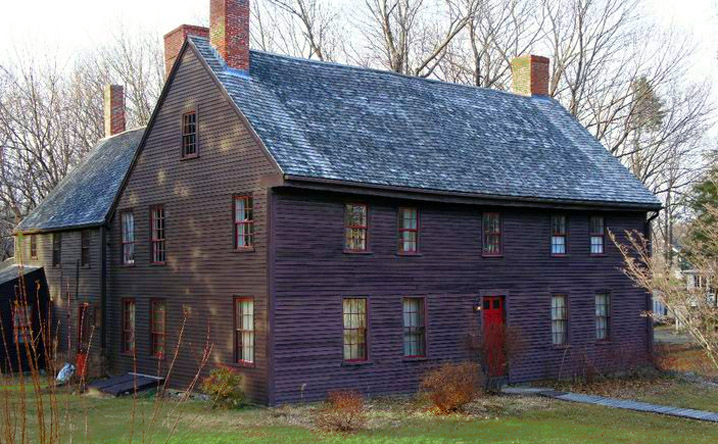


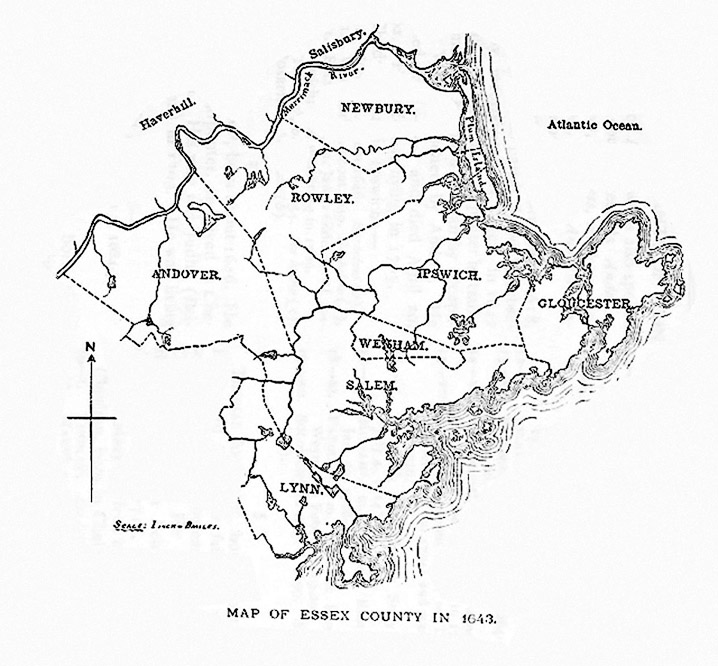
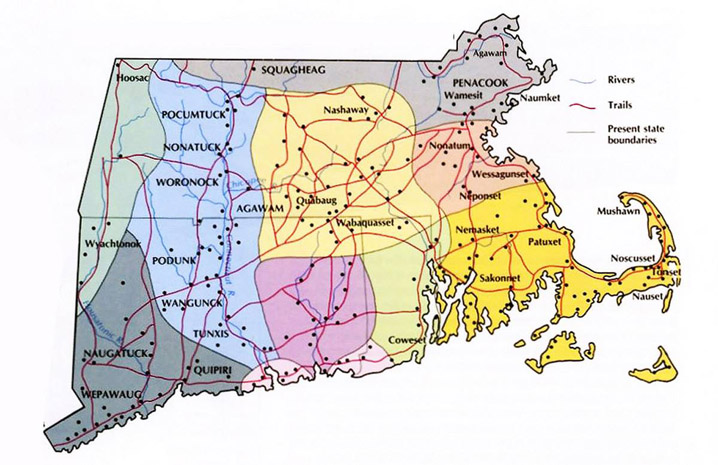
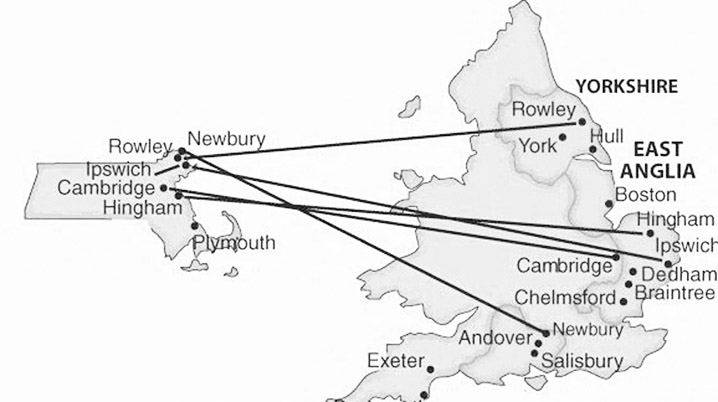

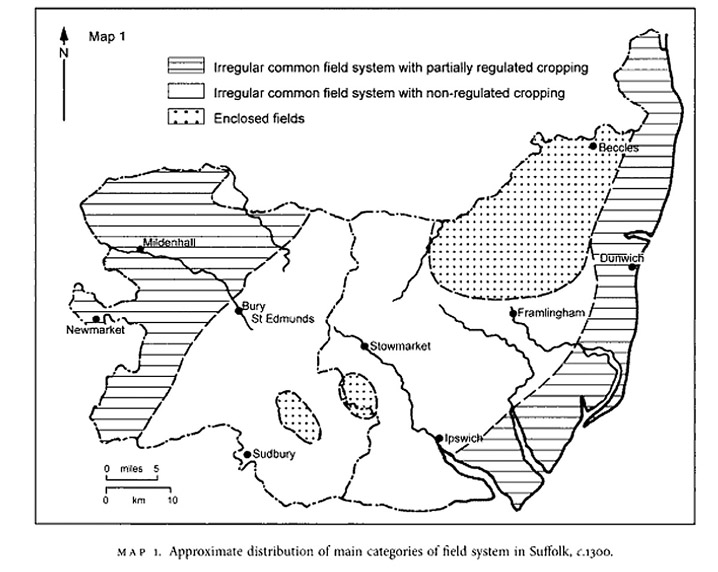

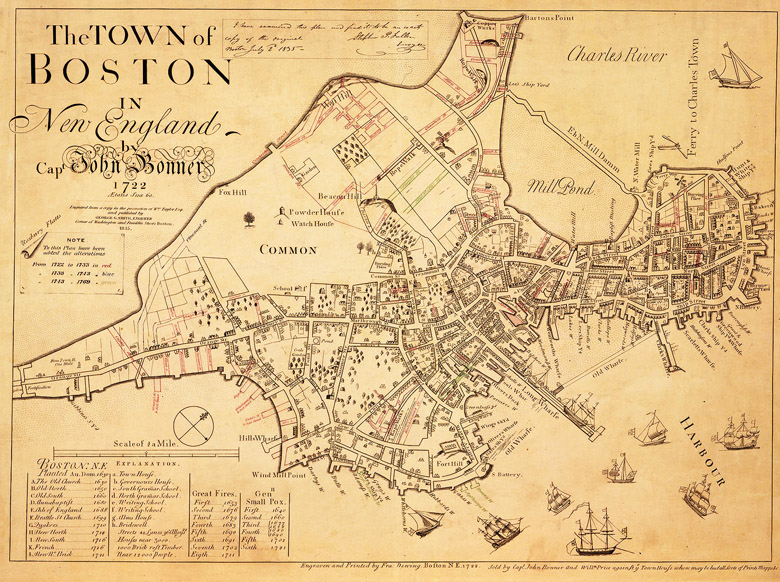
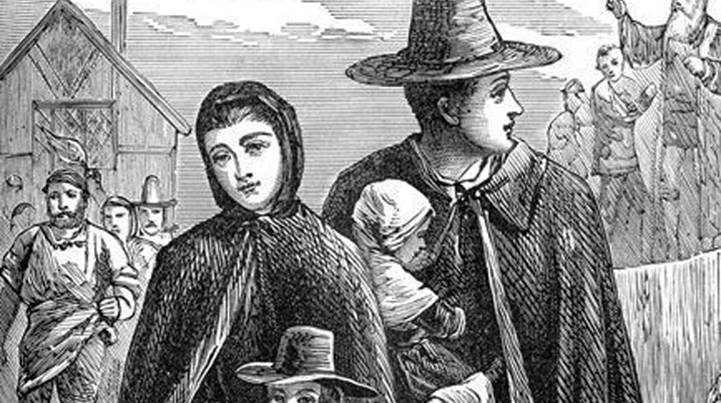
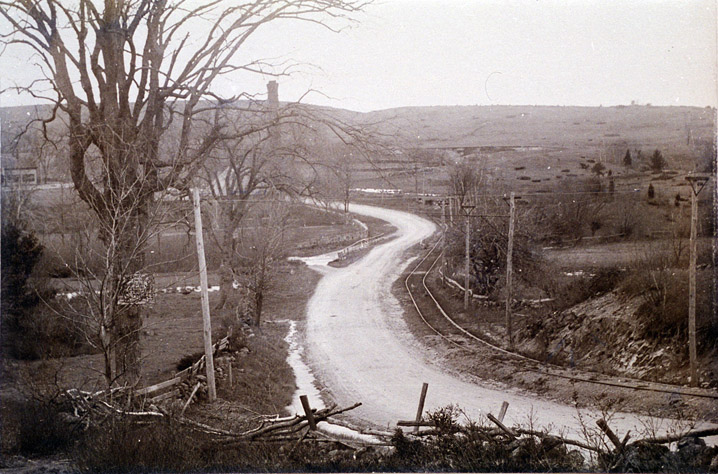
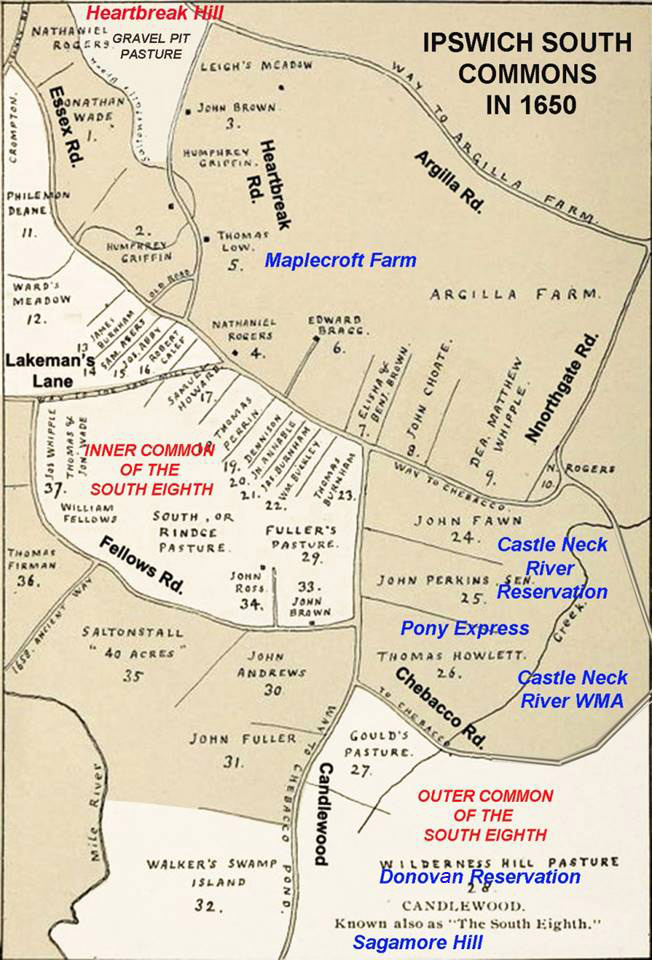
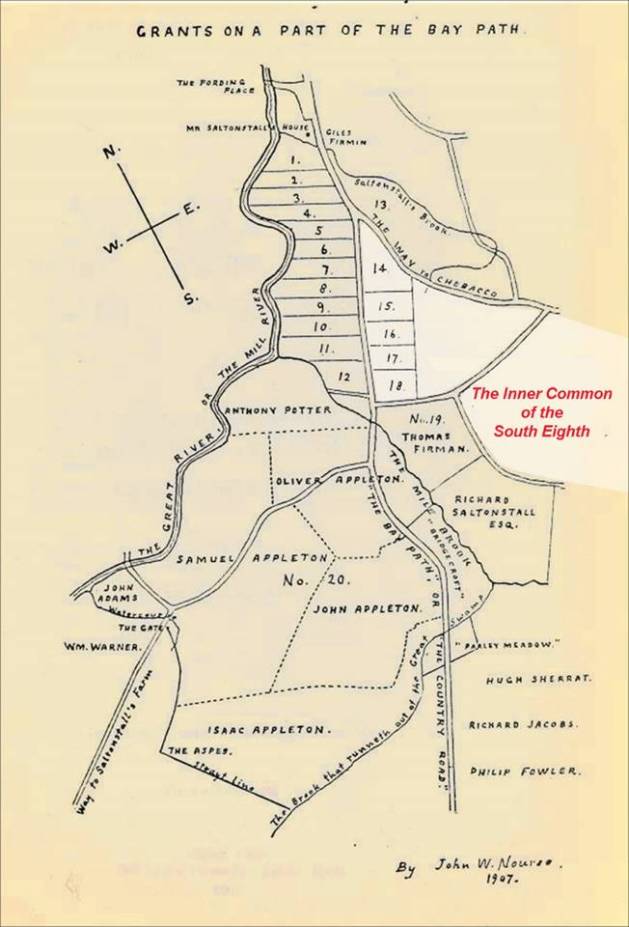

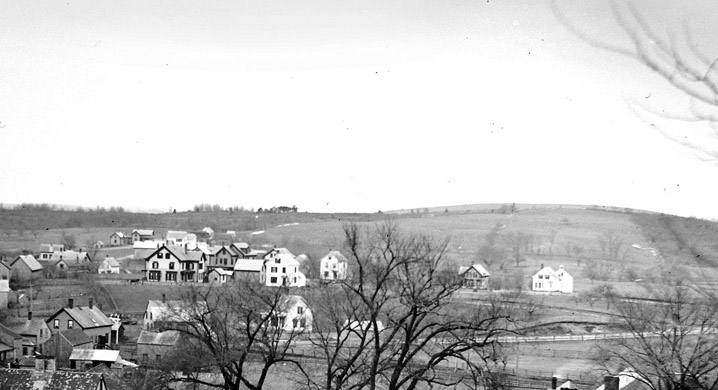
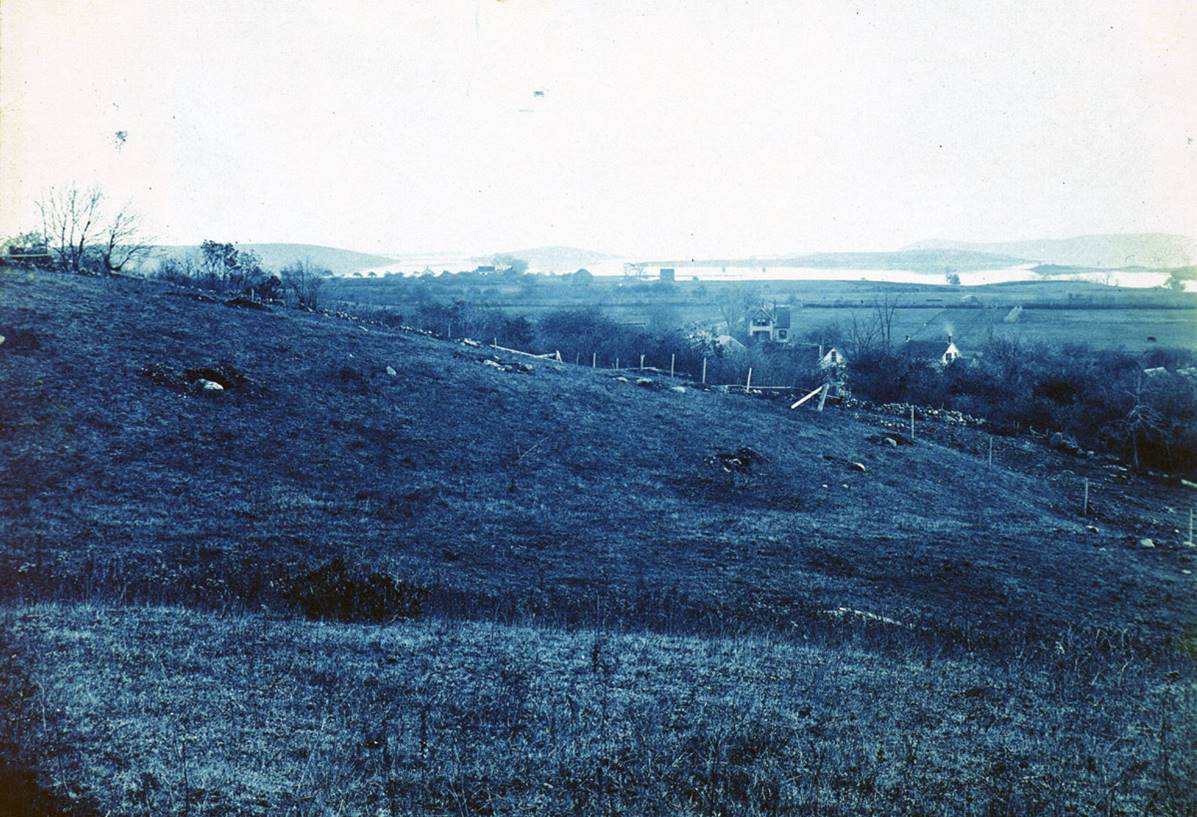
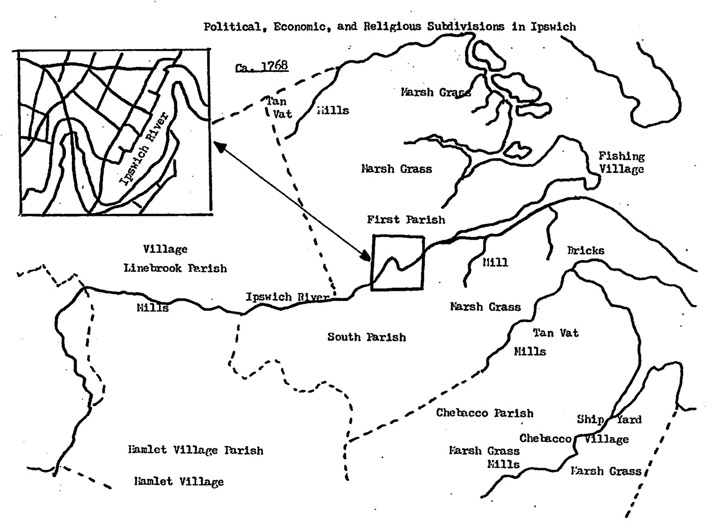
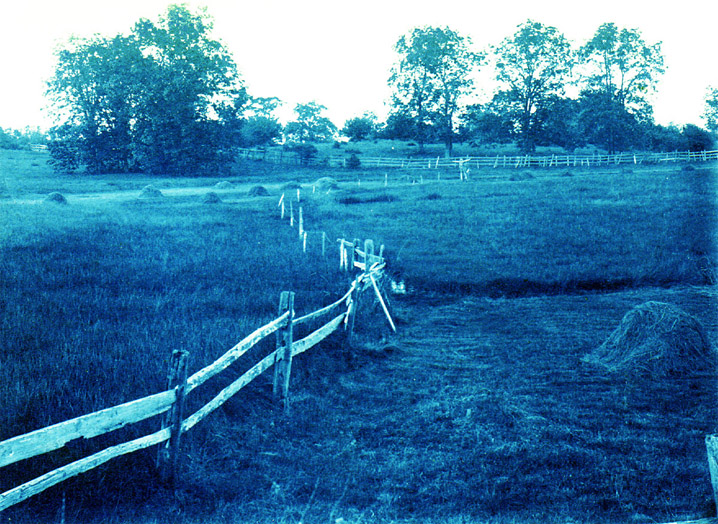


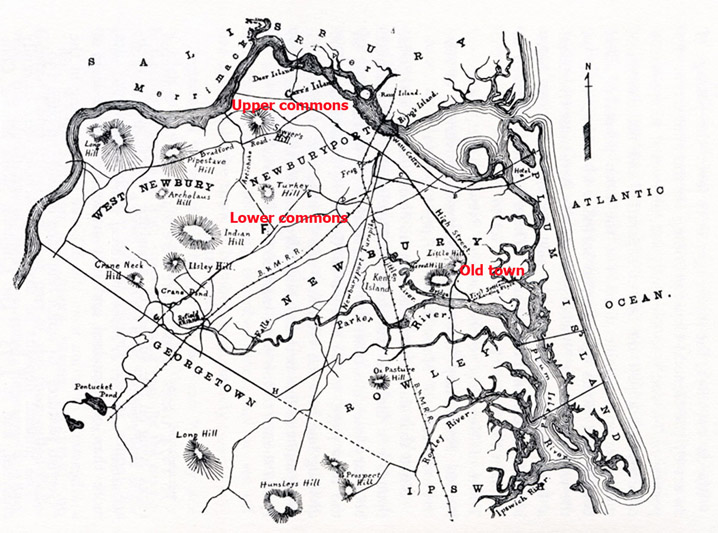


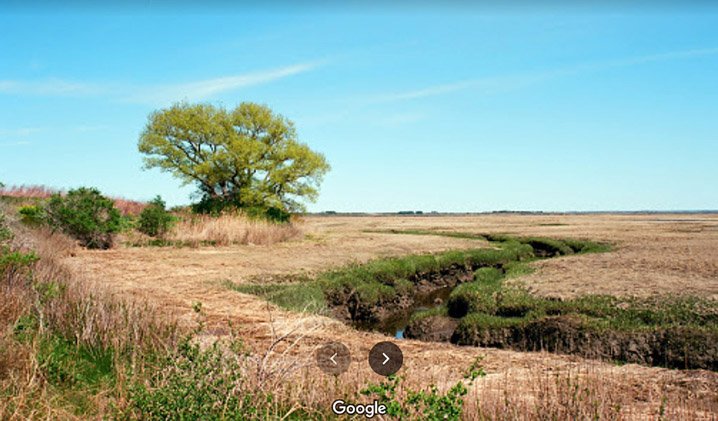
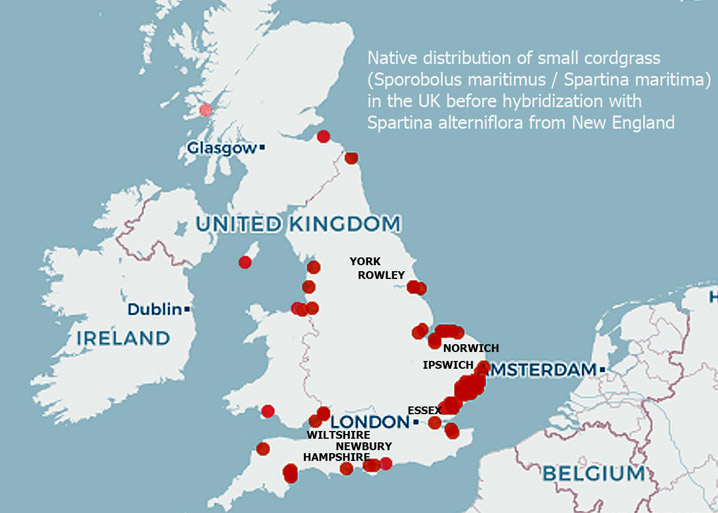
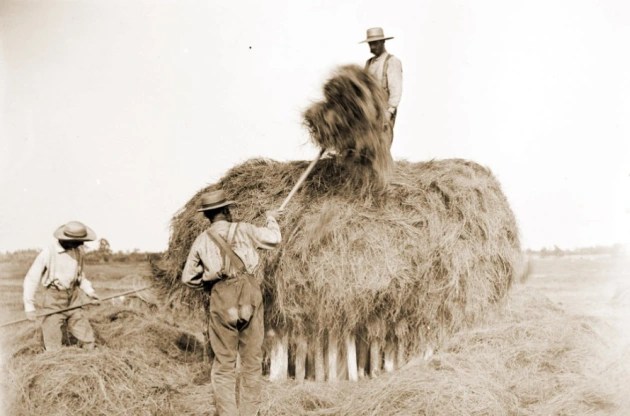
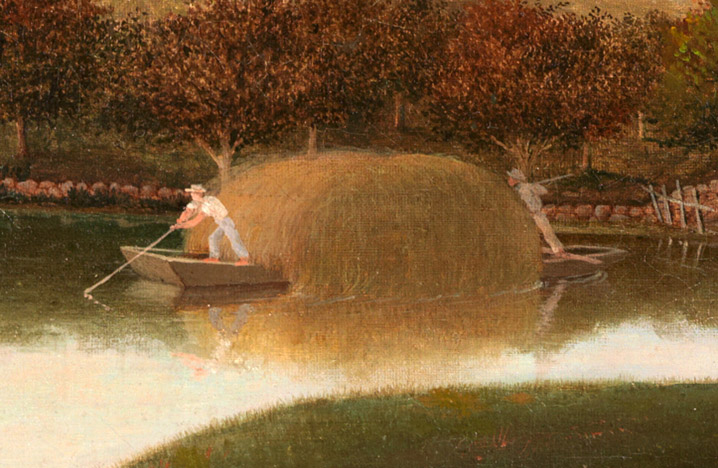
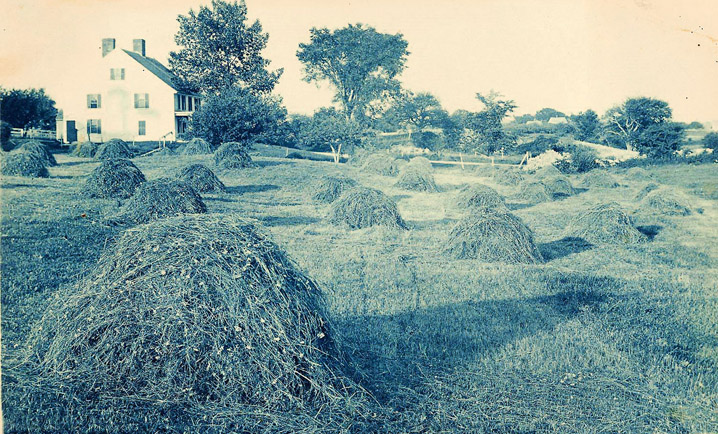
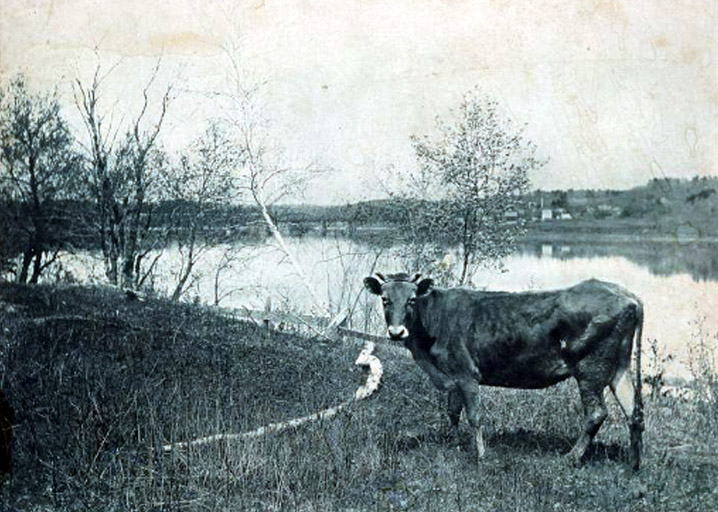


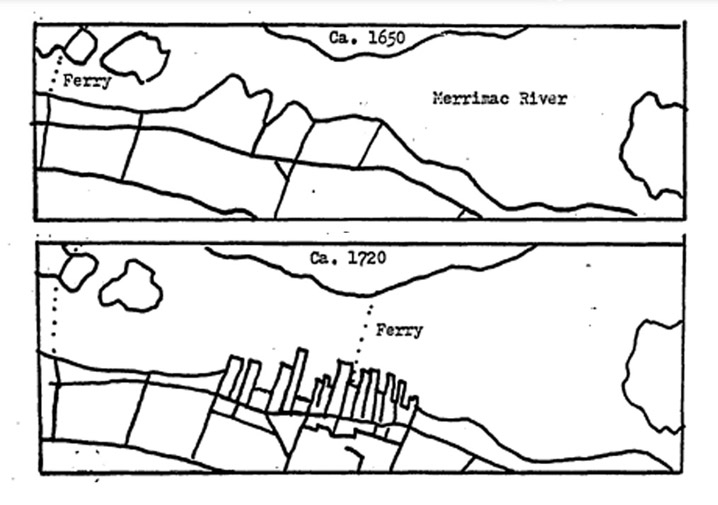


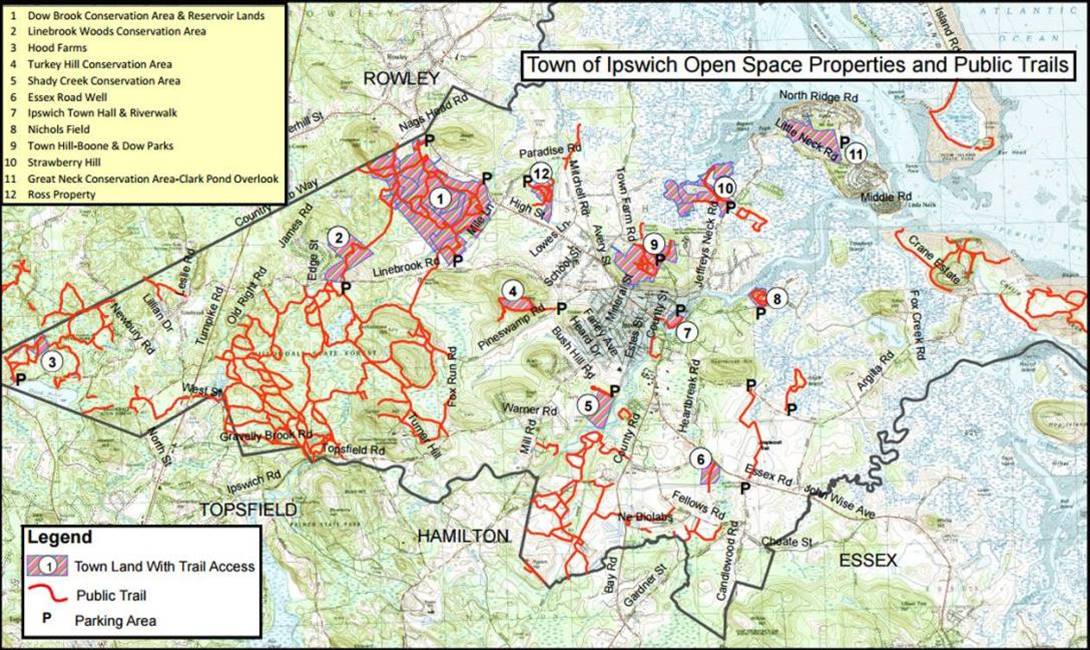


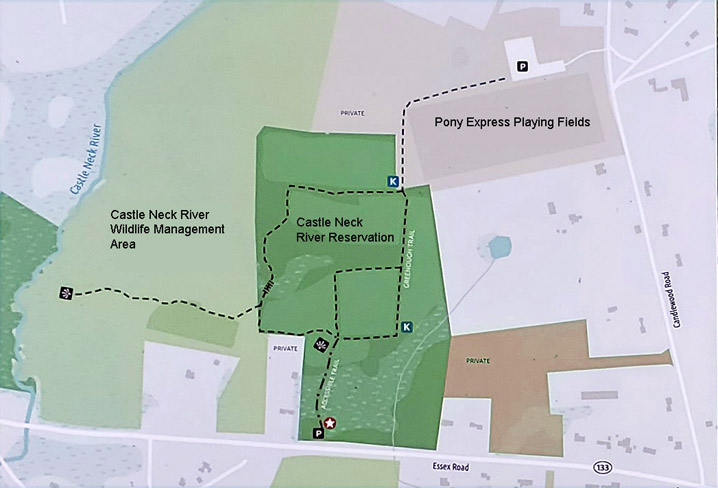

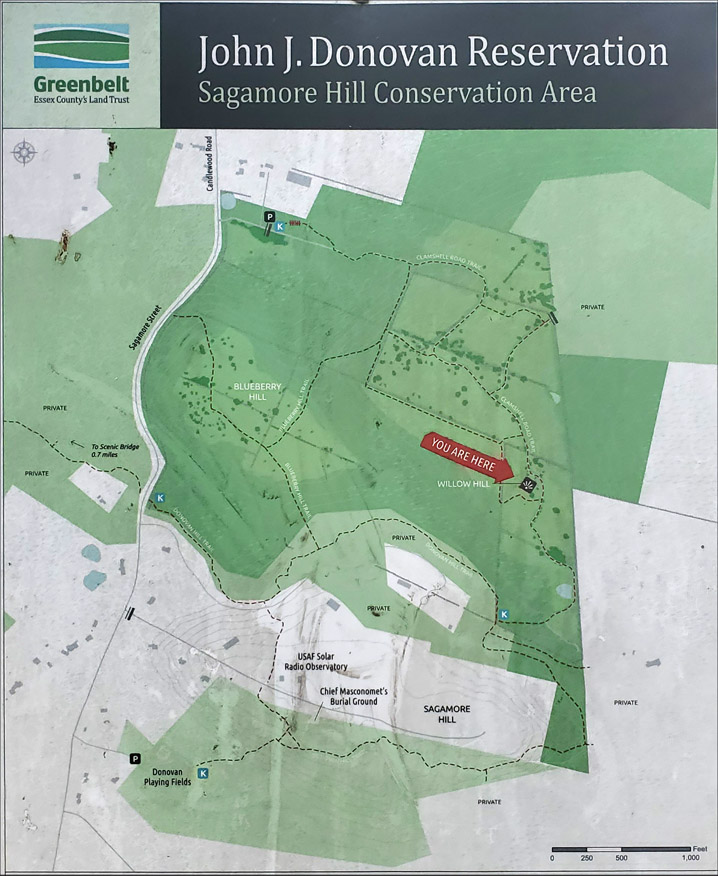


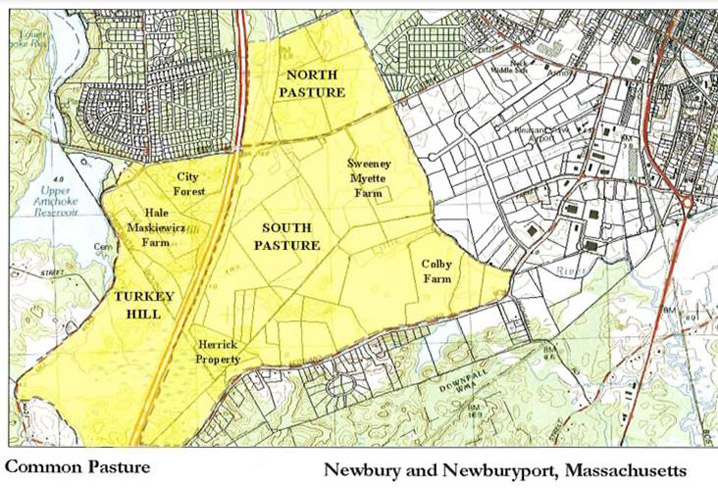
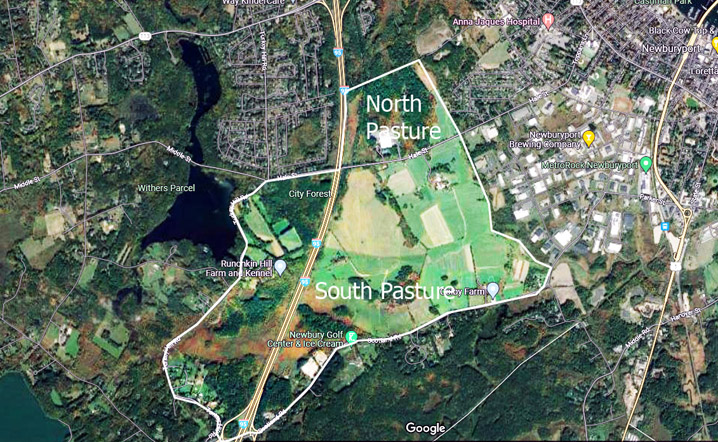
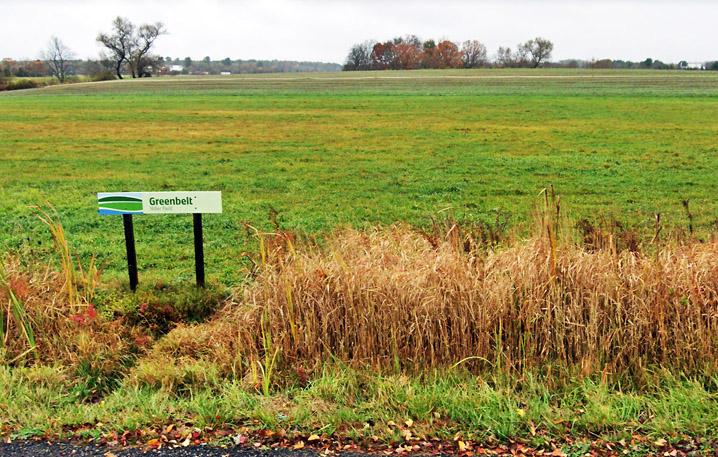

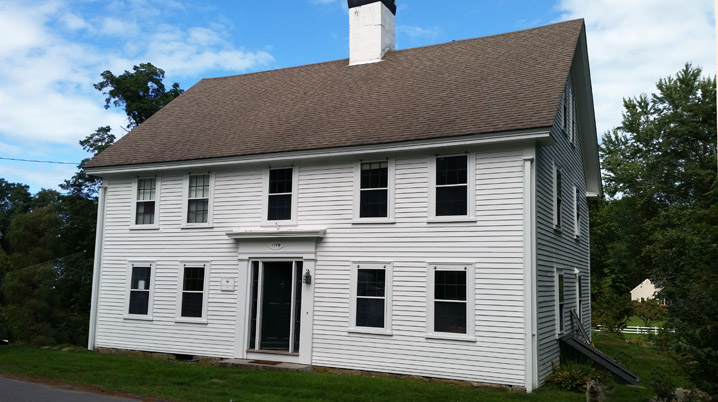
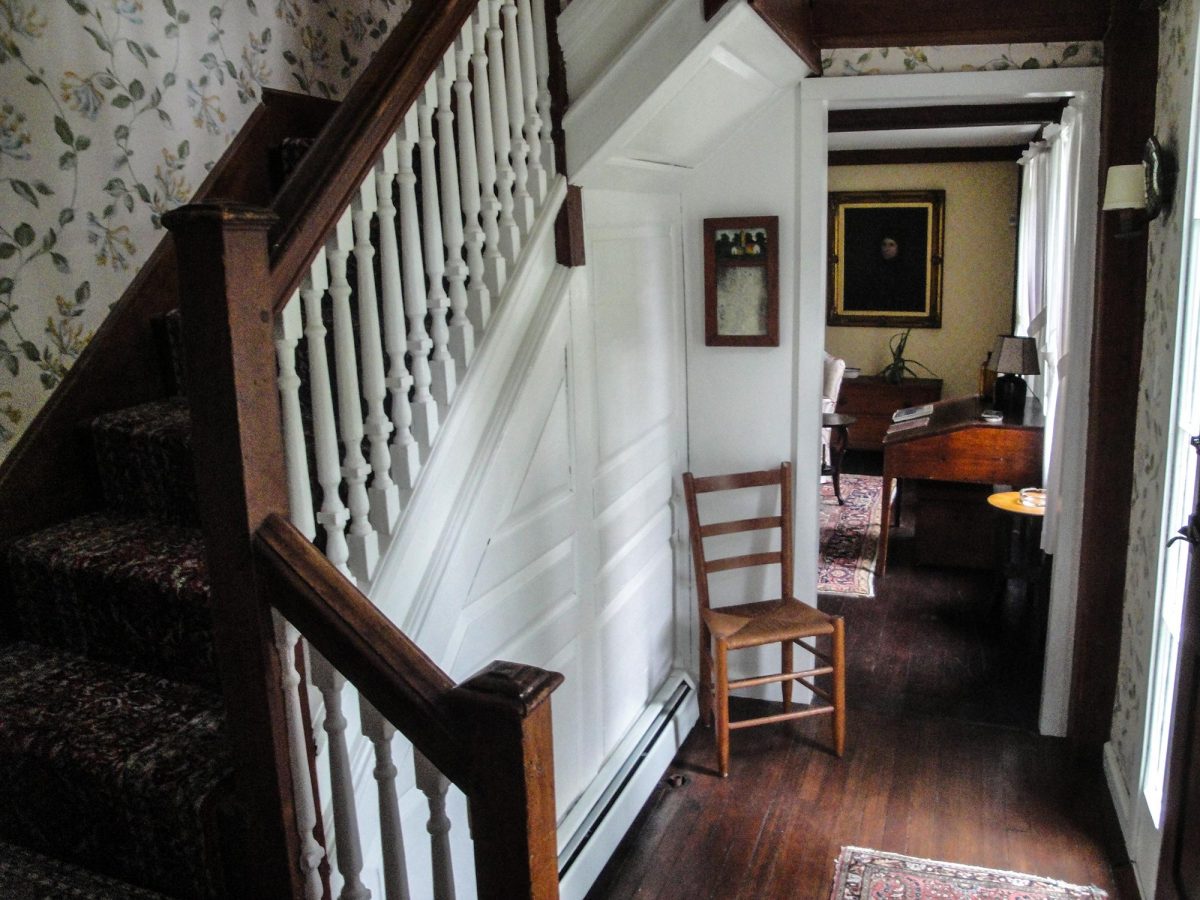

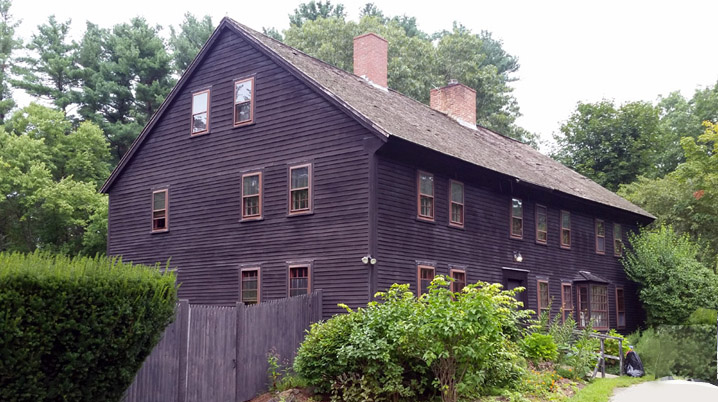


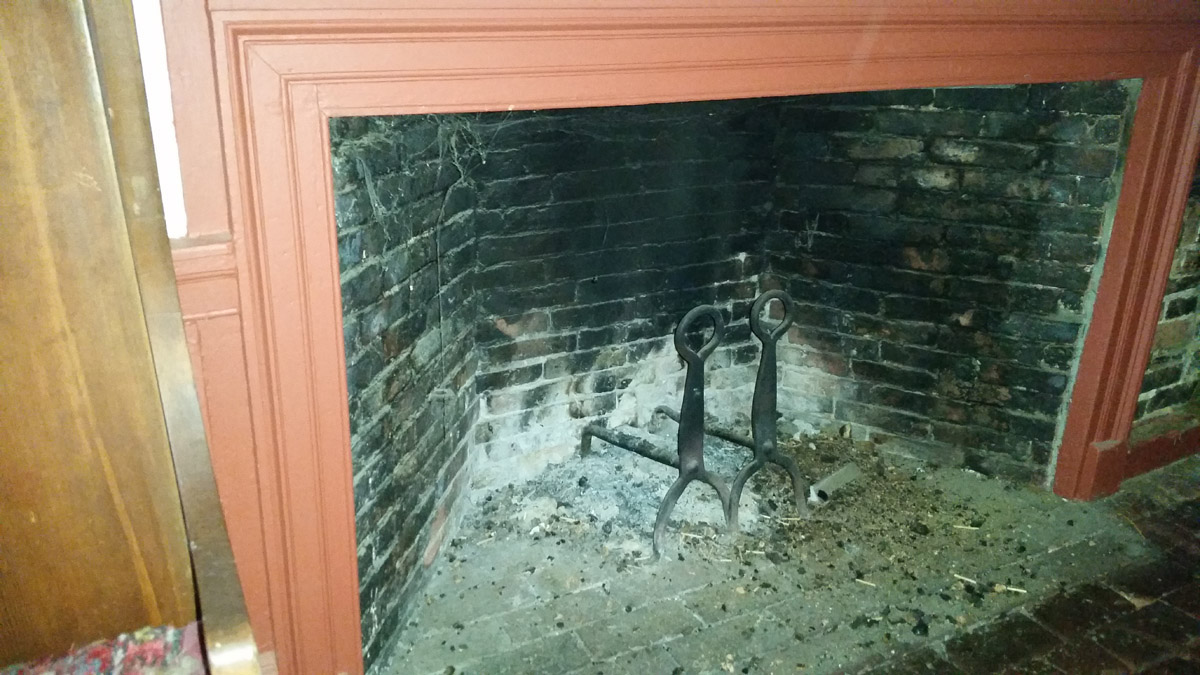
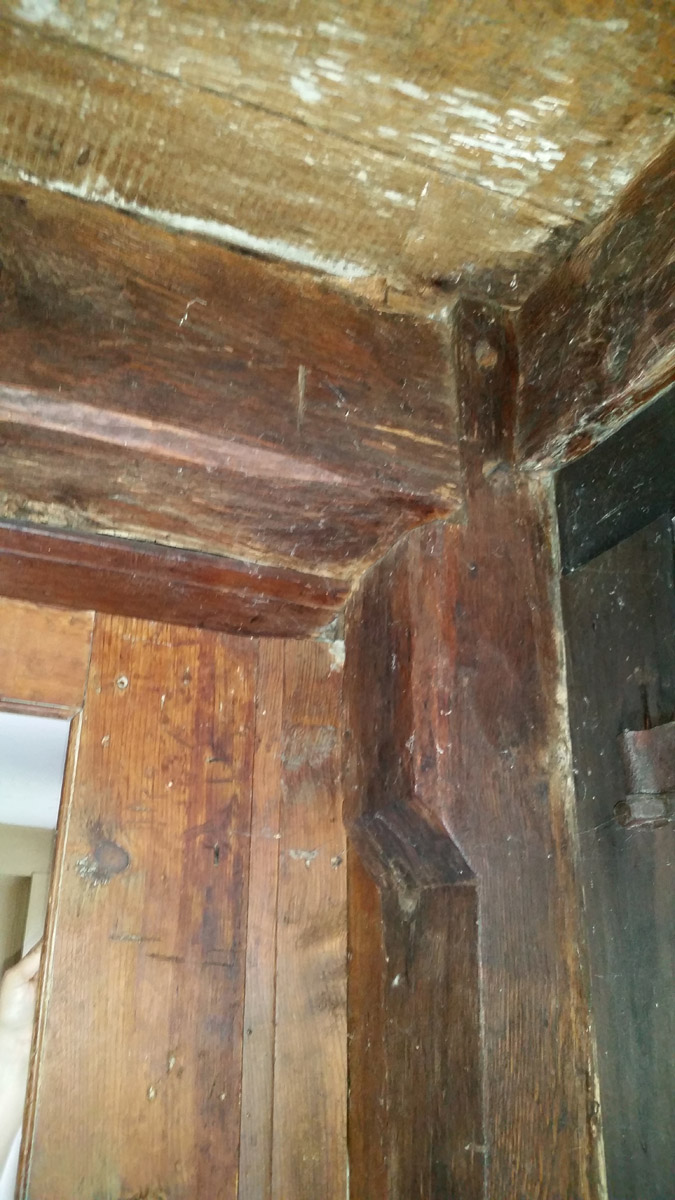


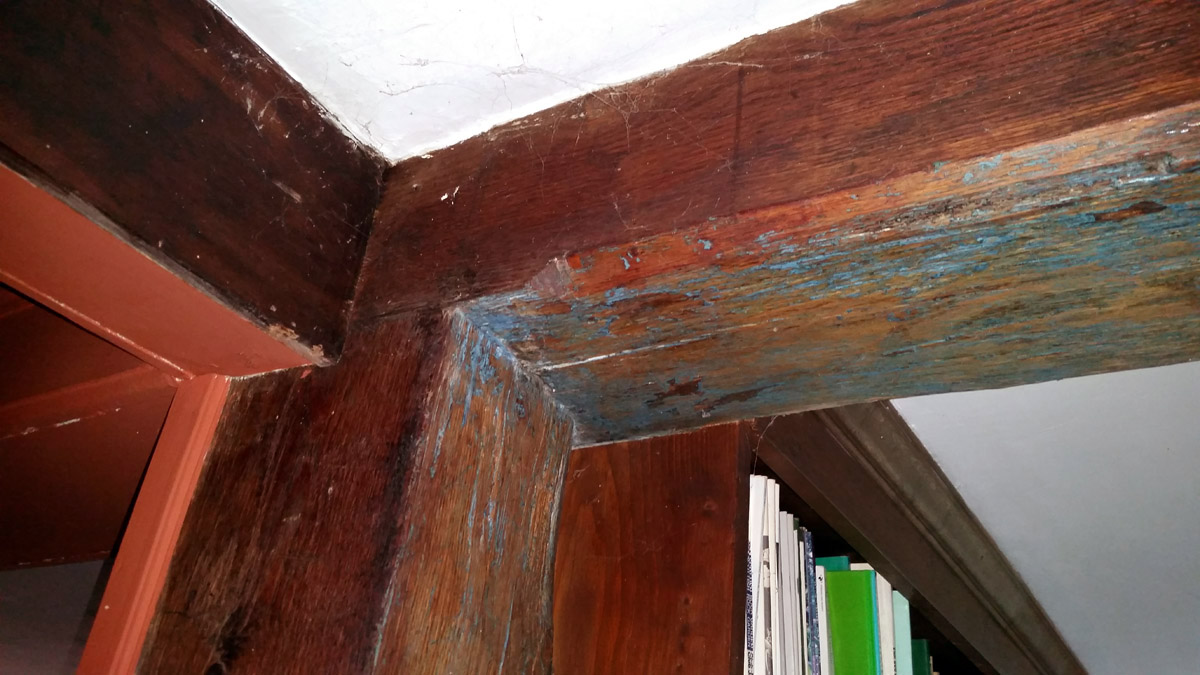


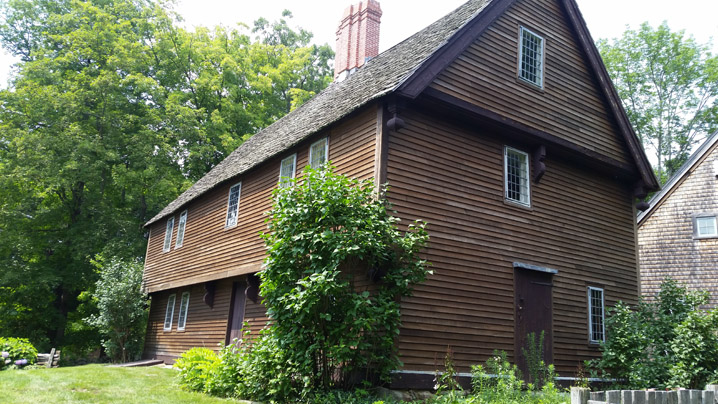


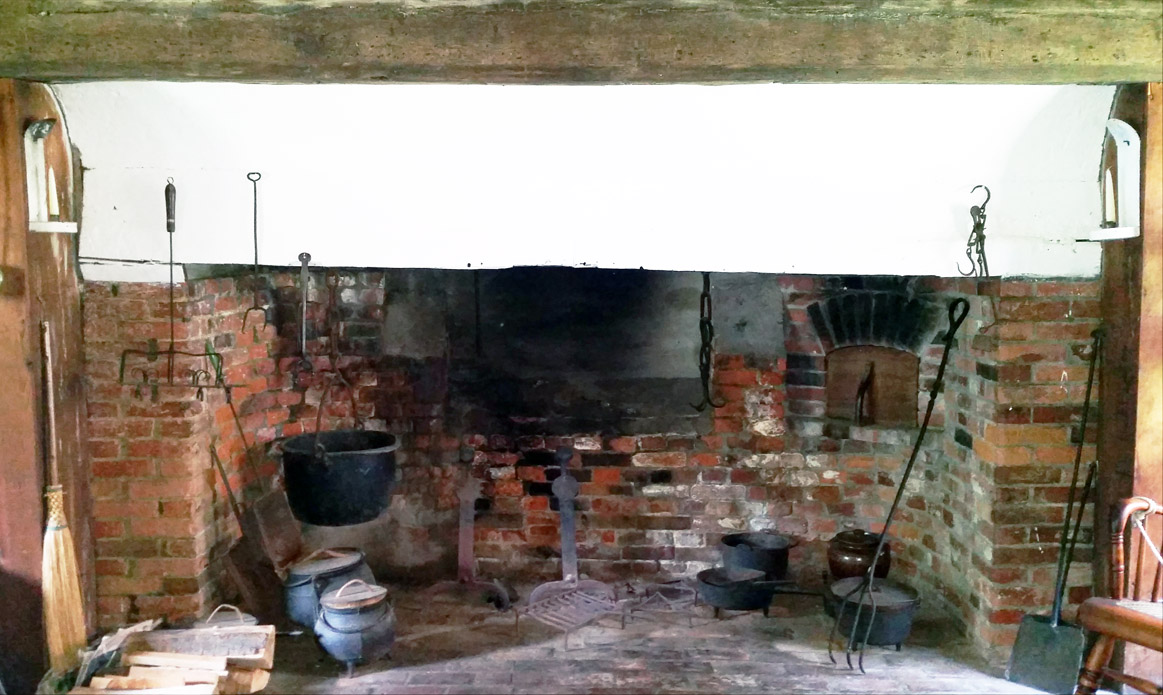


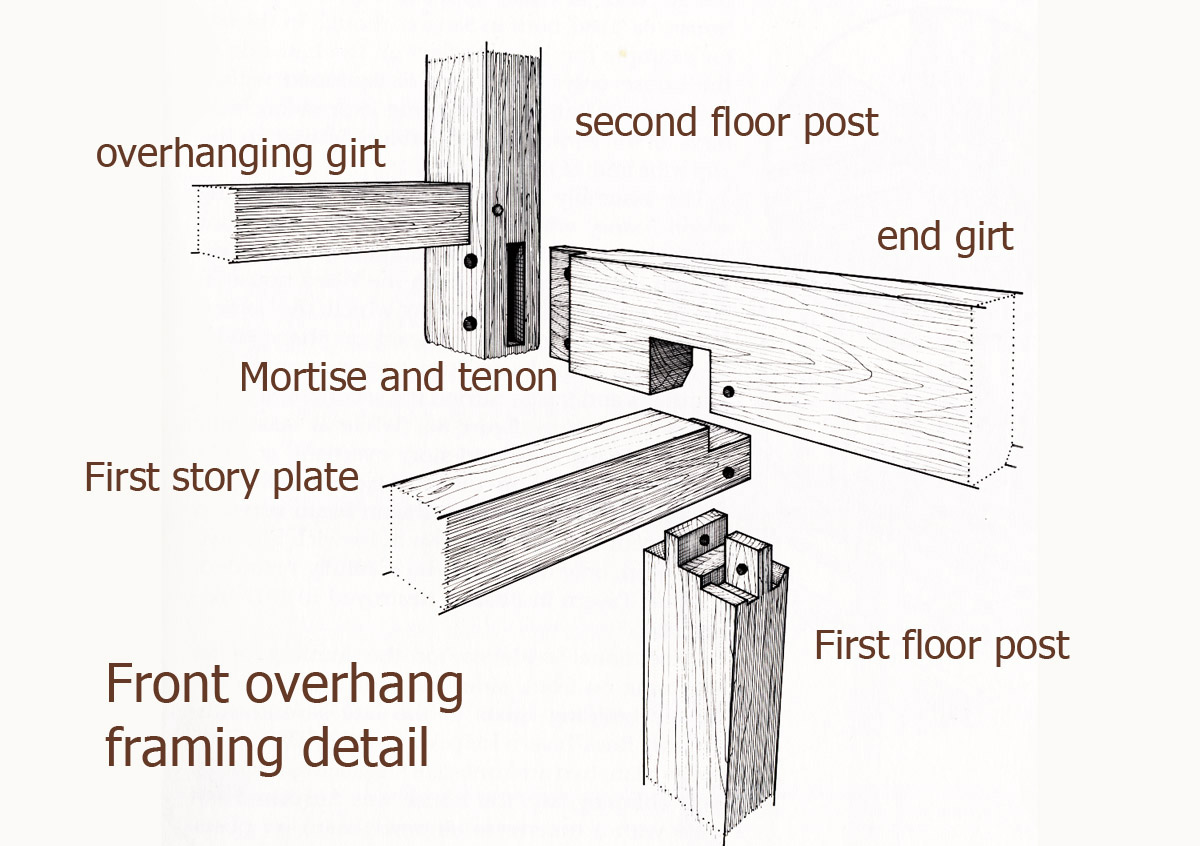
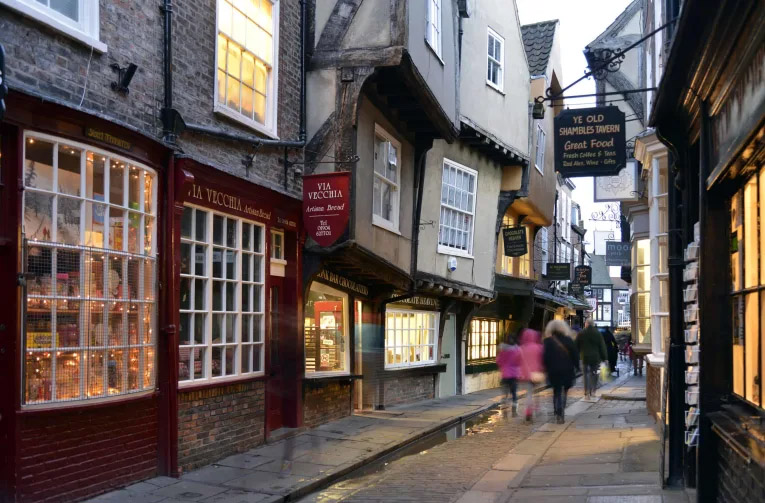
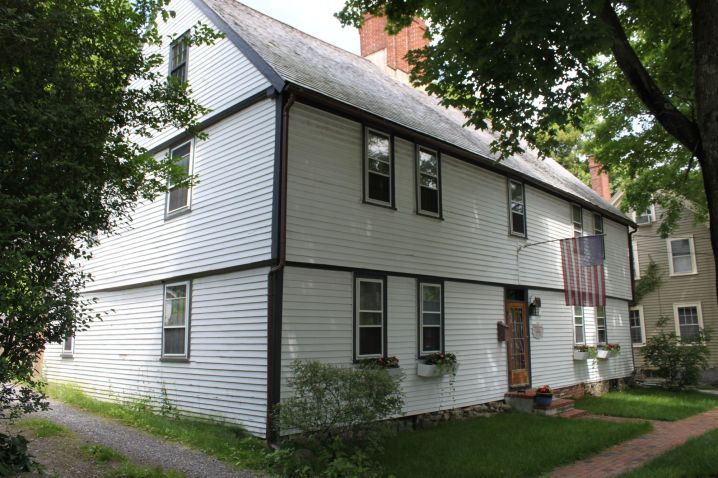
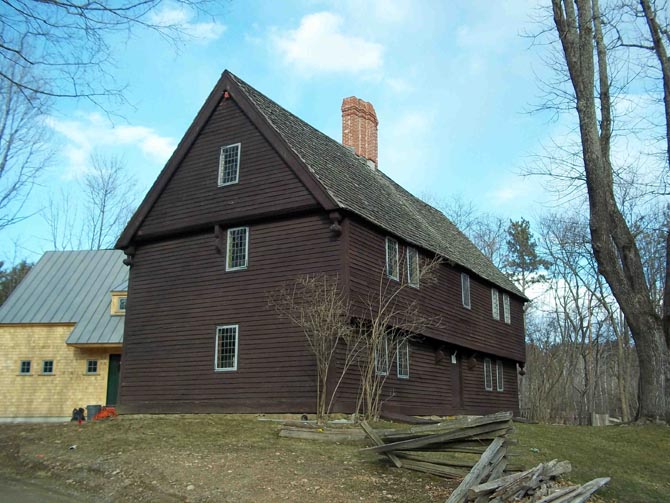

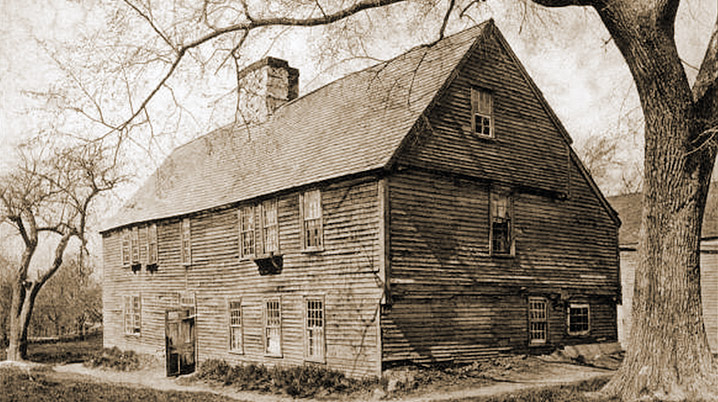
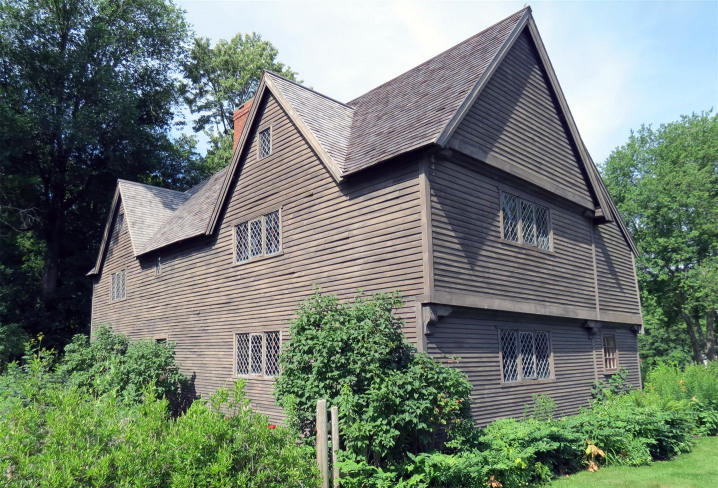
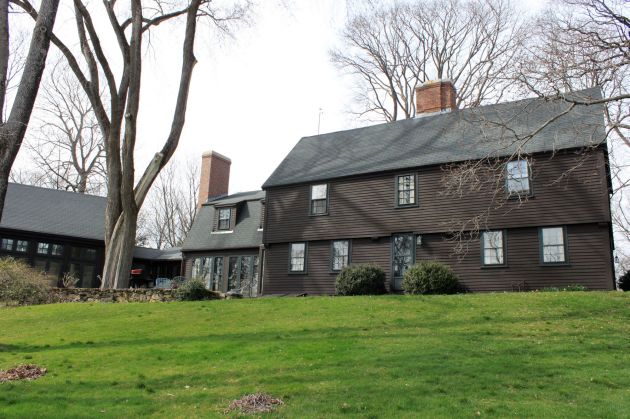


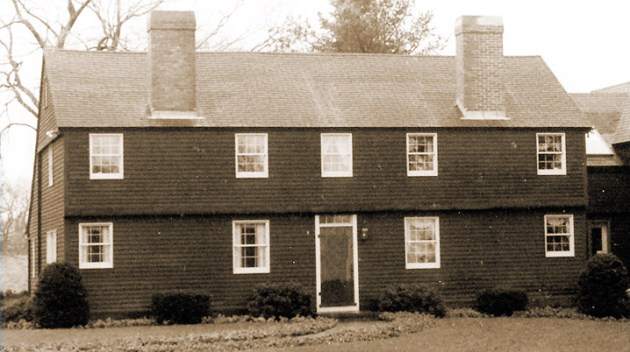
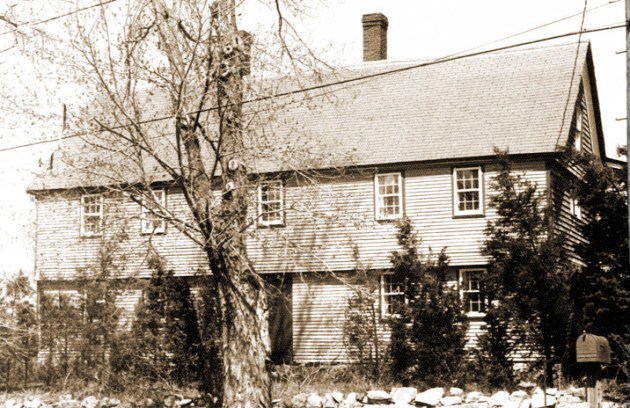
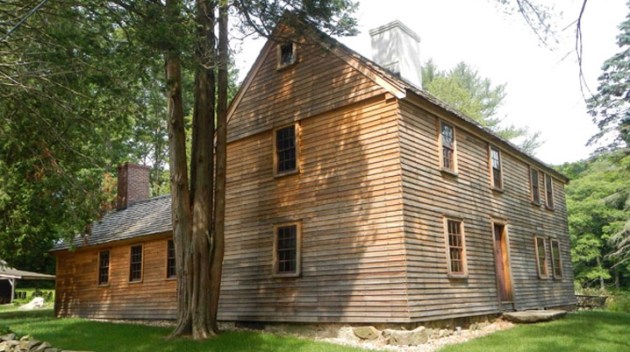
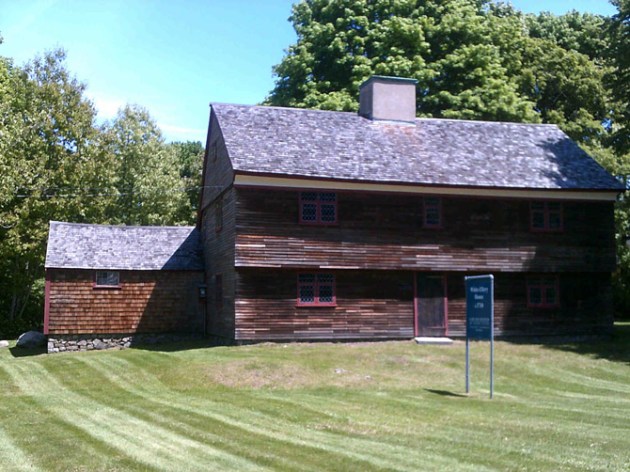
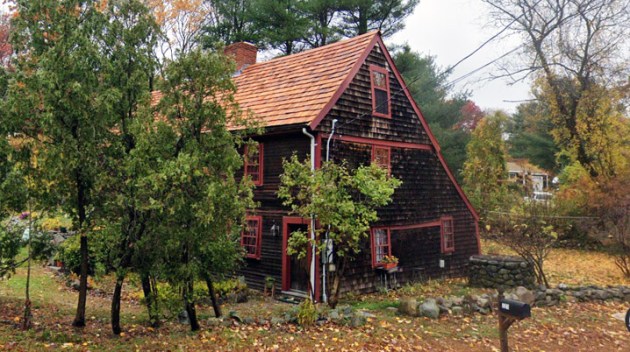
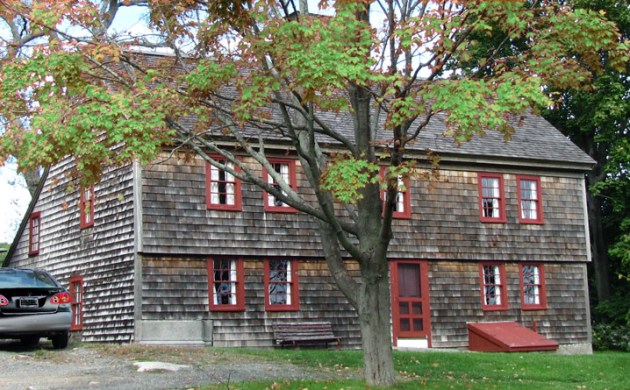


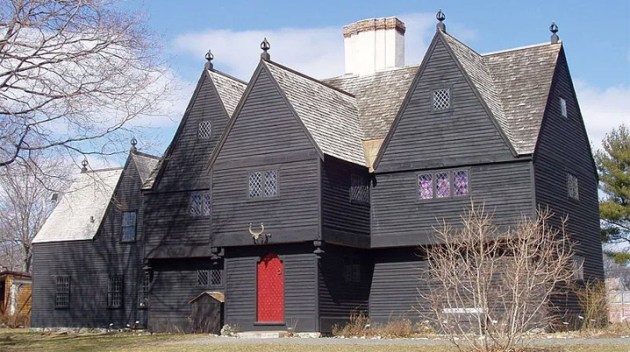
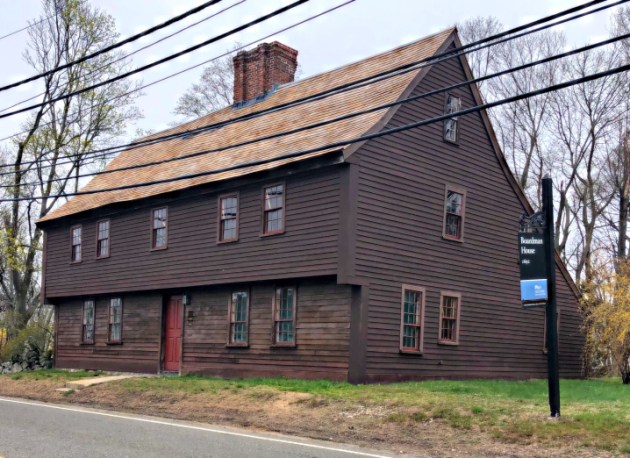
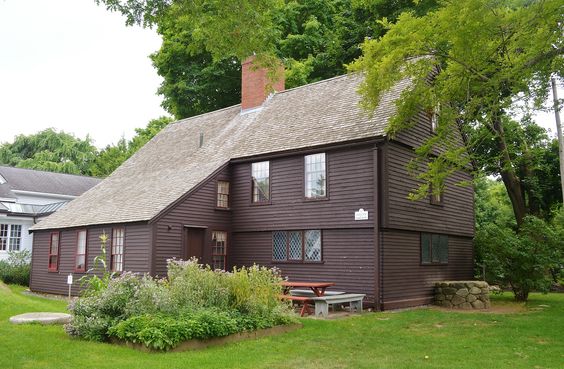
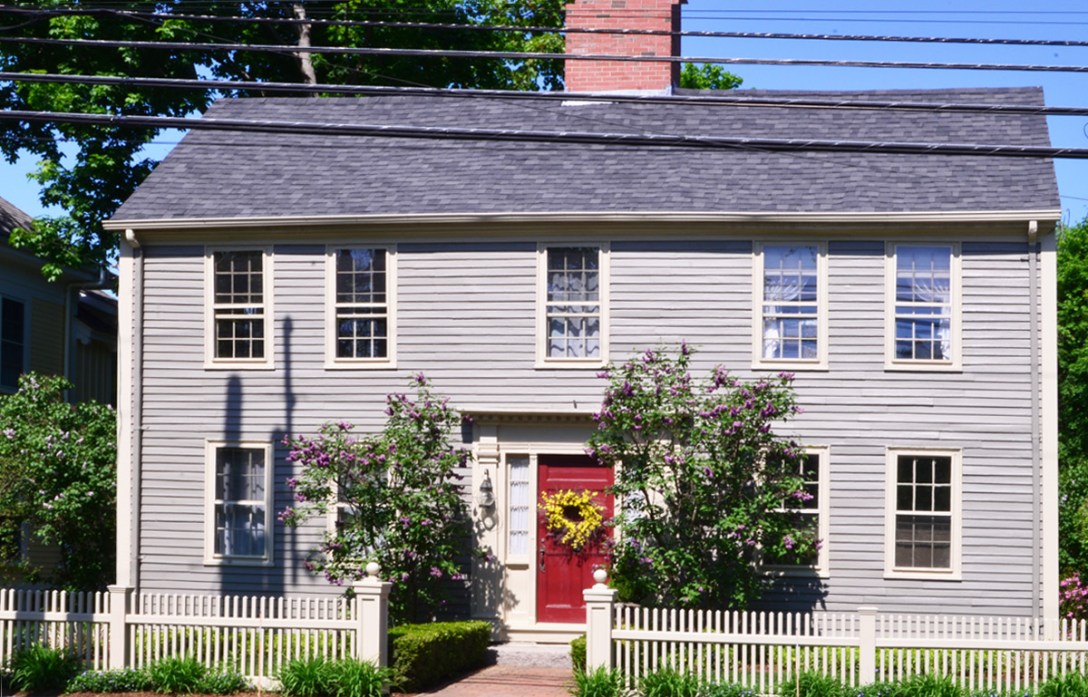

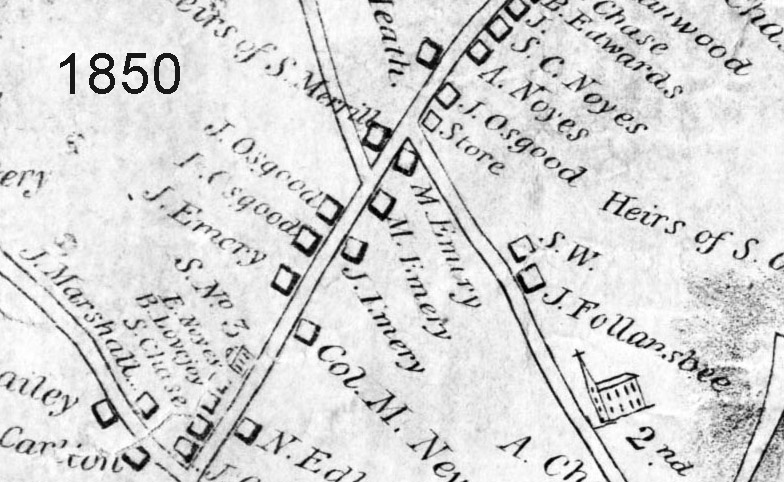

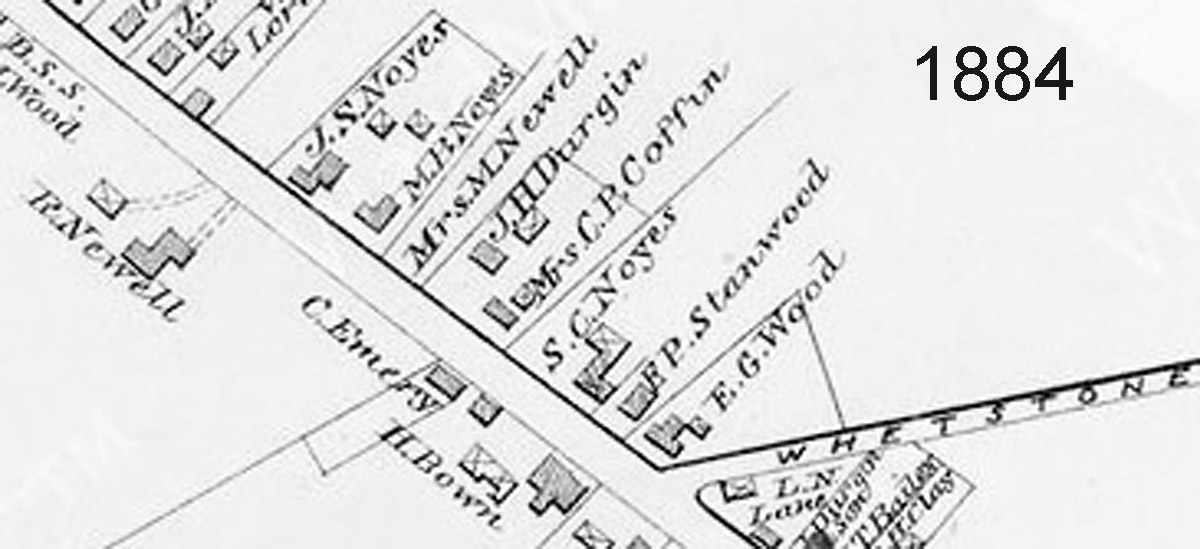
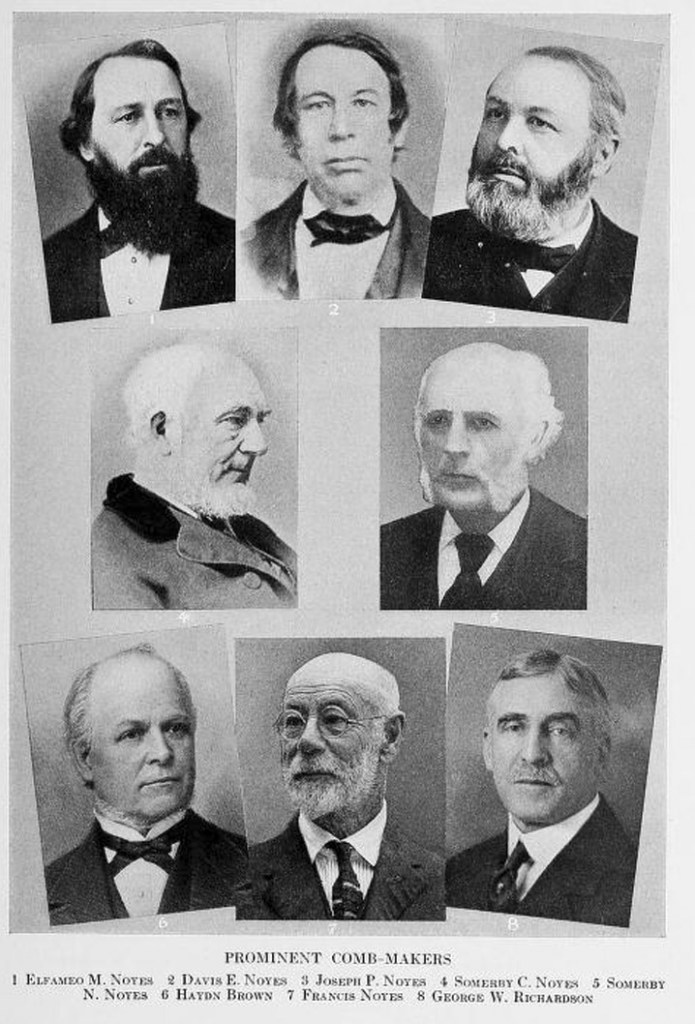


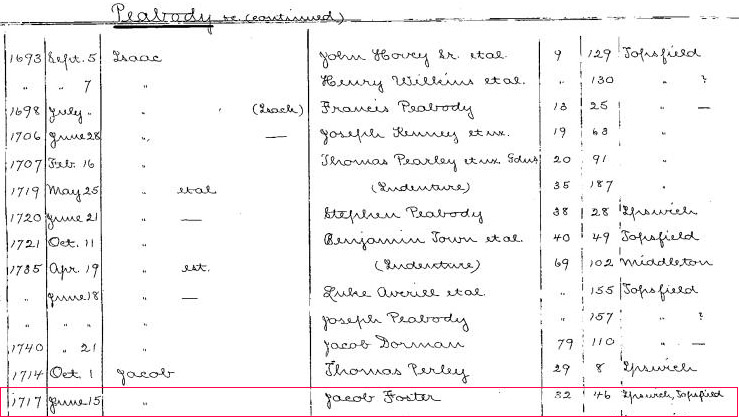


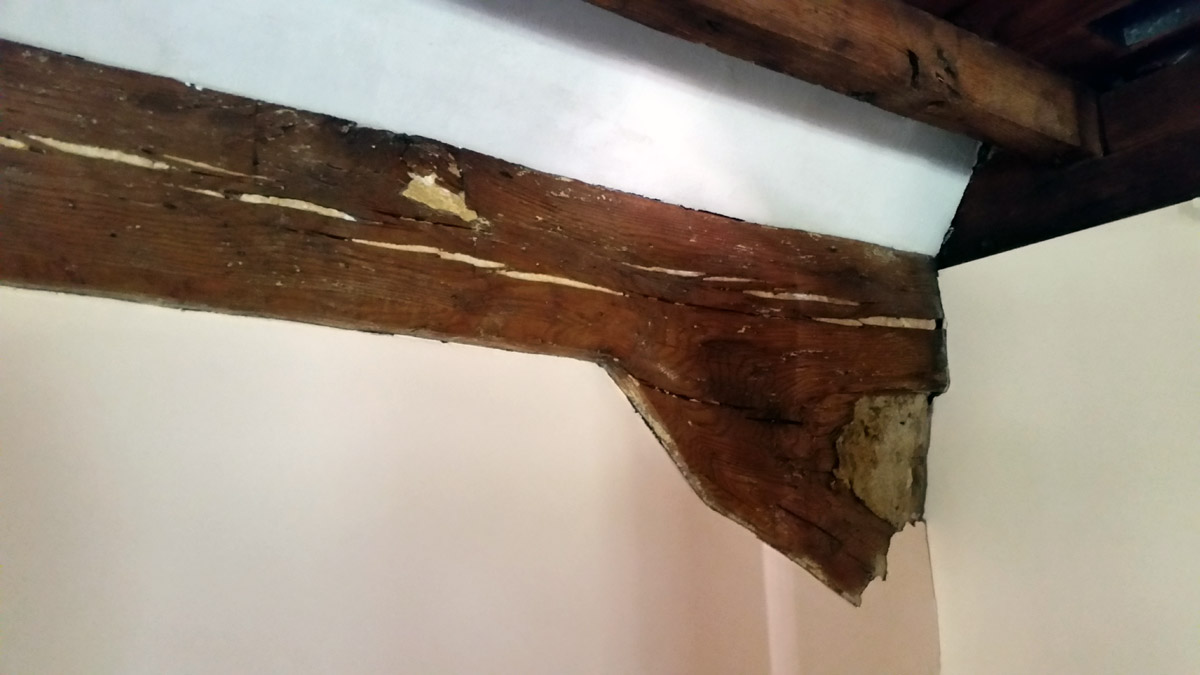

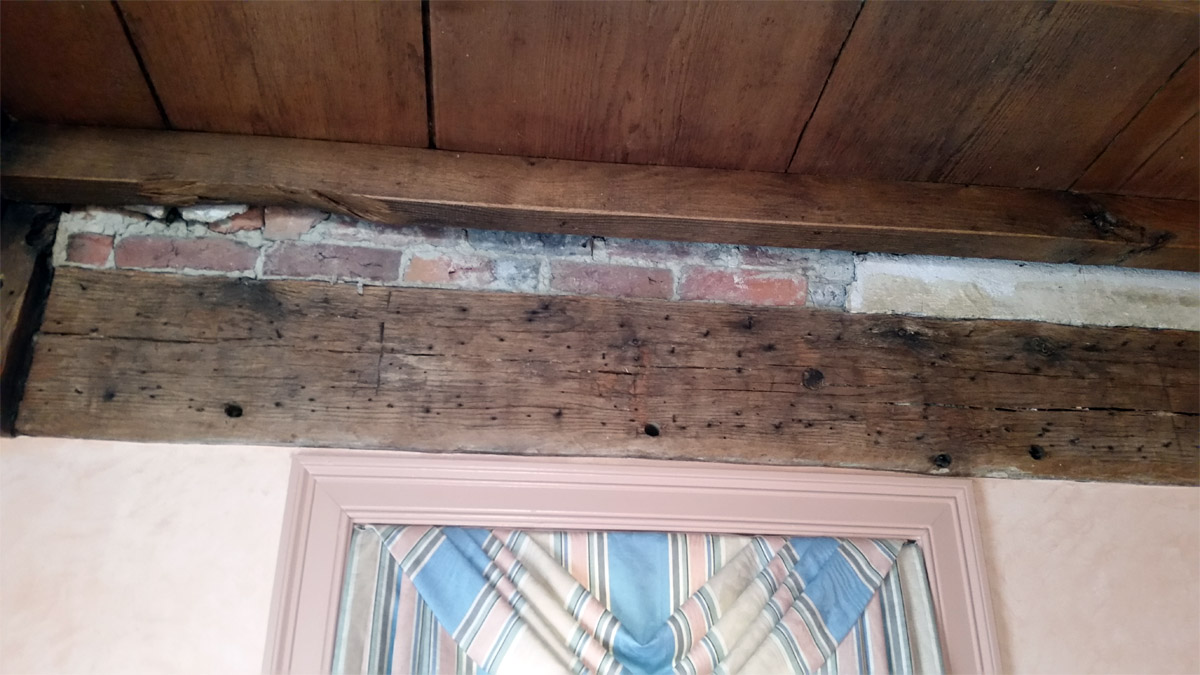
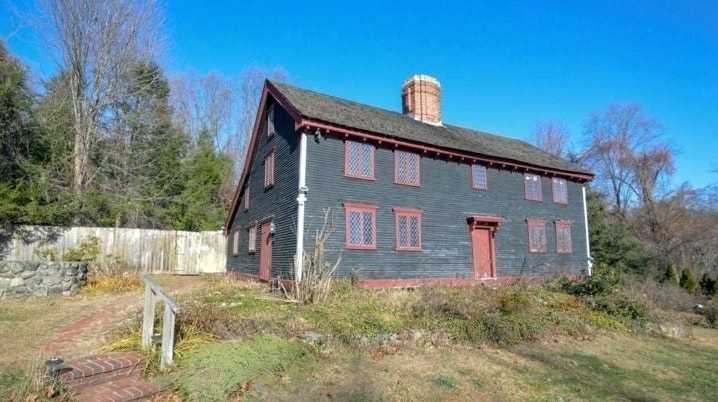
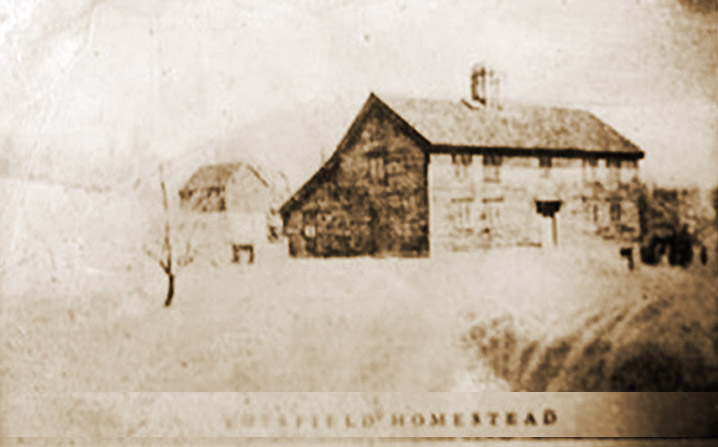

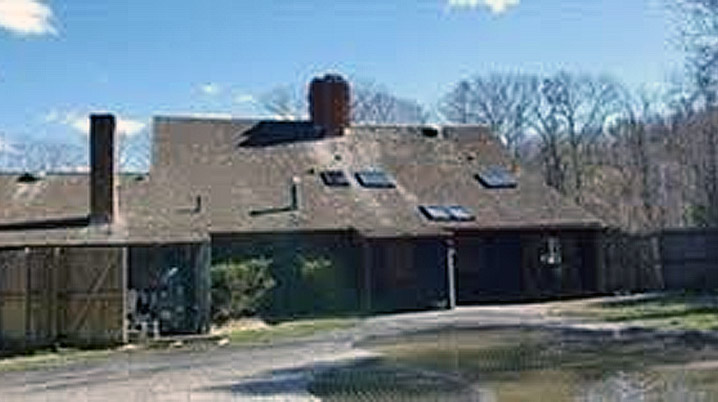


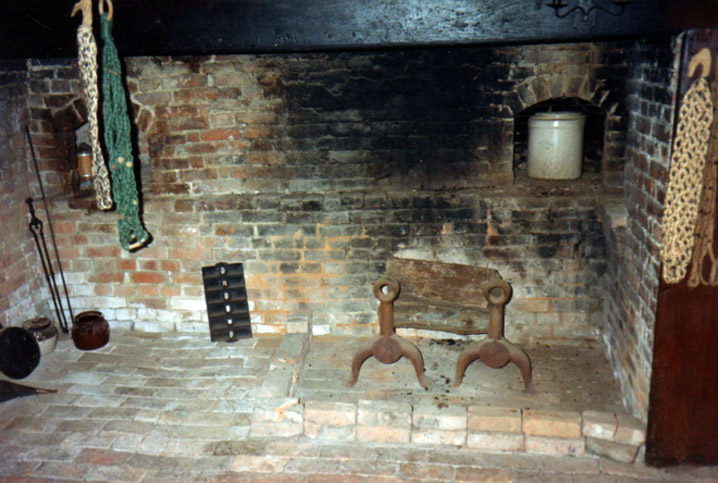


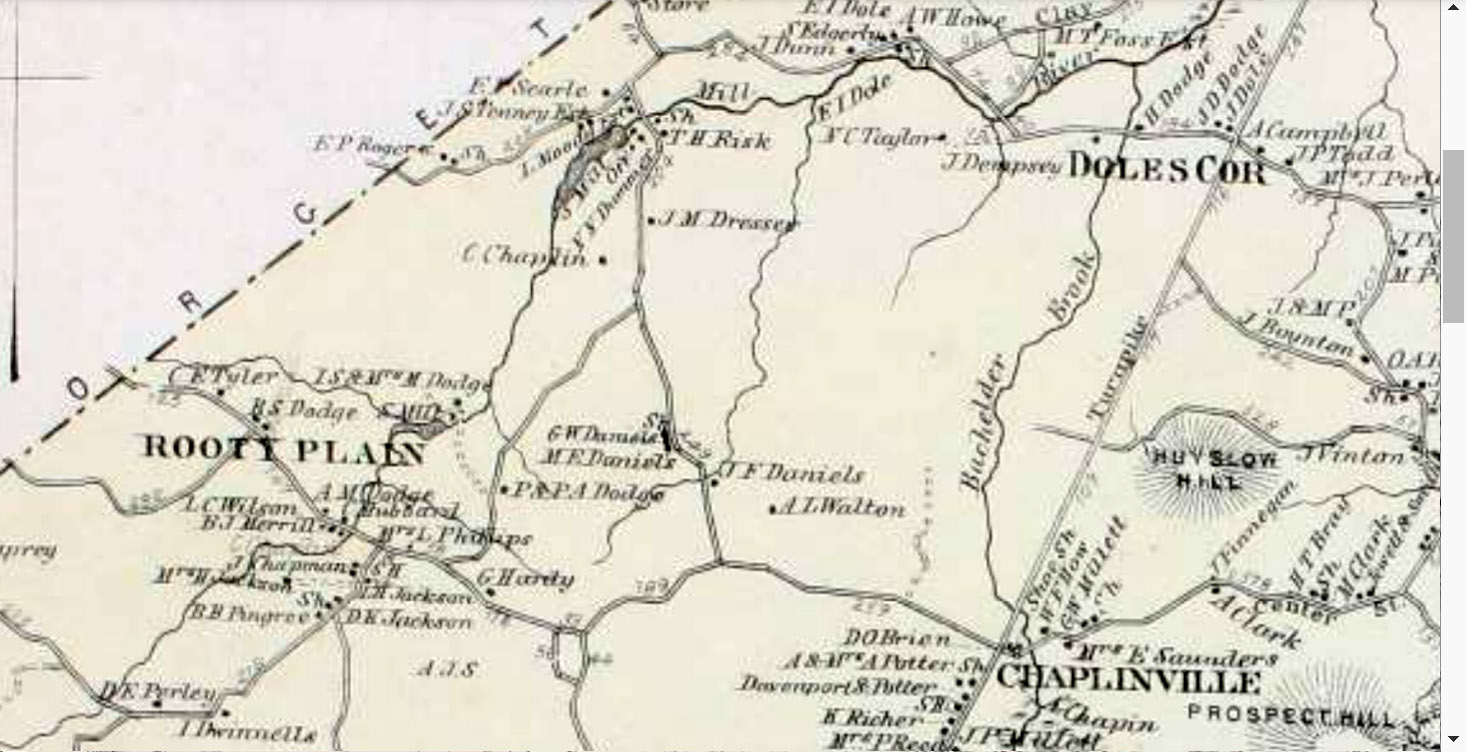

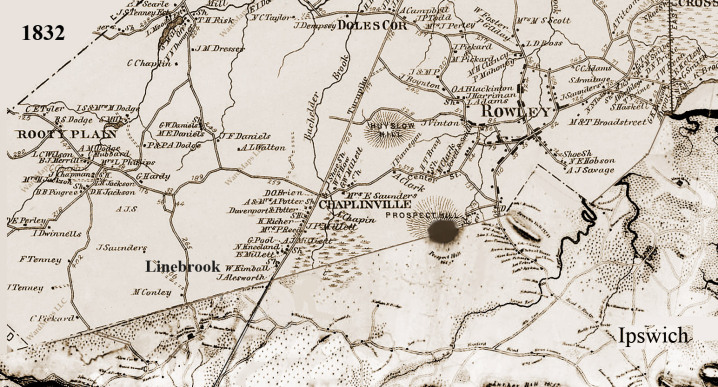


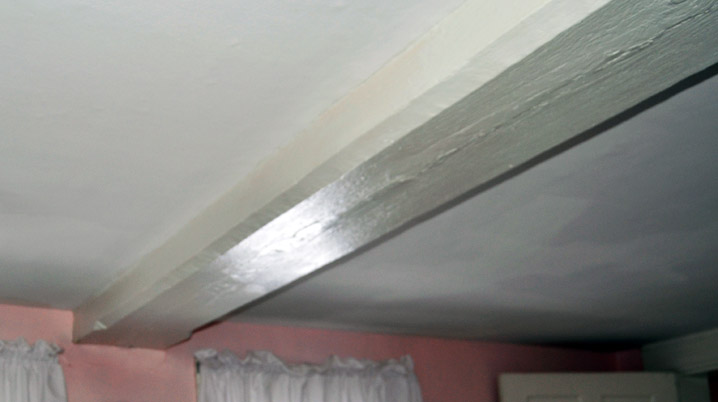
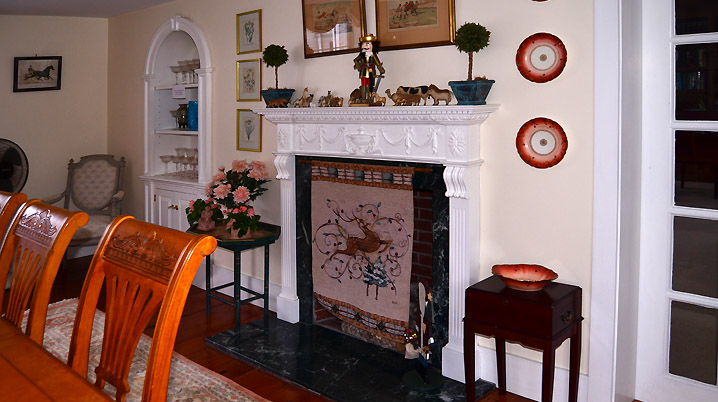
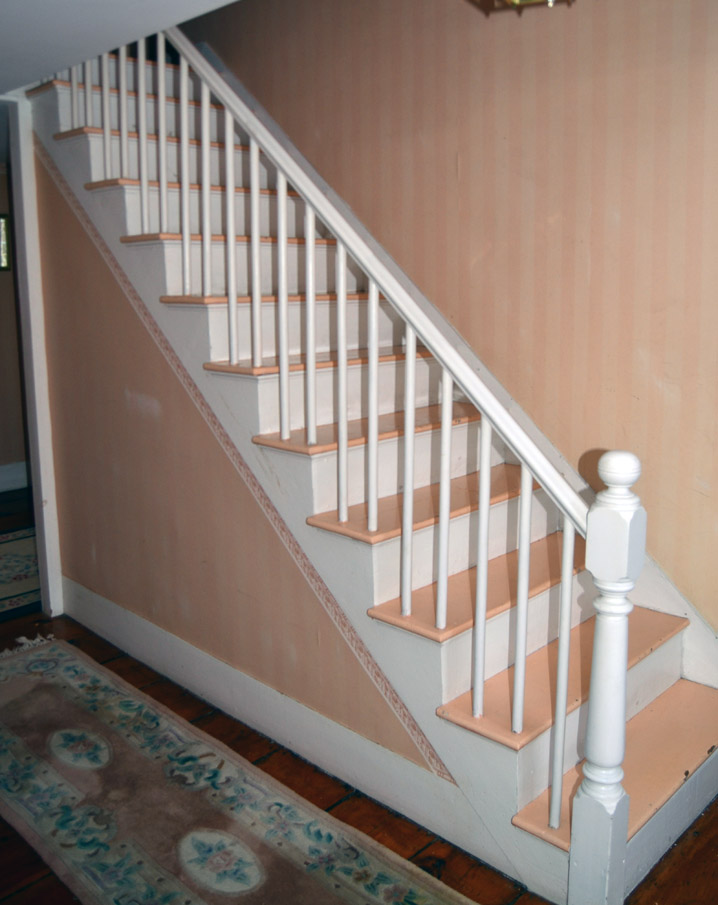

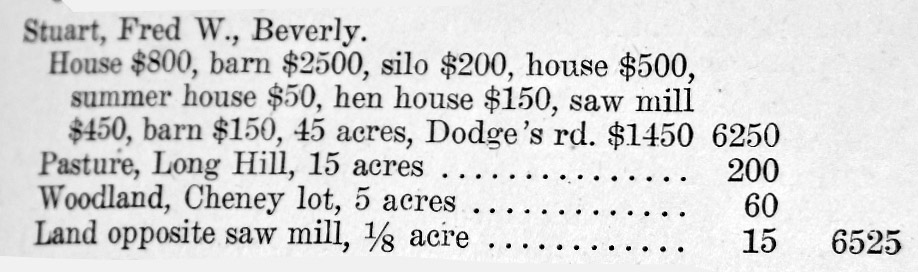


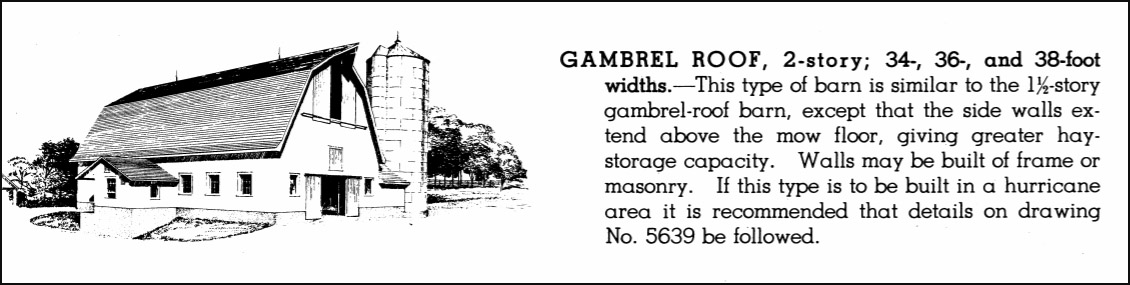


 17th & 18th Century Houses of Essex County, Massachusetts