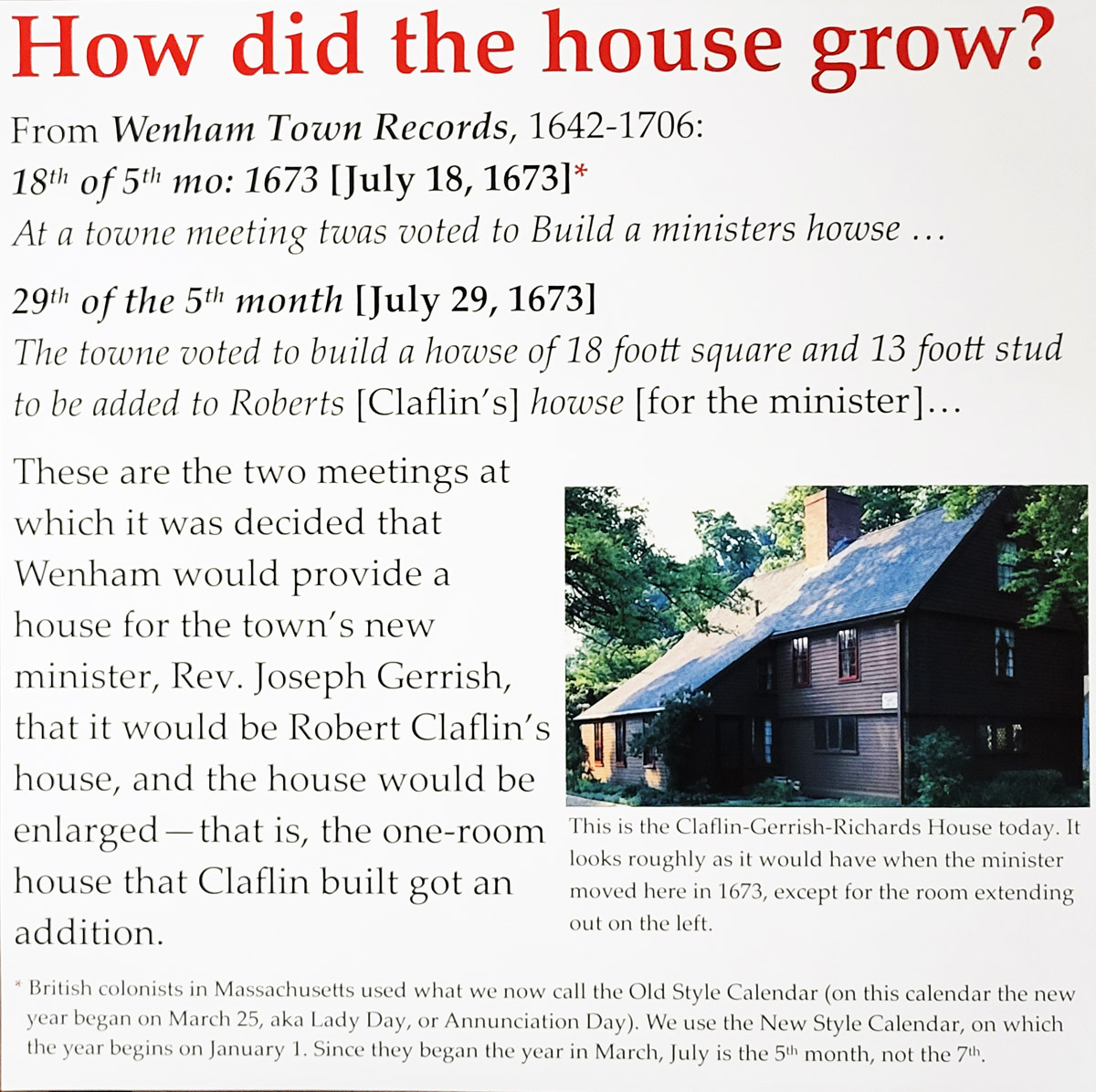
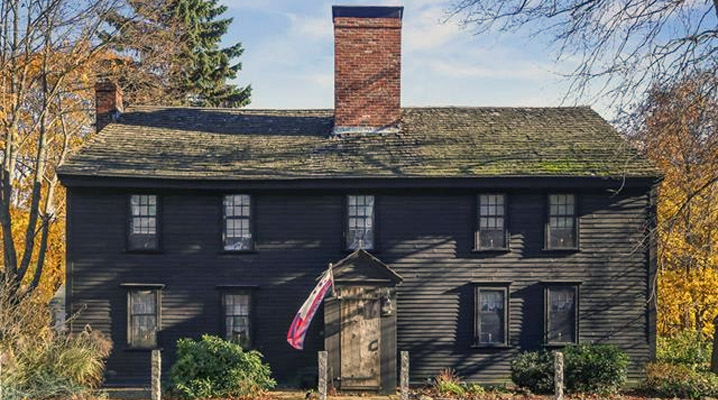
The Claflin-Richards House at 132 Main St, Wenham, is listed on the National Register of Historic Places. The house presents a First Period dwelling room, a late 17th-century minister’s parlor, a circa 1750 bed chamber, and a Victorian-era chamber. The house is named for the first owner of the lot and the last resident before it became part of the Wenham Museum.
In 1672, the town purchased a house and land at this location as a parsonage for Rev. Joseph Gerrish. Sign courtesy Wenham Museum
The first property owner of record, in 1661, was Robert Macklafflin (aka MacLafflin), who, according to family tradition, was a Scottish soldier and was among those taken prisoner and sent over to New England by Cromwell after the border battles of Dunbar in 1650 or Worcester in 1651. He is believed to have been transported to this country on the ship “Sarah and John” and worked here first in the iron works in Saugus, Massachusetts for 10 years, then removed to Wenham where he married. In the records of the town of Wenham, Mass., is the following entry: “4th of November, 1661, Robert Mackclothlan is accepted as a townsman”. Robert Claflin’s will was inventoried 19, Sept. 1690 by Richard Hutton and John Batchelder Sr., who found its value to be £101.9s.6d. A sign at the Wenham Museum as you enter the first room of the house states that it was the 18 ft. square Clafflin home.
Around 1690, the lot was acquired by Capt. Thomas Fiske, the leader of the town’s militia. Capt. Thomas Fiske Jr, 1693-1757, was the leading military man in town and was repeatedly elected to the legislature. In 1700, he was appointed to keep the first school here in the house.
Architectural Features
Exterior
In 1697, the selectmen of Wenham granted Thomas Fiske “pine Timber for building his house and for planke and board,” suggesting that at least part of the Captain’s house was constructed at that time. Architectural historian Abbot Lowell Cummings observed that all major framing members in the oldest part of the Claflin-Richards house, with the exception of posts and a chimney girt. are indeed pine, and that the walls are planked rather than studded.”
The earliest incidences of plank wall construction in Essex County was fairly rare, and are usually found along with overhangs. The demolished 1684 William Story House and the late 17th-century Giddings in Essex, and the White-Ellery House in Gloucester are other local examples of plank framing.
The exterior of the house bears a resemblance to the Whipple House in Ipswich, in which the framing of the oldest section is also pine.
When you enter the Wenham Museum, the rear of the Claflin-Richards house is on your right. The front of the house faces south, as was more often than not the orientation of First Period Houses. Dendrochronology testing has dated the left side of the Whipple House to 1677, and the right side to 1790. Dendrochronology has not been done to determine the actual age and builder of Claflin-Richards House.
The framed overhangs on the Claflin-Richards house are examples of the “Post-Medieval Revival” period of the late 17th century.
Interior
A unique interior feature of the Clafllin-Richards House is the serpentine ogee curved braces, a design found nowhere else in our experience
The frame features decorated posts and quarter-round chamfered summer beams with decorative “lambstongue stops.” Very similar to the Whipple House in Ipswich, this house was designed to reflect the wealth of the owner, Captain Thomas Fiske.
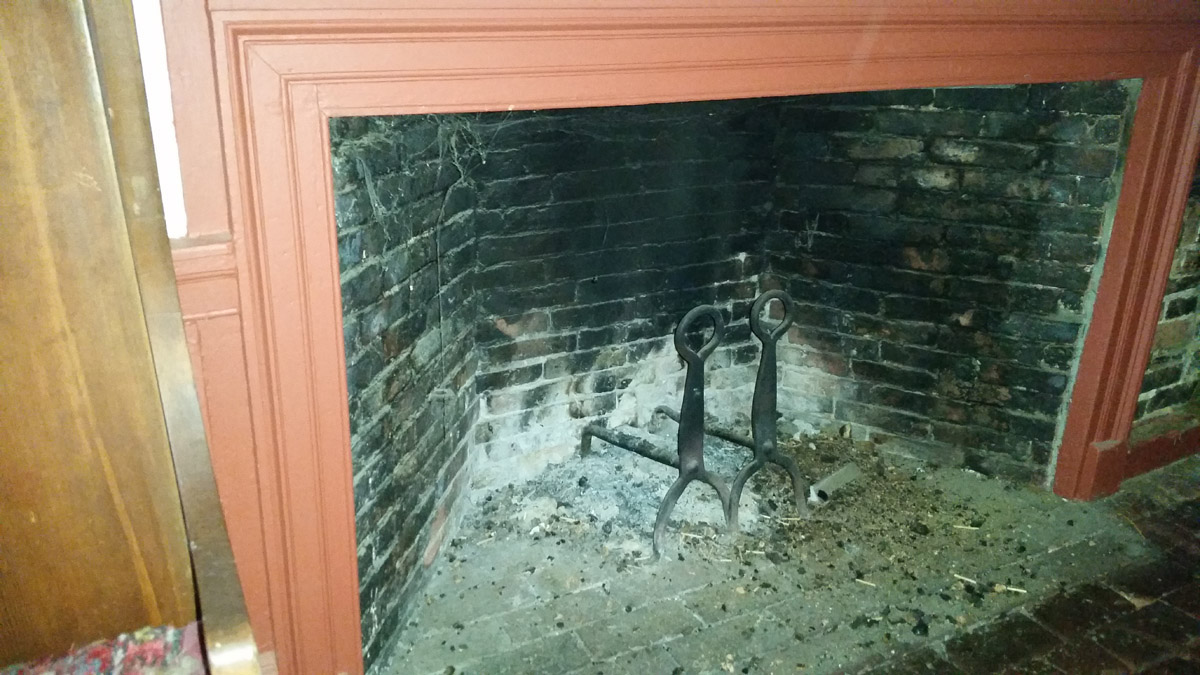
The fireplace in the far room of the Claflin House has rounded corners, similar to the Whipple House.
The Massachusetts Historical Commission’s MACRIS site refers to this as the Pierce House. On June 25, 1828, Nathaniel Noyes (son of Joseph Noyes Jr.) sold the house and land to Enoch Pierce, for $400, and the property remained in the Pierce family for 40 years. Prior to the Pierce ownership, the house and land had been owned by members of the Noyes family for 116 years.
The MACRIS page provides an estimated construction date of c. 1725, based on the year that streets running from High St. to the Merrimack River (including Bromfield St.) were laid out. Deeds for this lot include a sale by Joseph Knight to Joseph Noyes in 1712, the same year that dendrochronology tests indicate the wood for two oak corner posts was cut. The tree for the two oak chimney posts was cut in 1707.
The wood for some of the structural elements of the original one-over-one house is significantly older. The oak lentil for the parlor hearth appears to have been cut in 1678, and a cutting date of 1673 was determined for three structural features: a spruce attic tie, a spruce corner post, and the massive white oak summer beam in the parlor. The framing was boxed in the mid-18th-century Georgian fashion, but the frame in the downstairs parlor room was subsequently exposed.
The earliest history of this house is unclear, but the most likely scenario is that a 1678 oak post and beam one-over-one frame from another location was disassembled and reassembled at this location in 1712 by Joseph Noyes, a “house carpenter”. The frame was clearly exposed to the weather for several years, and the mortise and tenon joints show signs of displacement. The full basement and the large fireplace in the parlor were created in 1712. The earlier structure may have not included a chimney bay.
The house was significantly altered and enlarged around 1774. The chimney bay on the east side was rebuilt, a saltbox lean-to was added at the rear, and the stairway was altered to provide access to the attic over the lean-to. At the same time, the stone foundation for the large downstairs fireplace was replaced with brick arches. Modern fireplaces were constructed for the lean-to and the second-floor bedroom, and the chimney was reconstructed, as well as the two bake ovens.
Bromfield Street
“Cottle’s lane, from High street by Ezra Cottle’s dwelling house, to the dwelling house of Joseph Knight, Junior, on the highway near Merrimack river,” was laid out by the selectmen of Newbury March 6, 1718, although it was probably a private way long before that date. In 1764, the easterly side of Cottle’s Lane, was, by an act of the General Court, made the dividing line between the towns of Newbury and Newburyport, and the name of Cottle’s Lane was changed to South Street by the inhabitants of the last-named town. In 1851, “An Act to Annex a Part of the Town of Newbury to the Town of Newburyport ” established a new dividing line between the two towns, and, on November 1, 1852, by a vote of the city council of Newburyport, the name of South street was changed to Bromfield Street in honor of John Bromfield who, by his will, proved January 14, 1850, gave ten thousand dollars to the inhabitants of Newburyport, the income to be used for the purchase of shade trees and the improvement of sidewalks.” (History of Newburyport, Mass. 1764-1909 Vol. I by John. J. Currier)
Ownership of this property
Joseph Knight
John Knight (1594-1670), a tailor by occupation was a selectman and a prominent individual in the early settlement. He received permission to keep an ordinary in 1637 and held several offices, including selectman. When the town was moved in 1645 from its original location at “Old Town” on the Parker River to the west bank of the Merrimack River, Joseph Knight Sr. was assigned “a house lot at the new town joyning South Street.” (*South Street in 1645 was at the southern end of the new town, and is known today as Parker Street.)
John Knight’s grandson Joseph Knight (1652-1725), came into possession of several properties with multiple acreage in a series of deeds during a period from 1702-1709. This included a narrow lot “by ye highway of two rods wide next Merrimack River.” (Salem Deeds 22-146). In one of the deeds, he was granted a lot by his father “in consideration of his good service and dutiful obedience of me and also in consideration of a contract of marriage to be consummated with Deborah Coffin ye daughter of Tristam Coffin of Newbury.” (Salem Deeds 22-148). No mention of a building is found in these deeds.
The earliest known evidence for the Noyes’s ownership of this lot comes from the historical record of Cottle’s Lane, as recorded in Currier’s History of Newbury page 426: “April 4, 1710, voted to give eight pounds towards ye procuring of a way proposed for thru’ ye Little field provided ye sd way be laid out two rods wide the whole length from Ezra Cottle’s house to ye way by Henry Clarks next Merrimack River according to a vote of ye Town December 18, 1695. This way, called Cottle’s Lane, now Bromfield Street, Newburyport, was laid out, March 6, 1718-19, from High Street, by Ezra Cottle’s dwelling-house, to the dwelling-house of Joseph Knight, Jr., on the highway near Merrimack river.”
Joseph Noyes
Recorded December 29, 1712, Joseph Knight “blacksmith” conveyed to Joseph Noyes, “house carpenter” for £21, a certain piece of land containing one acre “bounded southerly by my own land, westerly by land of Henry Jacques, northerly by land of Joseph Hale, easterly by the highway, with all profits, privileges & appourtenances to ye same.” No mention is made of a house, but the deed states that “Joseph Noyes has been in possession of the premises.” (Salem Deeds 32-224). The low price may indicate that the lot was empty, or that it had on it an unfinished building that is today’s 8 Bromfield St. A year later when Joseph Knight sold land to Marvarick Gillman (Salem Deeds 26-223), the deed states that the lot was bordered by the land of Joseph Noyes northwest.
The Noyes family of Newbury
The Noyes family, like the Knight family, was significant in the early history of Newbury. Joseph Noyes Sr. (1686-1773), was the son of Lt. Col. James Noyes Sr. (1657 – 1725) and Hannah (Knight) Noyes (1664 – aft. 1723). The lieutenant was the son of Nicholas Noyes (1615 – 1701), who along with his brother James and father William were prominent figures in the settlement of Newbury in 1635. James Noyes Sr. is credited with the first discovery of lime in the Massachusetts Bay Colony. Major James Noyes was among 3 men chosen to settle and determine the bounds and measurements of the highways in the Town of Newbury.
Joseph Noyes (1688 – 1755), built (or rebuilt) the house in 1712. He married Elizabeth Knight. During his life in Newbury he inherited and purchased multiple parcels of land. Beginning in 1736, Joseph Noyes made many transfers of property unrelated to this lot, which is probably indicative of the year that he moved to Falmouth, ME, where he died in 1755. A few of the unrelated transfers are listed here. It is unclear if the house on Bromfield St. remained in the Noyes family until it was sold by Nathaniel Noyes in 1828.
He sold one half of a “certain messuage or tenament” and upland to Joshua Noyes for £165.00 (Salem Deeds 72: 171), having previously belonged to David Parsons.
He sold property to Samuel Bartlett for £142.00. ( Salem Deeds 72:159). The deed states that it was part of Deacon Nicholas Noyes’ freehold lot on the Artichoke River. He sold a second property to Samuel Bartlett for £103.00. (SalemDeeds 73:167)
In 1740, Joseph Noyes, now of Falmouth sold to Jacob Noyes, blacksmith, a portion of the saltmarsh and meadow land that had belonged to Joseph’s father, Cutting Noyes Sr. (Salem Deeds 80:200).
In 1746 he sold to “my kinsman” John Noyes one half of 14 acres of pasture land with orchards and buildings, “bounded northeasterly by my own land” (Salem Deeds 89:173)
In 1749, he sold some acreage to his son Cutting Noyes Jr. (Salem Deeds 120:257).
Noyes family’s possible line of ownership of this property
Joseph Noyes (builder of this house)
Cutting Noyes Jr. (1676 – 1757) and Elizabeth Tappan Noyes. He was the brother of Joseph Noyes. His estate on King Street (now Federal Street) was divided by his descendants in 1771, with the individuals each owning a small portion of the house. (Salem Deeds 129:198)
Jacob Noyes Sr. (1704 – 1786) and Jane Titcomb Noyes. Parents of Capt. Joseph Noyes Jr.
Nathaniel Noyes (1763 – 1847) sold the property to Enoch Pierce in 1828
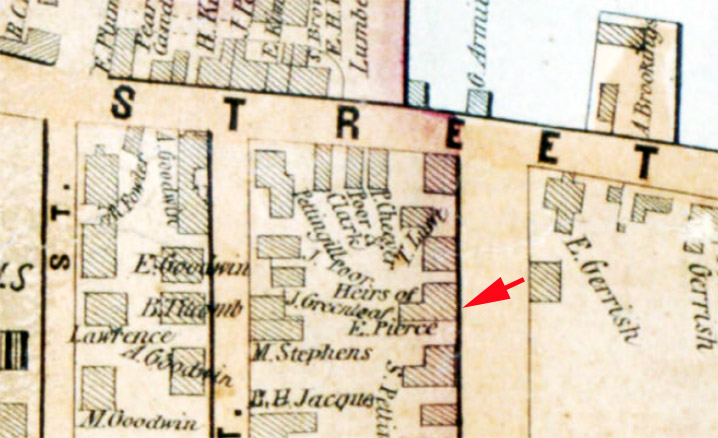
The 1851 map of Newburyport shows “Heirs of E. Pierce” at today’s 8 Bromfield St., which was called South Street at that time.
Pierce ownership
On June 25, 1828, Nathaniel Noyes (son of Joseph Noyes Jr.) sold the house and land to Enoch Pierce, for $400. (Salem Deeds 253-253) bounded southeasterly by South St., “with the buildings thereon.” South St. was renamed Bromfield St. in 1851, soon after the 1851 “Plan of Newburyport” shows the “heirs of E. Pierce” as the proprietors. Pierce served under the command of Ezra Lunt in the Revolutionary War at the age of 20. On Sept. 20, 1872, John Pierce sold to Joseph Howard, $250 for the lot and buildings. (Salem Deeds 864-36). Captain Joseph Howard had a fish market at 11 Huse Wharf.
The early house
The two rooms in the one-over-one oldest part of this house measure about 19′ wide x 20 ft. deep. It is unclear if there was originally a chimney bay on the right.
The layout of the oldest section of the house at 8 Bromfield St. may have been similar to the 1654 Coffin house in Newbury. Image from “The Framed Houses of Massachusetts Bay, 1625-1725” by Abbott Lowell Cummings.
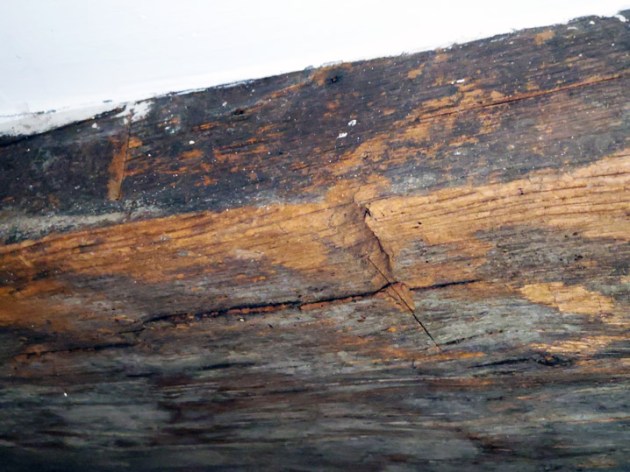
Section of oak summer beam in the downstairs older section at 8 Bromfield St. Dendrochronology indicates that it may have been re-used from a 1673 structure.
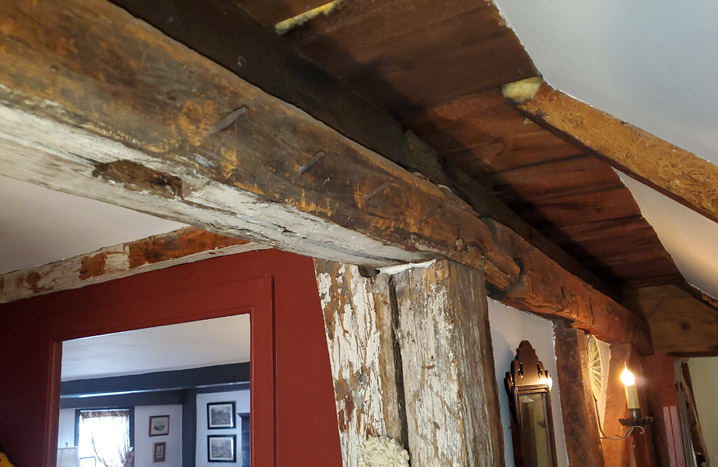
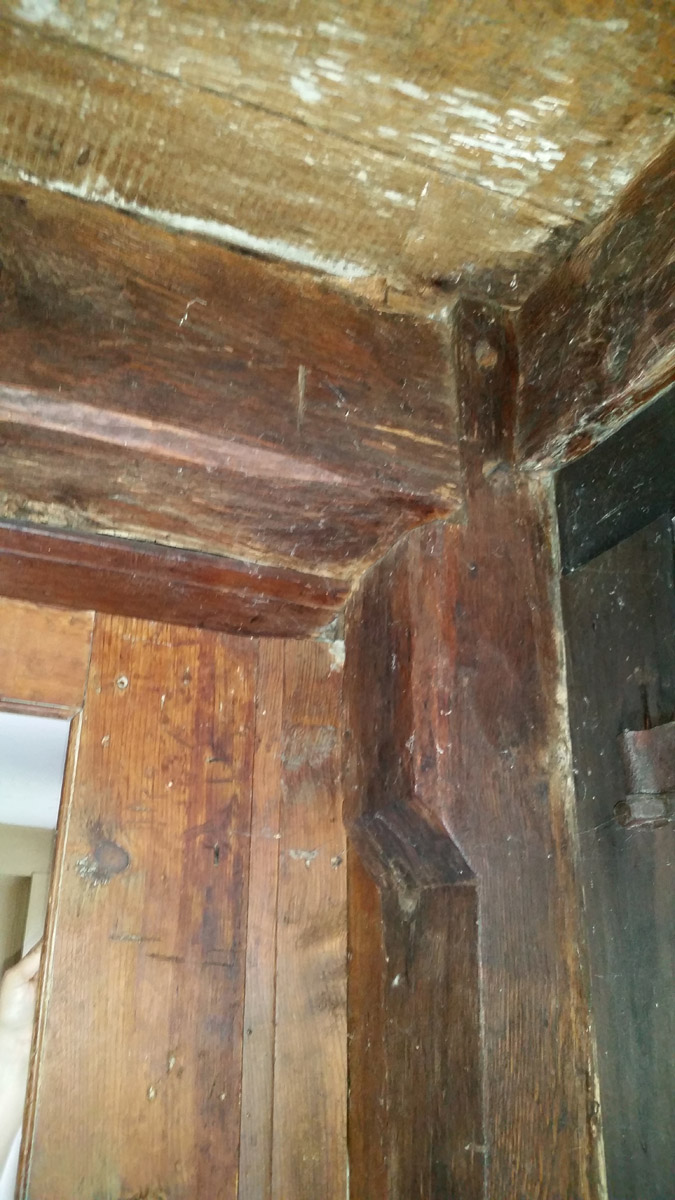
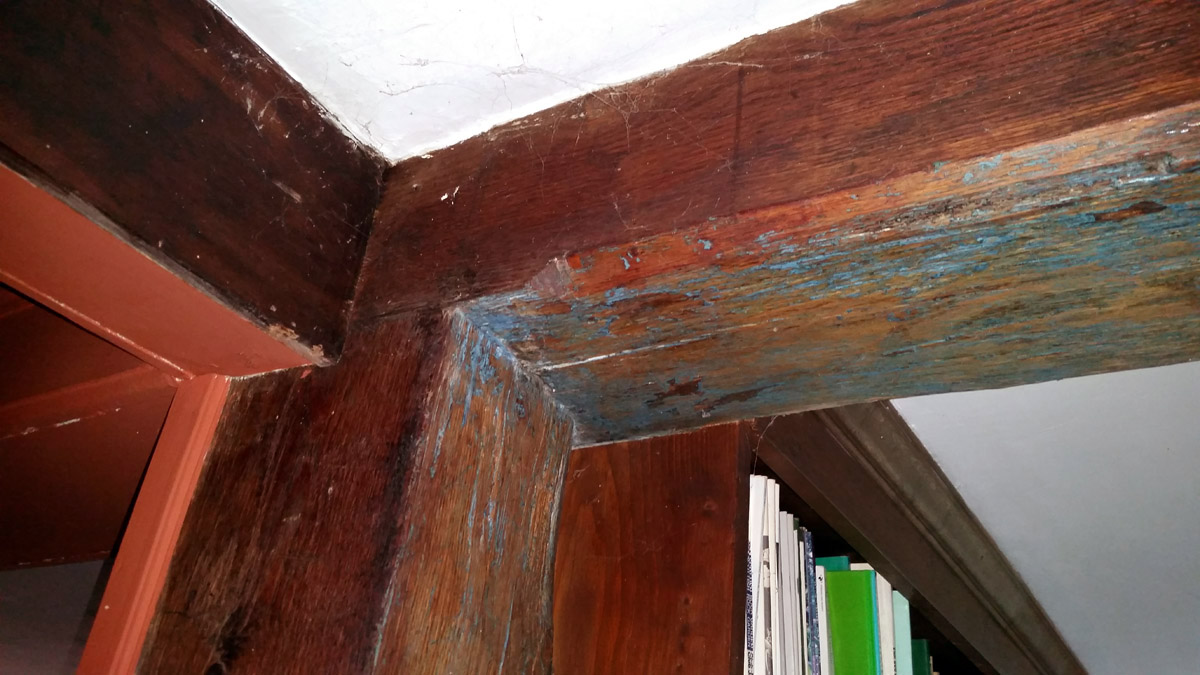
The exposed frame is weathered and gray, indicating that it sat for a period of time exposed to the weather, and the structural elements have remnants of old whitewash. The unchamfered massive oak summer beam is laid flat rather than vertically and measures about 15″ wide x 8″ high, an unusual installation. Summer beams in the 1667 Giddings-Burnham House and basement summers in the c1700 Perkins-Hodgkins House in Ipswich are also laid flatwise. In all four corners of the upper room in the oldest part of this house are massive gunstock posts, outlining the configuration of the two original rooms.
Downstairs summer beam & girt
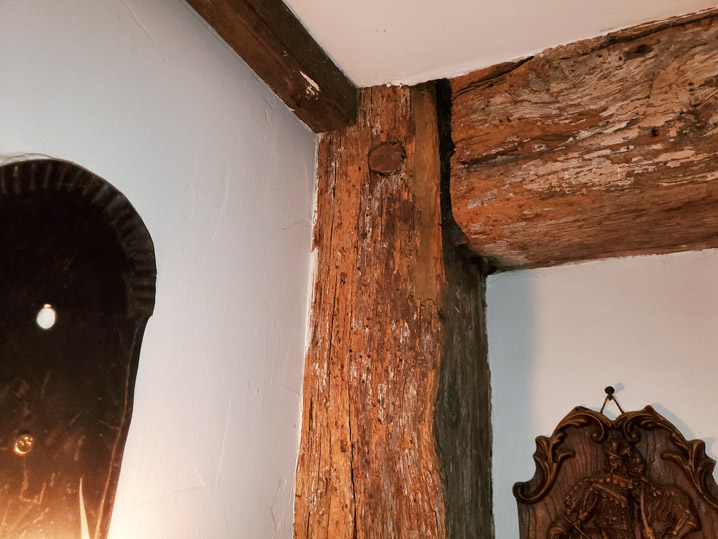
Downstairs front corner post, plate, and girt
The weathering of the frame in the original core of this house indicates that it was constructed years or even decades before the lot was purchased by Joseph Noyes in 1712. The lack of a chamfer on the summer beam in the original structure suggests that it was constructed before 1680 or was a utilitarian building. It is unknown if the early house was constructed at this location or was moved here as has been conjectured. There is some separation in the joinery, and the exterior walls are out of plumb. This could have occurred if and when the structure was moved, but can also be attributed to the age of the structure and its early exposure to the elements, which resulted in the deterioration of some of the trennels that hold the joints together.
Masonry
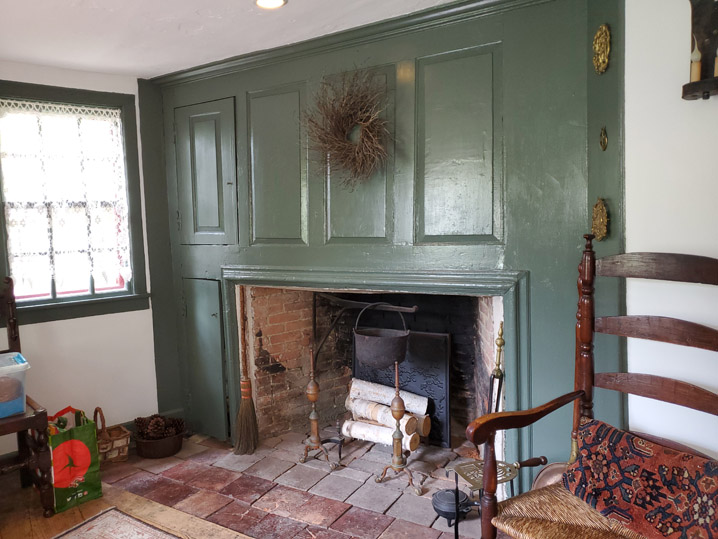
The first-floor fireplace at 8 Bromfield St.
An outstanding feature of this house is its 9′ fireplace, examples of which are found from the late 17th Century into the first half of the 18th Century. The bricks are somewhat shorter in height and have clay mortar, which was used in the 17th Century and early 18th Century. The existing chimney bay is part of the 18th-century alteration, with the stairs ascending over the rear of two bake ovens.
Above the fireplace lintel is a plastered brick cove that supports the hearth of the second-floor fireplace. Abbott Lowell Cummings wrote that of the plastered coves he had observed, none dated to earlier than the last quarter of the 17th Century:
The 1678 Tristram Coffin House, Newbury (Dendrochronology has not been done on this house)
The circa 1700 Beniah Titcomb House, moved from Newburyport to Essex. (Dendrochronology has not been done on this house)
Bake ovens and a shelf in the rear wall of the first-floor front fireplace. Bake ovens shifted forward for safety in the 18th Century. Firebox openings before the 1720s usually measured seven to nine feet wide. (Reference: Antique Houses by Edward P. Friedland.)
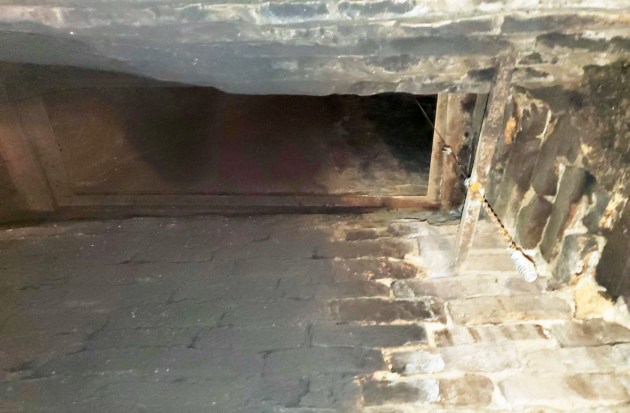
Looking up into the flu of the downstairs front room fireplace, the metal bar on the right indicates the flu was constructed before 1740 when the swinging crane came into favor. (Reference: Antique Houses by Edward P. Friedland.)
A brick arch was constructed in 1774, with an unusual stone sidewall supporting the pre-existing first-floor hearth. Brick arches are commonly found between 1740 and 1830, according to historic masonry expert Richard Irons.
The second floor of the oldest section
18th-century Georgian interior finish is found throughout the house, with the exception of the first floor of the oldest section, where it was subsequently removed.
Fireplace with Georgian moldings on the second floor
Mid-18th-century knob and latch on the second floor. Known as open box locks, the knobs are cast brass on either side of the door, but the mechanism is iron. (Reference: Antique Houses by Edward P. Friedland.)
The other side of the same door
Right side chimney bay addition and lean-to
When the house was altered in 1774 the winder stairway was modified so that it forks to bears left to the second floor of the original house, while the rest continues straight to an upstairs hall which provides access to a finished attic room. This hall also connects to a triangular attic area that was created when the saltbox lean-to was added.
The post on the north wall where the chimney bay stairs meet the lean-to framing is not flared, is made of pine, and dendrochronology dates it to 1707. Assuming it was replaced when the lean-to was added, there would have been no reason to flare this post.
This scarf joint on top of an original gunstock post on the second floor may indicate that the framing of the chimney bay was replaced or altered.
Another view of the rear upstairs beam and scarf joint
These marks found along the length of the upstairs rear beam may have been made by the “dogs” that moved wood in antique sawmills.
The attic room over the old part of the house shows the original principal rafters (minus their purlins) and above them are the rafters for the lean-to.
A dip in the roof in this view from the rear of the house indicates where the chimney bay addition was added or altered.
The fireplace in the lean-to is relatively small and does not have a bake oven.
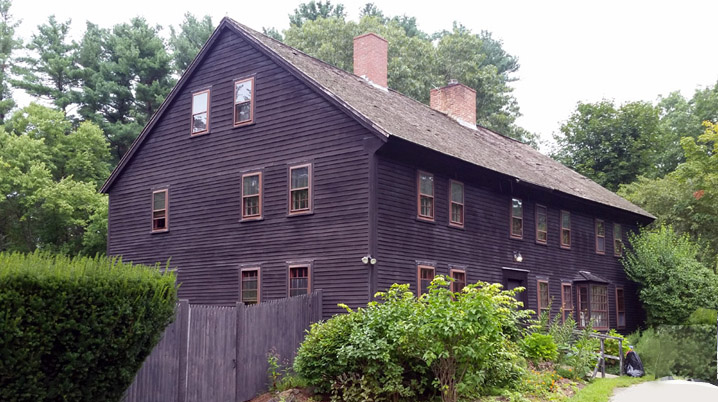
8 Bromfield in a 1980 photo on the MACRIS site.
Dendrochronology report
On August 1st, 2023, a selection of timbers was cored by William Flynt from the Joseph Noyes house, located at 8 Bromfield Street, Newburyport, Massachusetts for the purposes of conducting a dendrochronology study. All samples were mounted, sanded, measured, and analyzed by Mr. Flynt. A total of twenty samples were taken from the frame that appears to be constructed with a mix of reused and site-specific material. Species encountered included white oak, black ash, white pine, and spruce.
The wood for the parlor summer beam may have been cut in 1673 (although the evidence is weak). An oak southwest rafter and an oak purlin in the southeast bay returned dates of 1673 as well. The two oak chimney posts returned a date of 1707, as well as a black ash rafter on the west side. The oak parlor hearth lentil showed strong evidence of having been cut in 1678. The year 1712 was established for the southwest and southeast corner posts. A cutting date of 1773 was found for a spruce attic tie in the north wall, a spruce corner post, and a white pine corner post on the northwest side.
Discussion (by Bill Flynt): “While a relatively small structure, the Joseph Noyes house frame posed significant challenges due to the incorporation of clearly reused material, some quirky joinery where the entry bay frame joins the parlor/chamber bay at the plate level, and the use of softwood species in the entry bay frame but hardwood in the parlor/chamber bay. A review of the results of the dendrochronology testing suggests the reused material comes from a structure(s) constructed in the 1670s that gets used in conjunction with material felled during the period 1707-1712 (three being critical posts) most likely related to the initial build of the house.
“One would expect this structure to have included an entry bay, as it currently has, but it is difficult to explain why it may have been removed in the 1770s when the softwood framing was felled that currently supports this section. It is possible the evidence of weathering on some of the framing located on the backside of the upper chamber indicates that the structure was in disrepair by the early 1770s. It is worthy of note that one of the two samples taken from the removed lean-to rafters currently stored in the basement also indicates a 1773 felling date, suggesting that perhaps the entry modifications were undertaken at the time of the lean-to addition (though having only two samples from the lean-to roof is certainly less than ideal, especially when only one dated, for conclusively dating any construction event). “
The Capt. Joseph Gould House is an enigma; a substantial early 18th Century house constructed in at least two stages, and the only First Period house in our area believed to have been constructed two rooms deep (aka bays or piles) deep. The 1710 Gould Barn that once sat on this property was dismantled and reconstructed at the foot of Howlett St.
The three-bay east side of the house is the oldest, and the house achieved its present appearance when the left side, also of three bays was added c. 1725. Typical of the period, the spacing of the windows is irregular, although most are vertically aligned. The chimney on the right original side is more substantial, and the fireplace below it in the downstairs room is the largest in the house. The roof is of substantial principal rafter and common purlin construction on the two sides of the house. In addition to the depth of the house, another transitional feature is the eaves, which appear to have originally featured a plaster cove.
Inside the house, framing is doubled at the junction of the earlier and later sections and is exposed in several rooms in both sides of the house. Transverse summer beams (instead of longitudinal) are on both sides, measuring 11 1/4″ in general, featuring flat chamfers with “lambs tongue” taper stops. Summer beams in the upstairs of the west side are unchamfered. Story posts in the rear section are elaborately molded, similar to several houses in Salem. Simpler gunstock posts are found in other rooms. Downstairs in the entrance and rear room west (later) part of the house, posts and beams have narrower flat chamfers and simple triangular taper stops. Measurements for the joist spacing is about 25″ on center. A reused chamfered summer beam can be seen in the cellar.
Conflicting studies
The MACRIS listing and nomination papers for the Joseph Gould house state that the oldest section was always two rooms deep and dates to before the 18th Century.
The “Old House Whisper” John Cole and Eleanor Bailey studied the house and wrote that the earliest part was an over-room “half house” structure built for Joseph Gould about 1712 at the time of his marriage to Priscilla Perkins. Cole observed a reused summer beam in the basement and believes the house was expanded to the west and in the rear around 1751 at the marriage of Joseph Gould 2 to Elizabeth Emerson. He does not, however, reconcile the preponderance of First Period (pre-1725) architecture throughout the house with the mid-18th Century.
Abbott Lowell Cummings is known to have visited the house but his notes and observations have not been discovered.
Kari Ann Federer did a comprehensive study of the house in 1989 which is copied in part below.
Rear, Capt. Joseph Gould house. The left side in this photo is believed to be the older half.
The Joseph Gould House and barn
Kari Ann Federer, Boston University, December 18, 1989 (excerpt)
INTRODUCTION
This is a study of two late first-period buildings in Topsfield, Massachusetts, the Joseph Gould House and the barn which stood on the property, until it was dismantled in 1983. Both house and barn were constructed in two phases, the second doubling the original in size and following its plan and form quite closely.
The resulting six-bay dwelling was essentially two end chimney houses built back to back, with chimneys up against each other, creating something like a central chimney house. The barn totaling nine bays, consisted of two classic five-bay barns side by side with one bay overlapping.
This double house and a double barn existed by the mid-1700s and were occupied, at that time, by two different, though probably related families. Traditionally, the older half of the house was said to date prior to 1700 and the second half shortly thereafter. The popular tale was that the later section was added to make the house into a duplex for father and son. However, research into deeds and probate records has suggested that both of these traditions are inaccurate.
This study is an attempt to shed light on the history of the Joseph Gould farm by examining the original framing and construction of the house and the barn, as well as the overall layout of the farmyard and the changing uses of these spaces.
PHYSICAL DESCRIPTION OF THE JOSEPH GOULD HOUSE
The eastern half of the Joseph Gould house was the first portion to be constructed. It was initially an end chimney house, two and a half stories high, one room wide and two deep, with the chimney at the west end of the dwelling. The house measured twenty-seven and a half feet wide and twenty-eight and a half feet deep. The rear rooms were about two-thirds as deep as the front ones.
The Gould house is now covered in clapboards, attached with wire nails, which must all be replacements. However, the original house would also have been sheathed in unpainted clapboards. The roof cornice overhangs about a foot along the front of the house and diagonal boarding is said to cover a plaster cove.
The nine-over-six sash windows on the Gould house are later eighteenth-century replacements. The current configuration of this eastern section of the house is not original, as the chimney has been moved to the east and a room was created in what had been the chimney bay. Evidence of this alteration includes Federal mantels on the fireplaces of the southeast rooms upstairs and down, as well as the fact the transverse summer beams were off-center in these rooms lying closer to the chimney wall than would be expected.
Due to this alteration in the chimney bay of the Joseph Gould house, no evidence of the original entry door, staircase, or fireplaces can be seen. It might be assumed that the configuration of the chimney bay was fairly typical of the late first period. In New England houses of the First Period, the staircase and entry were usually combined, with the stairs rising up across the front of the chimney.
The staircase from the first to second floors of the Gould house may have been a straight run composed partially of winders. The open balustrade, with turned balusters and molded hand railing, would have housed within a closed string.
Under the stairs would have been molded vertical sheathing and perhaps a door to the cellar stairs. However, a trapdoor to the root cellar currently exists in the northeast corner room of the house and there is no reason to believe this is not its original location.
In this first half of the Joseph Gould House, the frame would have been entirely exposed, though some members are now boxed. All summer beams are transverse and these timbers are continuous from the front to the back of the house, proving that both stories were always two rooms deep. Joist spacing in this part of the house, is twenty-five inches on center; a measurement consistent with the late first-period date of the house. Where visible, all summer beams and girts have flat chamfers with lambs tongue stops except for those of the chimney girt in the rear room, which have triangular stops.
As in many other houses with transverse summer beams, the most highly embellished parts of the frame are the story and chimney posts. These have elaborately molded heads with a deep quarter round and two fillets. It seems to be only the rear posts that are fancy, however. Most of the front framing members are now boxed, but the front chimney post can be seen, and this is much simpler with only a very wide flat chamfer on its sides. The rear corner posts are similar to this one, as are all visible posts on the second floor.
In the attic, one can see that both halves of the Joseph Gould house are constructed with a principal rafter, common purlin roof system. Each half of the house consists of four pairs of rafters, bridled at the ridge, creating two three-bay sections. On each slope of the roof are five purlins trenched over rafters, with the ridge purlin resting in a notch cut into the upper rafter. Massive long collar beams tie together the rafters in the older (eastern) half of the house. These ties, along with the rafters, are finished with narrow flat chamfers.
The rafters are doubled at the transition point between the two sections of the house. When the second half was added, another complete house frame was built up against the old one. Visible in the ridge between these two frames, are original clapboards from the exterior west gable end of the earlier house. The roofing system of the second half of Joseph Gould House is very similar to that of the first. The frames line up exactly, though the later section has slightly heavier purlins and no collar beams, but struts rising up from tie beam to rafter instead.
In plan, the second half of the Gould house copied the original. However, the west half is about six feet narrower, being only twenty-one feet wide. The basic configuration of this half of the house has not been altered. The five-foot wide western chimney bay is in its original location, though the chimney stack is now smaller than it would have been.
The stairs from the first to the second floor and also up to the attic, are still in their initial location in front of the chimney. The staircase is typical of the late First Period, with turned balusters, but a plain newel post. Molded paneling under stairs makes it clear that there were never cellar stairs there. A trap door to the root cellar also exists under this half of the house. The staircase was probably a double run with landing, originally. The current unusual configuration was most likely created when the chimney was rebuilt and narrowed. An empty space was left behind the chimney and it was logical to use this as an easier way to reach the rear chamber.
The summer beams are also transverse in this second half of the Joseph Gould house. Much of the frame is now boxed, but it is visible in the rear rooms, upstairs and down, and in the front entry. Typical of the less decorative embellishments of the end of the First Period, very narrow chamfers with taper stops can be seen in rear rooms. The rear-story post has a fancy molded head, similar to those in the older half of the house. However, all other posts in the rear room are simple with only very narrow flat chamfers on their sides. In the west front entry hall, the front chimney and corner post can be seen and these are very plain with almost no chamfers at all. Upstairs, the rear posts are undecorated and here the summer beam is the only chamfered member.
Sometime later in the 18th century, the frames in the west front rooms of the Joseph Gould house were boxed and the first-floor room was embellished with a corner cupboard. Some of the feather-edged panels on the fireplace wall of this room may date from the construction of the house, as this became very popular in the early 18th century. The raised paneling in the west front chamber may also be original. This type of decoration came into use by about 1725 and like other new fashions, was often tried upstairs in the chambers first.
Typical of the First Period, the Joseph Gould house was built facing due south, while the barn backed up to the northwest wind. This created a sheltered farm yard in front of the house and barn and later outbuildings added between the two protected it even more. First Period barns were often located in front of the house, closer to the road, to show off the family’s stock and store of supplies. As the location of man-made structures helped to bring coherence into a chaotic world, the forty-five-degree angle between the ridgepoles of the Gould house and barn enforced the disjunction between the artificial rational world of man and the irrational dirty world of livestock.
BACKGROUND OF THE GOULD FAMILY AND THE SETTLEMENT OF TOPSFIELD
The area which is now the town of Topsfield, Massachusetts was originally part of the seventeenth-century plantations of Ipswich and Salem. During the 1630s and 1640s, large grants of Topsfield land were given to Ipswich Residents. The land where the Joseph Gould house stands was part of the Captain Patrick Grant, which like many of these large land holdings, was soon divided and sold. In 1644, three hundred acres of it were purchased by Zaccheus Gould (1589-1668), who had arrived from England in 1639 and decided to settle in the newly developing community of Topsfield. Twenty years later, in 1664, it is estimated that Zaccheus Gould owned some 3000 acres, 580 in Topsfield and the rest in neighboring Boxford. At this time, Zaccheus sold his entire estate and house in Topsfield to his only son John Gould (1635-1710), who had come with him from England as a young child. John Gould lived in his father’s house, past which Washington Street was laid out late in the 1660s. He and his wife Sara (Baker), who were married in 1660, raised eight children, one of whom was Joseph, born in 1677.
CONSTRUCTION HISTORY OF THE JOSEPH GOULD HOUSE AND BARN
Although Joseph Gould is traditionally said to have built his original house prior to 1700, there is no recorded deed giving him land until March of 1709. At this time, John Gould, who was nearing the end of his life, divided his estate among his surviving sons. Joseph was given sundry parcels of upland, meadow, and woodland in Topsfield and Boxford. This deed was not specific about the boundaries or acreage of the property, but it should be noted that it did not mention any buildings on the land, nor does it indicate that Joseph Gould owned any of the abutting land previously.
In 1709, Joseph Gould would have been 32 years old, but still unmarried. It seems quite likely that the first half of his house was not constructed prior to this time. This conclusion is supported by a map of Topsfield printed in 1950 for the town Tercentenary, which labels the house “Abbott 1709” (Abbott being the owner at the time). This date also coincides with that which First Period barn expert Robert Blair St. George has assigned to the earlier half of the Gould barn.
In the process of establishing his own farm, Joseph Gould probably built the first halves of his house and his barn in 1709 to 1710. A few years later, in 1712/13, Joseph married 23-year-old Priscilla Perkins. The two immediately began a family, Priscilla giving birth to their first child in 1714. The Goulds had eleven children, but only six survived past early childhood. The only surviving boy being Joseph Gould (2).
The second half of the Joseph Gould house was traditionally thought to have been added to the west of the existing house, built between 1700 and 1720. Perhaps the latter end of this range is correct. No documentary evidence could be found for the construction date of this portion of the house. According to the probate inventory of Joseph Gould (1), it was certainly in existence by 1753. The features of this western end of the house are typical of the late First Period and thus it is unlikely that it could have been added any later than the 1720s. The second half of the barn was also standing by 1753 and Robert St. George felt it must date from between 1720 and 1750.
The traditional story tells that the second half of the Joseph Gould house was built to make a duplex for father and son. However, as Joseph (2), the only surviving Gould son, was not even born until 1725, it seems impossible that it could have been constructed specifically for his use. None of the Gould girls were grown and married by the 1720s either.
On the other hand, there are no deeds indicating that Joseph Gould sold off a portion of the house or even any land near his house. It has been suggested that the addition of the western half of the Gould house was simply an unusual way of enlarging the original dwelling. Building two complete frames up against each other makes the house appear to have been constructed as a duplex, but this was not necessarily the case. Perhaps Joseph Gould made the addition to his home during the 1720s in order to house his growing family. He may have had in mind that one of his children would occupy half of the house, later when the family had grown, and thus built the house so it could easily accommodate this purpose.
The farm was indeed being used as a two-family home in 1753 when Joseph Gould’s inventory included only the easterly end of the dwelling house and half of the barn. The inventory does not make clear who owned the other halves of the buildings and there is no evidence that Joseph Gould (1) ever sold them to anyone else. Therefore, it does seem probable that Joseph Gould (2), who was married in 1751 at age 24, was the occupant of the western half of the house and barn by the time of his father’s death. This could have been the origin of the story about the father and son duplex. Joseph (2) was willed the remainder of his father’s real estate and by the 1760s was being taxed for the entire farm.
–Kari Ann Federer
Images
Joseph Gould house, Topsfield MA
Main stair rail, turned posts and vertical sheathing in the Capt. Joseph Gould house
Living room fireplace Capt. Joseph Gould house
Post and beam in the in the Capt. Joseph Gould house
Ornamental posts in the rear kitchen wall of the Capt. Joseph Gould house are very similar to posts in the 1675-1693 Stanley-Lake house in Topsfield, the “1675” Jonathan Corwin house in Salem, and the 1679 Balch house in Beverly.
Gunstock post, beam, and girt in the Capt. Joseph Gould house
Summer beam, rear kitchen in the Capt. Joseph Gould house
John Gould inherited part of the 3000 acres of land owned by his father Zaccheus Gould (1589-1668), whose home is believed to have been nearby on Washington St., and was already an important citizen of the town of Topsfield. During the Revolution of 1686 for which Ipswich claims fame, Capt. John Gould was imprisoned for opposing Gov. Andros. He served as a selectman and gave a deposition against Sarah Wilds, his neighbor, who was hung as a witch during the Salem hysteria. Capt. John Gould and his wife Sarah (Baker) Gold conveyed their farmlands to their five sons.
Capt. Joseph Gould (1677-1753)
Joseph, who married Priscilla Perkins, received the homestead. Like his father, he served as a selectman and was elected to the General Court for seven terms. In his will, dated March 1753, Capt. Gould gave his household goods to his wife, and one-third of the use of the estate, as was customary at the time, with “the liberty of the Great Room in my Dwelling House and the improvement of half the cellar and Said Room.”
Major Joseph Gould (1726-1803)
At the time of Joseph Sr.’s death, Joseph Jr. was living in the westerly wing with his wife Elizabeth Emerson Gould, and assumed ownership of the farm. Joseph Gould Jr. is said to have played an important role in the Battle of Concord and was made a major in Col. John Cogswell’s Regiment. At his death, the house was inherited by Joseph 3, who married Ruth Porter of Danvers. In 1867, the house passed out of the Gould family.
The Joseph Gould house and the Gould barn, about 1900.
The original single-cell end of the house is sheathed in vertical boards, while the left addition has horizontal sheathing. The right front rooms of the house exhibit late First Period features. The second-phase rooms to the left, stairway, and the first-phase right chamber exhibit good early second period details, suggesting a circa 1725-30 construction date for the addition.
The house was beautifully restored by Bill Haight and is listed in the National Register of Historic Places. Deed and genealogical material below provide evidence for the original owner of this house.
“By these presents witnesseth that I William Livermore with my wife Elizabeth of Beverly in the County of Essex Have bargained & sold unto William Hooper of the same Town my house which I now live in with all ye out houses and appurtenances therewith belonging as an acre of ground with all the fences and apple trees except six apple trees and three plumb trees for ye said houses of land William Hooper is to pay or cause to be paid to William Livermore or his assignees the full and just sum of thirty five pounds in current pay as followeth, ten pounds in hand and twenty pounds in dry fish to Mrs. Brown or Nicholas Woodbery at or before the last of July next 1670. The wife of William Livermore hath paid to Captain Price one pound thirteen shillings & ten pence & ten pounds more (…..) in year 1674. The remainder of 35 to be paid to William Livermore when my wife doth surrender up to William Hooper or his assignees all ye house and land above mentioned upon ye last of September One Thousand Six Hundred & Seventy& do give him quiet possession our selves and assignees to warrant him against all opposite whatever.
William Hopper sold to Joseph Corning, August 17, 1713; one and one half acres of upland in Beverly with house, barn and shop “bounded easterly by land of Dr. Hale, southerly by land of Joseph Morgan, and westerly by the road.” (Source: Salem Deeds site, book 28, page 176.) Although the surname is spelled differently, this is the only Beverly land transfer listed for William Hopper or William Hooper in Beverly during the 1644 – 1799 period. There are no maps for the neighborhood during that time area, so we have no way to be sure that these deeds refer to the present house or land. (note: The Samuel Corning house in Beverly is also first period.)
Livermore Whittredge
William and Elizabeth (Houchin) Livermore had one daughter, Charity (1657-1700).
In 1681 Charity married Lt. Thomas Wittridge (1657-1717), a descendant of William Whitredge (1596/97-1668) of Ipswich. William Whitteredge, age 36, a carpenter, came to America in 1635 on the “Elizabeth” with his wife Elizabeth, 30, and son Thomas, 10. He was in Ipswich, Mass. by 1637 and died in December 1668, probably in Ipswich.
Thomas and Charity Wittridge had six children, William (1683-1726), Charity (1685-1734), Thomas Whittridge (1687- ), (1689-1755), Elizabeth (1691-1776) and Sarah (1693-1762).
When she was 25 years of age, Sarah Whittredge married John Morgan (1693-1752), son of Samuel, Jr., and Sarah (Herrick) Morgan. John Morgan was a lieutenant at the siege of Louisbourg, the French citadel commanding the entrance to the St. Lawrence River. (*Note that the 1713 deed listed above shows sale of what is believed to be this house shows an abutter as Joseph Morgan.)
Lt. Livermore Whittredge was born 1703 in Beverly and died July 28, 1773 in Beverly. He was the son of Thomas Whittredge, Jr. and Thomas, Jr.’s second wife, Sarah Herrick Morgan Whittredge.
This house is traditionally associated with Livermore Whittredge Sr. and Jr, who were members of the Committee of Correspondence and active privateers during the Revolutionary War. The brigantine Fanny, owned in part by Livermore Whittredge, on a voyage from Beverly for Hispaniola with a cargo of fish, was captured May 28, 1781 by the English brig Providence and taken into New York.
The last will and testament of Livermore Whittredge Sr.”yeoman” of Beverly, dated July 23, 1773, names “Mary my well beloved wife. “I Give to my Daughter Rebeckah Mansfield ye use of ye west chamber in my Dwelling house, To Live in for as Long as She Shall Continue a Widow.” The will names four sons — Thomas, William, Livermore, and John Whittredge — and four daughters: Mary Langdon, Rebeckah Mansfield (a widow), Hannah Dodge, and Charity Ford. On August 3, 1773, the will of Livermore Whittredge was presented for probate. His widow signed her own name “Mary Whittrage.” Inventory of the estate included “about 25 acres of homestead” in Beverly, plus other property, for a total of about 83 acres.(*Mary Whitteridge was the daughter of Thomas Gage of Beverly.)…………..
Sally Whittredge who was born there 13 Dec 1786 the daughter of Livermore Jr. and Lydia Herrick Whittredge and married goldsmith Nathaniel Fowler of Beverly. On Feb. 10, 1808, Sally in her right sells Thomas Whittredge “the westerly half of a dwelling house, buildings and land, the late mansion house of Mr. Livermore Whittredge deceased of Beverly..”
Living Room in the William Livermore house
In his book, The Framed Houses of Massachusetts Bay 1625-1725, Abbot Lowell Cummings wrote: “For the North Shore, the bulk of the earlier houses date to the last three decades of the seventeenth century and the opening years of the eighteenth century. Many of these buildings reveal a stylistic affinity, especially in the prevalence of the transverse ground-story summer beam supported on posts ornamented with carved shoulders. Of ninety examples of this transverse, as opposed to the more common longitudinal positioning of the summer beam located at Massachusetts Bay, fifty-eight are located in Salem or its derivative communities, while an additional seventeen are to be found in Essex County towns just above Salem.” (The Samuel Corning house in Beverly has similar carved posts.)
Fireplace and room in the William Livermore house
In his book, The Framed Houses of Massachusetts Bay 1625-1725, Abbot Lowell Cummings wrote: “The Hall fireplace measured seven to nine feet on the average in width of opening, and the parlor fireplace six to eight feet. The depth was never more than three and a half feet, and the height of the opening to the bottom of the lintel was between four and five feet. Despite the fact that one is apt to find the rear corners of the workaday hall fireplace squared off, both hall and parlor openings could be enhanced in purely decorative terms by having their rear corners rounded and by the insertion of a panel of brickwork laid up in herringbone fashion at the center of the rear wall behind the smoke panel. The hall fireplace was invariably wider, owing primarily to the presence of an oven. This was followed by a dramatic reduction in the size of the cooking fireplace when, during the second quarter of the eighteenth century, the oven was removed from the opening altogether. Bake ovens were not invariable in the earliest years, although by the later decades of the seventeenth century at Massachusetts Bay the oven in the hall fireplace had become a commonplace fixture.”
Room with fireplace in the William Livermore house
Post head supporting summer beam in the downstairs oldest section of the William Livermore house.Identical massive arches support the first floor fireplace on the chamber and parlor sides of the William Livermore house.Side view of the William Livermore house. The front left corner of the house in this photo is the original house, doubled in width by the early 18th Century. The roof was replaced or altered when the house was extended to become mass scale in depth.



United State Department of the Interior, First Period Buildings of Eastern Massachusetts


















 17th & 18th Century Houses of Essex County, Massachusetts